 8 min read
Why should FPOs buy agri inputs in bulk?
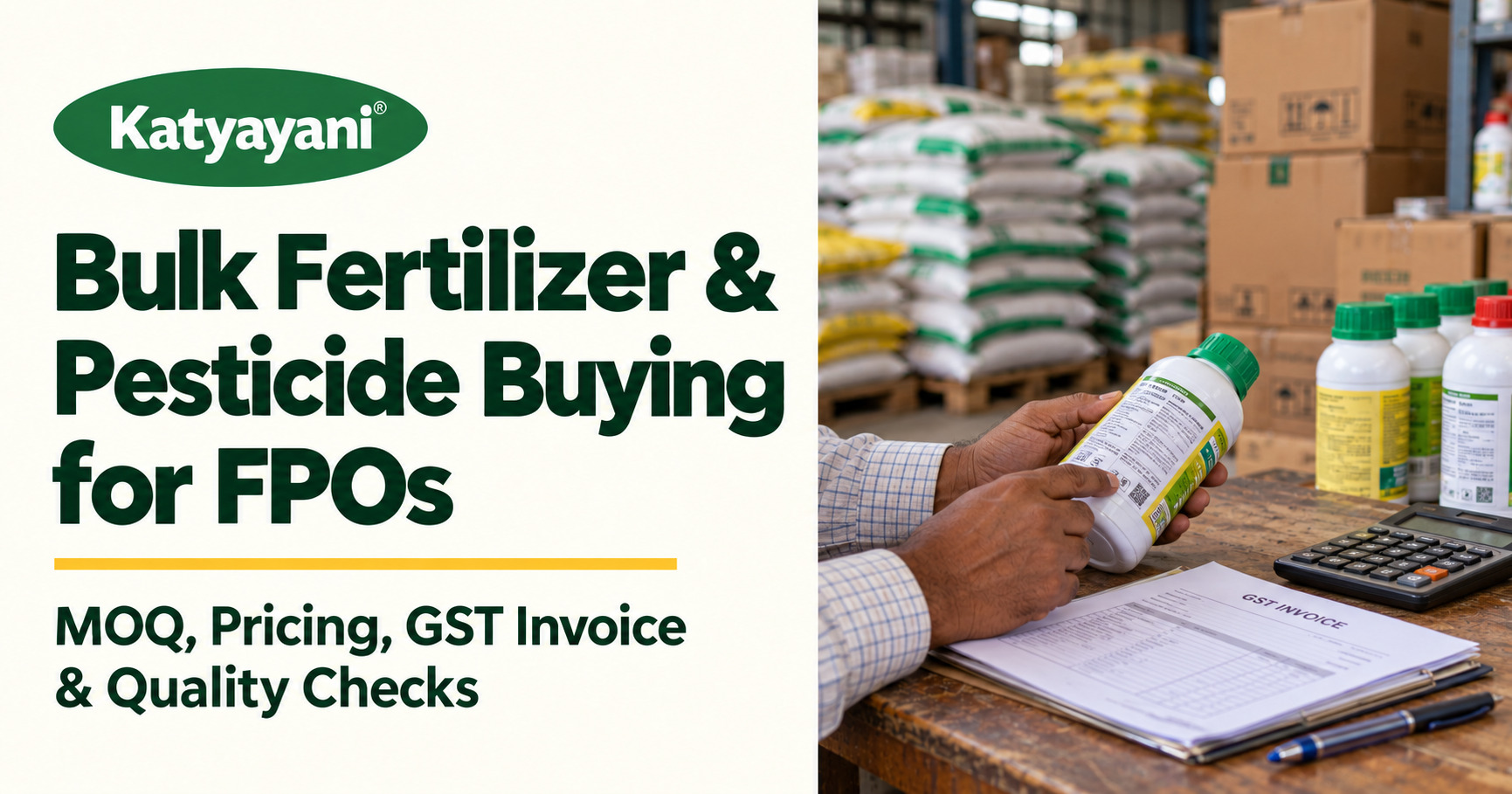
Bulk buying lets an FPO pool the demand of its members, buy closer to manufacturer or distributor price and pass part of the saving back as lower input cost. It also gives the FPO a steady trading income between harvests.
The benefit depends on getting three things right: legal compliance, quality control and cash flow. An FPO that buys cheap but spurious stock, or locks its working capital in slow-moving products, loses member trust quickly. The steps below cover each part.
Which licences does an FPO need to buy and sell inputs?
An FPO that sells inputs to members or other farmers is treated as a dealer. It needs separate authorisations for fertilizers, pesticides and seeds from the state agriculture department.
|
Input |
Law |
What the FPO needs |
|
Fertilizers (incl. micronutrients, bio-fertilizers, water-soluble) |
Fertilizer (Control) Order, 1985 |
Memorandum of intimation in Form A1 with fee, and a certificate of source in Form O from each supplier |
|
Pesticides (chemical and bio) |
Insecticides Act, 1968 and Insecticides Rules, 1971 |
Licence to sell, stock or exhibit, with a qualified person on staff, plus a principal certificate from each manufacturer |
|
Seeds |
Seeds Act, 1966 and Seeds (Control) Order, 1983 |
Seed dealer licence and source documents for each seed lot |
Under the Insecticides (Second Amendment) Rules, 2017, a pesticide dealer must have or employ a person with a prescribed qualification, such as a degree or diploma in agriculture or a related science, or an approved certificate course. Fees, forms and portals differ by state, so confirm with your District Agriculture Officer.
When you add a new supplier, you must add its source or principal certificate to your licence. Buying from a supplier not endorsed on your licence is a common inspection finding.
How to verify a bulk pesticide supplier in India
A reliable bulk pesticide supplier is a licensed manufacturer, or its authorised distributor, whose products carry a valid Central Insecticides Board and Registration Committee (CIBRC) registration for the crop and pest on the label.
1. Ask for the manufacturing licence issued by the state and the GSTIN of the company.
2. Ask for the CIBRC registration certificate number for each product. Match the molecule, formulation and strength with the label.
3. Check that the crop and pest you plan to use it on are approved. The CIBRC major uses of pesticides list on the PPQS website shows approved crops for each molecule.
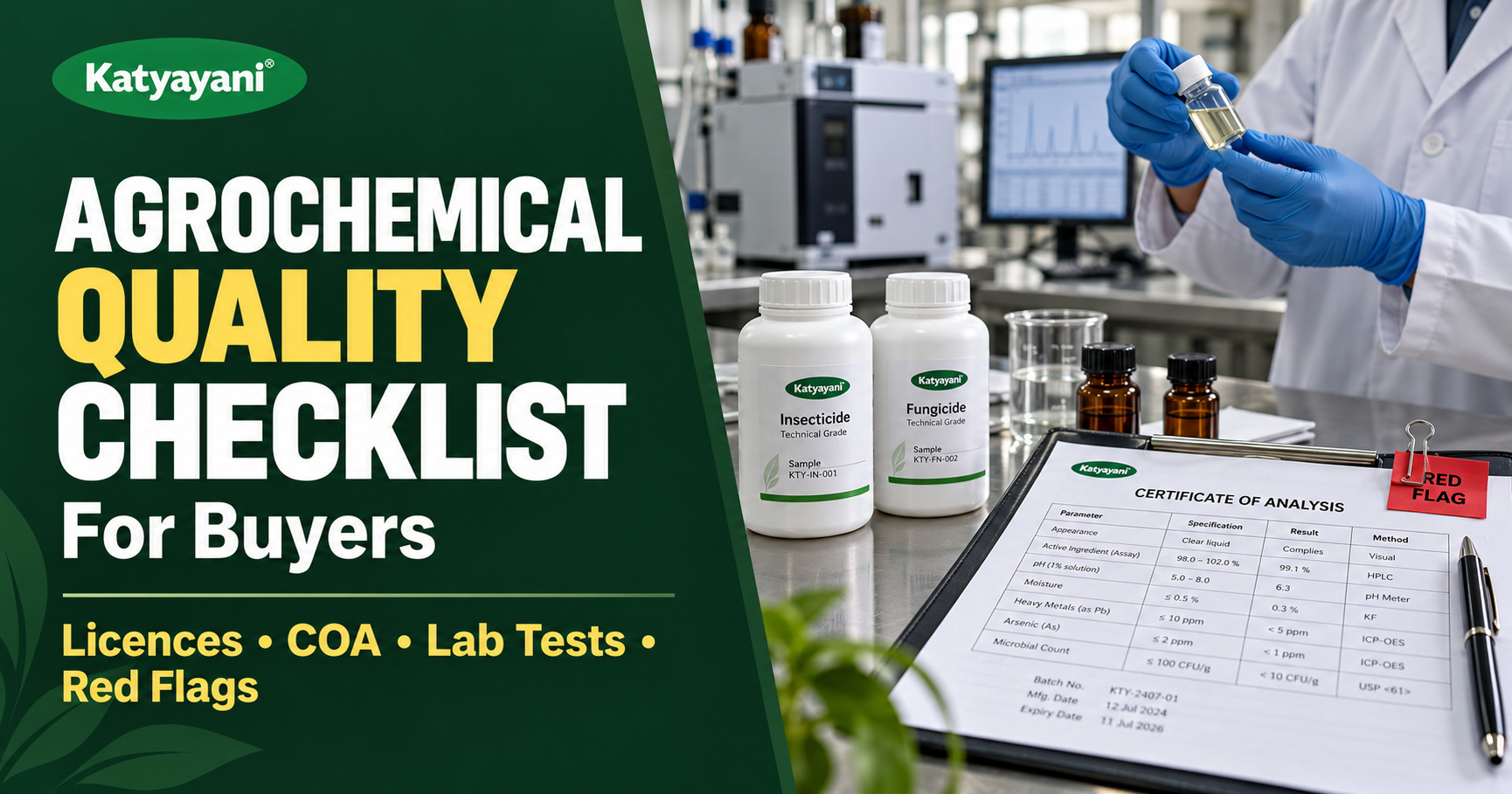
4. Ask for a sample certificate of analysis (COA) from the in-house or third-party lab.
5. Confirm the supplier will issue the principal certificate needed for your licence.
6. Visit the plant or warehouse if the order is large, or ask for photos and videos of the QC lab and storage.
Avoid anyone who cannot give a registration number, sells loose or unlabelled product, or offers prices far below the market for the same molecule.
Red flags when choosing a bulk agrochemical supplier
Most bad purchases show warning signs before the order is placed. Walk away, or ask harder questions, if you see any of the following.
• Price far below other licensed suppliers for the same molecule and strength.
• No CIBRC registration number, or a number that belongs to a different product or company.
• Refusal to share a certificate of analysis or to allow a sample to be tested.
• Invoices without GSTIN or HSN codes, or a request to pay cash without an invoice.
• Labels without batch number, manufacturing date or expiry, or with stickers pasted over the original dates.
• Pressure to buy large volumes of slow-moving SKUs to get a discount on fast ones.
Spurious and substandard agrochemicals are a known problem in the Indian market. A careful first order and full delivery check are cheaper than a failed crop and a licence notice.
What MOQ, pricing and payment terms should FPOs expect?
Minimum order quantity (MOQ) and price slabs are set by each supplier and vary by product, pack size and location. Treat any numbers you receive as negotiable starting points and get them in writing.
• MOQ is usually quoted per SKU in cartons, litres or kilograms, or as a minimum invoice value. Mixed-SKU orders often help an FPO reach it.
• Larger packs (5 L, 25 kg) cost less per unit than 100 ml or 250 g packs, but members with small holdings may still want small packs.
• Prices may be quoted ex-works (freight extra) or delivered. Ask which, and who pays for unloading.
• Credit terms range from advance payment for first orders to 30 to 90 days for established buyers.
• Ask for scheme or volume discounts to be shown on the invoice or as a documented credit note, not as a verbal promise.
Compare landed cost per acre treated, not price per litre. A cheaper product at double the dose is not cheaper.
|
Cost element |
What to check |
|
Base price |
Per unit, per pack size, validity of the quote |
|
GST |
Correct HSN and rate on each line |
|
Freight |
Ex-works or delivered, transit time, insurance |
|
Credit cost |
Interest you pay or lose while stock waits for sale |
|
Returns |
Whether near-expiry or unsold stock can be returned or exchanged |
GST on fertilizers vs pesticides: what rates apply?
Fertilizers and most crop nutrition products are taxed at 5% GST, while chemical pesticides are taxed at 18%. The GST Council's 56th meeting cut several agri-input rates, effective 22 September 2025.
|
Product type |
Typical HSN |
GST rate |
|
Chemical fertilizers (urea, DAP, NPK, MOP, water-soluble grades) |
Chapter 31 |
5% |
|
Micronutrients listed in FCO Schedule 1, Part A, serial 1(g) |
Varies |
5% (earlier 12%) |
|
12 notified bio-pesticides (such as certain Trichoderma, Bacillus thuringiensis and neem-based products) |
3808 |
5% (earlier 12%) |
|
Chemical insecticides, fungicides, herbicides, PGRs |
3808 |
18% |
|
Gibberellic acid |
3808 |
5% (earlier 12%) |
Source: the PIB factsheet on GST reforms in agriculture and GST Council recommendations. Only the notified bio-pesticides get 5%; other bio-products may be classified differently, so check the HSN and rate on each invoice line with your tax adviser.
An FPO registered under GST can claim input tax credit on these purchases when it sells the goods onward with tax. If it only distributes to members without a taxable sale, ITC may not be available, so structure the business with your chartered accountant.
What should a proper GST invoice for agri inputs include?
A valid tax invoice is your proof of legal purchase for GST, for the agriculture department and for any quality complaint. Check it on the day goods arrive.
• Supplier name, address and GSTIN, and your FPO name, address and GSTIN.
• Invoice number and date, and place of supply.
• Product name, formulation and strength, HSN code, quantity, unit price and taxable value.
• CGST and SGST (same state) or IGST (inter-state), shown separately.
• Batch number, manufacturing date and expiry date for each line. GST does not require this, but your stock register and licence inspection do.
• An e-way bill for consignments above the prescribed value, generally ₹50,000.
Under GST rules, if you do not pay the supplier within 180 days of the invoice date, the credit you claimed must be reversed and interest paid. Plan member recoveries around this.
How to check batch, expiry and certificate of analysis on delivery
Every bulk lot should be checked against the invoice and the COA before it enters your store. A COA is a lab report from the manufacturer showing the tested active ingredient content and physical parameters of a specific batch.
1. Count cartons and match product, pack size and batch numbers with the invoice.
2. Check each label for the CIR or registration number, manufacturer licence number, batch, manufacturing date and expiry.
3. Reject stock with less than about 12 months of shelf life left unless you have agreed otherwise and can sell it in time.
4. Match the COA batch number with the label. The active ingredient should meet the label claim within the allowed tolerance.
5. Look for leaks, caking in wettable powders, sedimentation in suspension concentrates and damaged seals.
6. Record everything in the stock register and keep the COA on file for the life of the batch.
7. For any doubt, draw a sample and send it to the state pesticide or fertilizer testing lab through the agriculture department.
How should an FPO store bulk fertilizers and pesticides?
Store pesticides and fertilizers separately, in a dry, ventilated and locked godown that the licence inspector can check. The address on your licence must match the actual storage place.
• Keep pesticides away from seeds, fertilizers, food grain and animal feed, on pallets and not directly on the floor.
• Stack fertilizer bags no higher than recommended on the bag, with gaps for air and access.
• Keep bio-fertilizers and bio-pesticides in shade and away from heat, since live microbes lose count quickly above about 30°C.
• Display safety signage, keep soap, water and a first-aid kit near the store, and train staff on spill handling.
• Maintain stock and sale registers batch-wise so any complaint can be traced to the exact lot.
Good storage protects quality as well as compliance. A wettable powder that absorbs moisture cakes and will not mix, and a member who has a bad spray result will blame the FPO, not the manufacturer.
Building a balanced bulk basket for members
A good FPO input basket mixes fast-moving essentials with a few margin items. Keep it tied to members' actual crops and the season calendar.
For rabi, for example, the basket might include basal fertilizers and zinc, a phosphate solubilizing bacteria biofertilizer for pulses and wheat, a broad-spectrum contact fungicide such as mancozeb 75% WP for potato and vegetable blights, and a lepidopteran insecticide such as emamectin benzoate 5% SG for chana pod borer. All doses should follow the product label and local agriculture officer advice.
Buy seasonal crop protection in two lots, and keep bio-inputs in shade within shelf life. Katyayani Organics Private Limited manufactures crop protection and crop nutrition products and handles bulk enquiries from FPOs and distributors, which is one option to compare alongside others.
What to do next
Confirm that your FPO's fertilizer, pesticide and seed licences are current and list the suppliers you plan to use. Then make a crop-wise demand sheet from member data and request written quotes from two or three licensed suppliers.
Compare landed cost, credit days, return terms and documentation, place a trial order and check the first delivery fully before scaling up.
Questions Farmers Ask
Can an FPO sell fertilizers and pesticides to farmers?
What is the GST rate on pesticides in India?
What is the GST rate on fertilizers?
How do I check if a pesticide is registered with CIBRC?
What is a certificate of analysis for pesticides?
What is the minimum order quantity for bulk pesticides?
Can an FPO claim input tax credit on pesticides?
How much shelf life should bulk pesticide stock have?
What documents should I get from a bulk agrochemical supplier?
Is buying direct from the manufacturer cheaper for FPOs?

Senior Microbiologist and Production Executive
Senior Microbiologist and Production Executive at Katyayani Organics. BSc in Biotechnology, MSc in Microbiology, 2.5 years of experience.
View all authors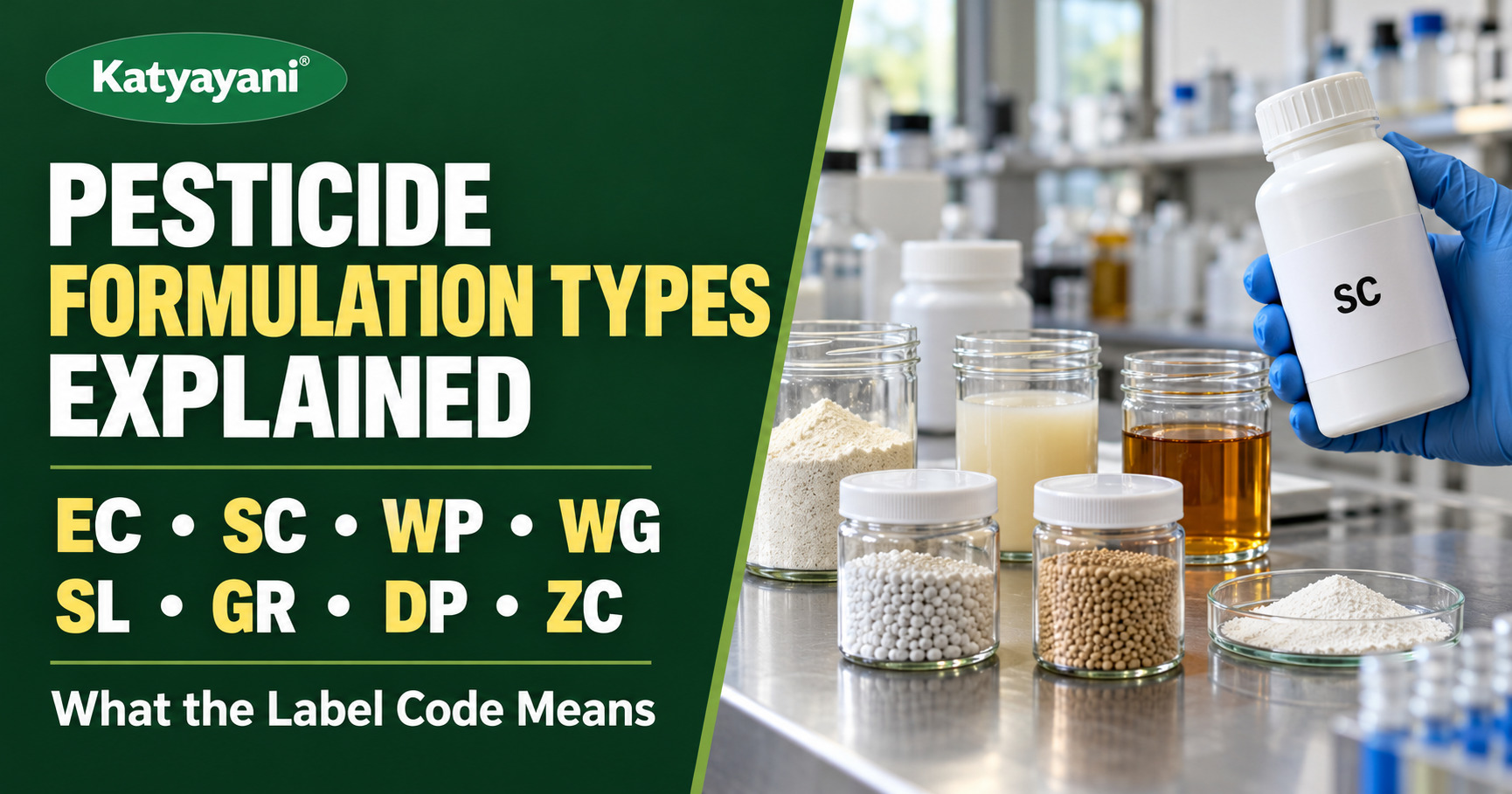

Leave a Comment