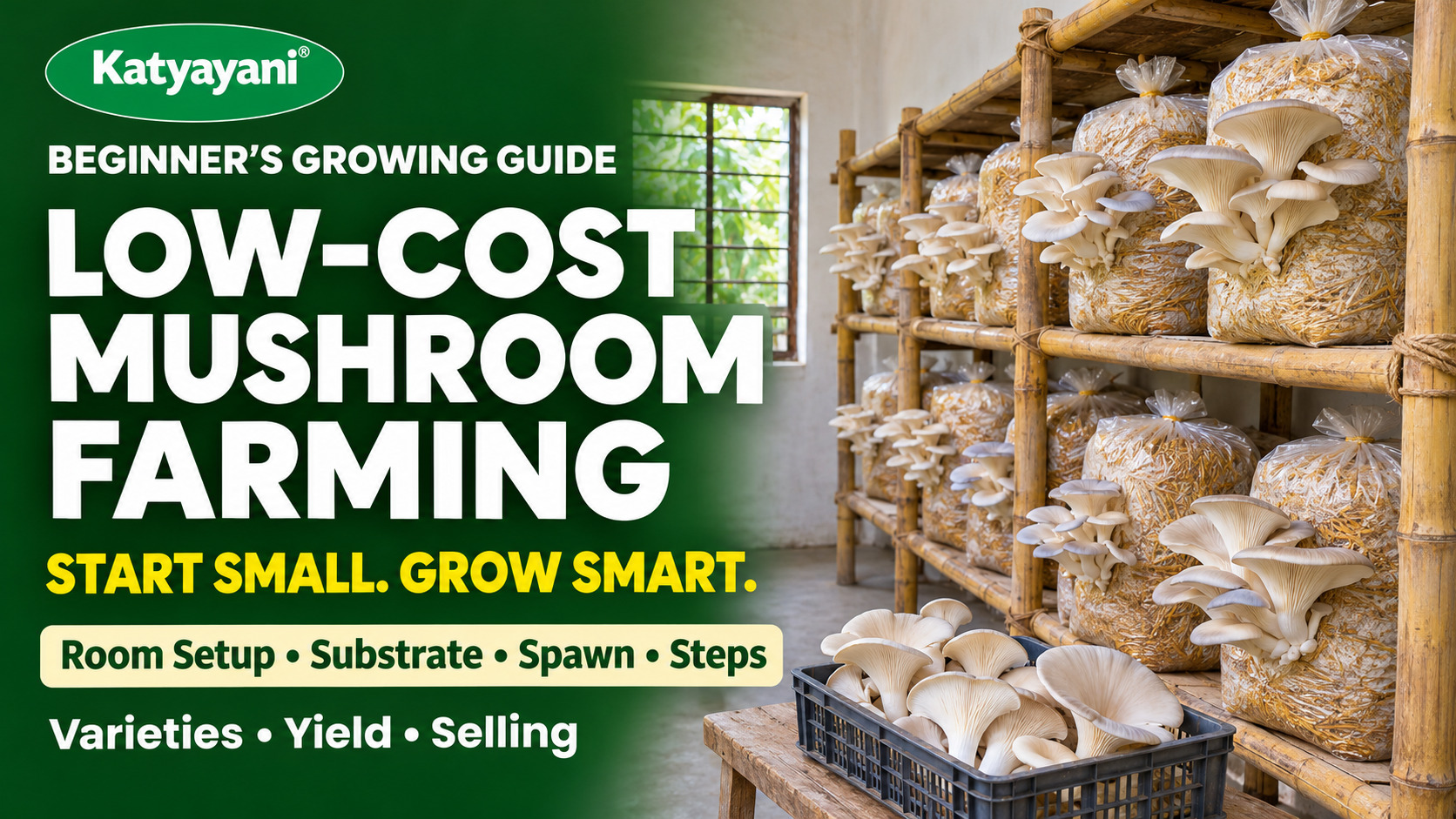
 18 min read
For a first mushroom crop with little money, start with oyster mushroom in the cooler months (Oct to Feb in the plains) or with milky or paddy straw mushroom in the hot months (Mar to Oct). All three grow on cheap straw in a simple, ventilated room or shed with a sprayer and thermometer. Oyster needs 20 to 30 C, milky 30 to 35 C at fruiting, paddy straw 25 to 38 C. Skip button mushroom at first. Begin with about 10 to 20 bags or 2 beds, learn the humidity routine, then scale. Buy spawn from a trusted lab, keep straw below 70 percent moisture, and line up a buyer before the first flush.
What is low-cost mushroom farming, and who is it for?
Low-cost mushroom farming means growing mushrooms indoors on cheap farm waste such as paddy or wheat straw, in a small room or shed, with basic tools like a sprayer and a thermometer. It needs no farmland and little water, so it suits farm women, SHG members, rural youth and anyone with a spare room.
The ICAR-CIWA page on mushroom production lists the benefits for farm women in plain terms: low investment, little space, work that fits around household time, early returns and better family nutrition. It also lists the tools for an oyster bed as a sprayer, a thermometer and a sickle or chaff cutter. That is a short list, which is why the business is called low cost.
Low cost does not mean no risk. Most failures come from the wrong variety for the season, poor spawn, wet straw and no buyer. This guide is built around those four decisions. If you want the full oyster cost and profit breakdown, our post on oyster mushroom farming in India already covers it, and this article avoids repeating it.
Which mushroom is best for beginners in India?
Oyster mushroom is the usual first choice because it tolerates a wide temperature band and grows on plain straw. Milky and paddy straw mushroom are better first choices for hot months and hot regions. Button mushroom is harder and is better left until you have a few cycles behind you.
ICAR-CIWA says three types suit the Odisha climate: paddy straw, oyster and milk mushroom, with most growers focusing on paddy straw and oyster. The ICAR-RCER Ranchi training in September 2026 taught oyster and milky mushroom to first-time tribal farmers, which tells you what trainers consider beginner-friendly.
| Variety | Why beginners pick it | Watch out for | Source |
|---|---|---|---|
| Oyster (dhingri) | Wide temperature band, plain straw, short cycle, small bags | Needs cool months in most plains; high humidity; spores | ICAR-CIWA, ICAR-NEH Nagaland |
| Milky (Calocybe indica) | Grows in heat, better shelf life, low spore content | Needs a casing layer; yields in trials vary a lot | TNAU, IIHR portal |
| Paddy straw (Volvariella) | Very cheap per bed, grows in heat, quick picking | Needs 25 to 38 C and high humidity; picked at button stage | ICAR-CIWA, TNAU |
| White button | Largest share of national output | Very few start it under controlled conditions in Odisha | Mushroom Research, ICAR-CIWA |
Oyster vs milky vs paddy straw: how do their conditions compare?
They differ mainly in temperature, humidity and season. Oyster wants 20 to 30 C and suits winter. Paddy straw wants 25 to 38 C and milky about 30 to 35 C at fruiting, so both suit summer. Humidity stays high for all three, from 80 to 90 percent.
| Condition | Oyster | Paddy straw | Milky |
|---|---|---|---|
| Temperature | 20 to 30 C (ICAR-CIWA) | 25 to 38 C (ICAR-CIWA); 30 to 35 C best for buttons (TNAU) | 22 to 25 C spawn run; 30 to 35 C fruiting (TNAU) |
| Humidity | 80 to 85 percent (ICAR-CIWA) | 85 to 90 percent (ICAR-CIWA); 75 to 80 percent in film house (TNAU) | 85 to 90 percent spawn run; 80 to 85 percent fruiting (TNAU) |
| Season on the ICAR-CIWA page | November to February | March to October | March to October |
| Input per bed (ICAR-CIWA) | 2 kg straw, 200 g spawn | 15 kg straw, 400 g spawn | Not stated; TNAU bag is 60 x 30 cm |
| Average yield per bed (ICAR-CIWA) | 1.5 kg, up to 3 kg | 800 g, up to 1.5 kg | Not stated |
| Harvests | 3 to 4 flushes, about 10 days apart (Nagaland) | Buttons in 6 to 10 days, picked 4 to 5 days later (TNAU) | Maximum 3 harvests (TNAU) |
Treat the yields as ICAR averages for one centre, not a promise. They depend on spawn quality, straw, temperature and your handling, and the Odisha page itself lists those factors as the reasons yields fall.
How do you choose a variety for your climate and season?
Match the variety to your room temperature first. If your room stays between 20 and 30 C, go with oyster. If it sits above 30 C for months, choose milky or paddy straw. Check the month too, because the ICAR pages give different seasons for each type.
- Plains, October to March: the ICAR-NEH Nagaland article gives this as the oyster season for plains. The ICAR-CIWA Odisha page gives November to February.
- Hills, March to October: the same Nagaland article gives this as the oyster season for hills.
- Hot months, March to October: ICAR-CIWA lists paddy straw and milk mushroom for this period.
- Rule of thumb: put a thermometer in the room for a week before you buy anything. Note the highest and lowest reading, then pick the variety whose range fits.
If you are somewhere with both cold winters and hot summers, you can run oyster in one half of the year and milky or paddy straw in the other. That keeps the room and the buyers busy all year. Start with only one variety for your first two cycles, so you can tell what went wrong when something does.
Why should a beginner wait before trying button mushroom?
Button mushroom is the biggest crop nationally but it is harder to run. ICAR-CIWA notes that very few entrepreneurs in Odisha have started it under controlled conditions. Beginners are better off learning humidity, hygiene and selling on a simpler straw mushroom first.
An ICAR journal abstract on the status of mushroom production in India puts white button at 73 percent of output, oyster at 16, paddy straw at 7 and milky at 3, from total production of about 0.13 million tons. The abstract was published in 2018, so the shares are old. The point for you is that button sits in a different business: larger units, controlled rooms and prepared compost. We will compare all three side by side in a separate guide on button vs oyster vs milky mushroom farming cost and profit.
How much does low-cost mushroom farming cost to start?
Cost has two parts: a one-time set-up (room, racks, tools) and a running cost per cycle (straw, spawn, bags, labour, fuel). Published running costs for oyster are Rs 28 to 32 per kg of mushroom (KVK Katni, 2018) and Rs 12,000 to 15,000 for a 300 to 320 bag cycle (ICAR Longleng unit).
The KVK Katni study puts average oyster production cost at Rs 28 to 32 per kg of fresh mushroom across four straw mixes. The ICAR Longleng report gives an outlay of Rs 12,000 to 15,000 for 300 to 320 bags, which works out to about Rs 40 to 47 a bag. For the oyster cost ranges other guides report, see our oyster mushroom farming cost, process and profit guide.
| Set-up item | Published benchmark | Source |
|---|---|---|
| Growing room, plastic-sheet type | 300 sq ft at Rs 50 per sq ft = Rs 15,000 | NHB oyster model report |
| Iron racks | 9 racks at Rs 1,000 each = Rs 9,000 | NHB oyster model report |
| Sprayer | 1 at Rs 1,500 | NHB oyster model report |
| Galvanised tubs for soaking | 4 at Rs 250 = Rs 1,000 | NHB oyster model report |
| Thermometer | Rs 400 | NHB oyster model report |
| Room, racks, sprayer, tubs, thermometer together | Rs 26,900 (our addition of the NHB lines above) | NHB oyster model report |
| Larger oyster and milky shed | 800 sq ft shed at Rs 75,000 | TNAU Agritech mushroom schemes page (2016) |
These are published planning rates from older reports. Your own quotes decide the real number, which is why the worksheet in the profit section is the part to fill in. A trial of 10 to 20 bags needs no new room, only a sprayer, a drum, a thermometer and a few racks.
What room or hut do you need for mushroom farming?
You need a clean, ventilated, shaded room that holds steady temperature and humidity, with a washable floor and insect-proof vents. ICAR-RCER trainers said about 500 oyster bags in staggered batches need roughly 150 to 200 sq ft. A 10 to 20 bag trial fits in a corner.
The ICAR-RCER Ranchi training news from September 2026 gives that 150 to 200 sq ft figure for a unit of around 500 oyster bags and a target of about Rs 12,000 a month. That is a trainers estimate for income, not a guarantee. The Nagaland article adds the practical rule that rooms need proper ventilation with fine wire on vents to keep flies out.
- Light: oyster needs light in the early stage and slight darkness when fruiting (ICAR-CIWA). Milky spawn run is kept dark (TNAU). A normal room with a window you can cover works.
- Floor and walls: choose surfaces you can wash and spray. Mud floors are hard to keep clean, so cover or seal them.
- Air: the room must breathe. Closed rooms trap carbon dioxide, and closed hot rooms cook the crop.
- Plastic film house for hot months: TNAU notes that growers of paddy straw mushroom often use plastic film houses to hold 25 to 35 C and 75 to 80 percent humidity.
- Hut cost benchmarks: NHB prices a 300 sq ft plastic-sheet growing room at Rs 50 per sq ft, and TNAU lists an 800 sq ft shed at Rs 75,000. Visit a working unit at your KVK before you build.
Which substrate should you use?
Dry paddy straw is the cheapest and most used substrate for all three low-cost mushrooms, and wheat straw works for oyster. Use clean straw from the latest harvest, not mouldy or rain-soaked straw, and cut it to size before soaking. The ICAR pages open for this brief use straw throughout.
- Oyster: straw cut to 3 to 5 cm (Nagaland). ICAR-CIWA lists a chaff cutter or sickle as the tool.
- Paddy straw mushroom: 10 to 15 kg of fresh, disease-free paddy straw per bed, made into bundles or twists (TNAU). Powdered dal or bran is added at spawning.
- Milky: dried straw mixed so moisture is even (TNAU).
- Extras: ICAR-CIWA lists 200 g of boiled wheat for oyster beds and 200 g of pulse powder or rice bran for paddy straw beds.
Moisture matters more than most beginners expect. The Nagaland article says to avoid bed moisture above 70 percent, and ICAR-CIWA gives 65 percent moisture in the straw for paddy straw mushroom. A handful squeezed hard should drip only a few drops, not run.
How do you treat the straw before spawning?
Straw must be cleaned of competing moulds before spawn goes in. The simplest low-cost methods are a hot-water soak or pasteurisation. The Nagaland article soaks chopped straw for 8 to 12 hours, then boils it for 15 to 20 minutes, drains and cools it in shade.
| Method | Steps and numbers | Source |
|---|---|---|
| Soak and boil (oyster) | Straw 3 to 5 cm; soak 8 to 12 hours in cold water; boil 15 to 20 minutes; drain and cool in shade | ICAR-NEH Nagaland / KVK Dimapur |
| Pasteurisation (oyster) | 55 to 60 C for 30 to 60 minutes | Nagaland article |
| Chemical soak | 100 ml formalin or 8 g Bavistin per 100 litres of water; soak 12 to 16 hours | ICAR-CIWA |
| Cold-water soak (paddy straw) | Bundles 12 to 18 hours; twists 12 hours; drain before spreading | TNAU |
For a first batch, the hot-water method needs only a drum and fuel and no chemicals, so it is the easier one to repeat safely at home. If you use the chemical soak, follow the label and your KVK advice, wear gloves, and keep the room well ventilated while you work.
Where do you get mushroom spawn, and how do you judge it?
Buy spawn from a government lab, KVK, agricultural university or a reputable commercial lab, and buy it fresh. Poor spawn is a top cause of failed batches. The ICAR-CIWA page lists spawn quality among the main factors that reduce yield.
The ICAR journal abstract on mushroom production status estimates spawn demand at 8,000 to 10,000 tons a year and says public-sector organisations supplied only about 10 percent of it. That is from 2017, so the mix may have changed. The takeaway is simple: most spawn comes from private suppliers, so quality varies.
- Ask for the variety and the date made. Fresh spawn runs faster.
- Look at the bottle or packet. It should show clean white growth with no green, black or pink patches.
- Order only what you will use in a few days. Old spawn loses vigour.
- Ask for a batch with the same strain for your second cycle, so you can compare results fairly.
How do you grow oyster mushroom step by step?
Treat the straw, drain it, fill bags in layers with spawn, hold them dark for the spawn run, then cut and move them to the cropping room where you spray for humidity and pick the flushes. The full cycle takes about 45 to 60 days according to ICAR-RCER trainers.
- Prepare straw. Chop to 3 to 5 cm, soak 8 to 12 hours, boil 15 to 20 minutes, drain and cool in shade (Nagaland).
- Clean the room. Wash floor and racks. The Nagaland article uses Dettol at 2 tablespoons per litre of water for bag and tool cleaning.
- Fill bags. Use bags of 60 x 45 cm or 50 x 35 cm. Put 5 cm of straw, then spawn, then 5 cm of straw, and repeat 4 to 5 times. Make holes about every 10 cm (Nagaland).
- Spawn run. Keep bags in a dark room for 12 to 20 days. The straw is fully white in about 20 to 25 days (Nagaland).
- Open and fruit. Remove the polythene or cut the bag. Start watering two days after removing the polythene, and spray at least twice a day once pinheads form (Nagaland).
- Harvest. First flush about 5 to 7 days after pinheads appear, later flushes about 10 days apart, 3 to 4 flushes per cycle (Nagaland).
This keeps oyster steps brief on purpose. The live guide on oyster mushroom farming in India goes deeper on contamination and problems.
How do you grow milky mushroom?
Milky mushroom is grown in 60 x 30 cm bags of dried straw with spawn between layers, kept dark and warm for the spawn run, then topped with a thin layer of sterilised casing soil to trigger buttons. It fruits at 30 to 35 C, so it fills the gap when oyster is too hot.
- Bags: transparent polythene, 60 x 30 cm, 80 gauge (TNAU).
- Layers: 3 inches of straw then spawn at the bottom, then 5 inches per layer, five layers in all, with 6 ventilation holes (TNAU).
- Spawn run: 22 to 25 C and 85 to 90 percent humidity in the dark (TNAU).
- Casing: about 1 cm of sterilised soil, such as garden soil rich in calcium or equal parts soil and river sand (TNAU).
- Fruiting: 30 to 35 C, 80 to 85 percent humidity (TNAU).
- Timing: pinheads about 10 days after casing, first harvest about 7 days after buttons appear, second about 10 days later, third about 10 days after that. TNAU says three harvests is the maximum for commercial cultivation.
The extra casing step is why milky is a little harder than oyster. Per the India Science and Technology portal, milky mushroom was the first indigenous mushroom variety to be commercialised in India, with better shelf life than oyster or button and a very low spore content.
How do you grow paddy straw mushroom?
Paddy straw mushroom is grown in open beds, not bags. You soak straw bundles, stack them in layers on a raised platform, spawn around the edges, compact and cover with polythene. Buttons appear in 6 to 10 days. It suits hot weather and is picked at the button stage.
- Platform. A raised bed about 1 m long and 0.75 m wide, set on bricks at the corners (TNAU).
- Soak. Bundles 12 to 18 hours, then drain (TNAU).
- Layer. Eight bundles make one layer, laid with butt ends alternating. About five layers, the top one unspawned (TNAU).
- Spawn. Place small amounts 8 to 12 cm in from the edge, 10 to 15 cm apart, with a spoonful of coarsely powdered dal (TNAU). ICAR-CIWA uses about 400 g spawn and 200 g pulse powder or rice bran per 15 kg bed.
- Cover. Compact the bed and cover it with transparent polythene. Water with a rose can if dry; uncover slightly if too wet (TNAU).
- Pick. Buttons appear in 6 to 10 days. Harvest 4 to 5 days later at the button stage (TNAU).
The TNAU paddy straw page gives 1 to 2 kg of mushrooms per 10 kg of substrate, and ICAR-CIWA gives 800 g average per bed from 15 kg of straw, up to 1.5 kg. The two pages measure differently, so do not mix the numbers. Use them as a range and record your own.
What temperature and humidity do mushrooms need, and how do you control them?
Keep the room inside the band for your variety and raise humidity by spraying walls, floors and bags with a fine mist, not by soaking the beds. Use a thermometer daily. Oyster needs 20 to 30 C and 80 to 85 percent humidity, and the straw mushrooms need more heat.
- Too hot: wet the roof and walls, use a shade net, open vents at night. Do not spray directly on fruiting bodies in the heat of the day.
- Too cold: close extra vents in the evening, and consider the other variety for that season.
- Too dry: mist the floor and walls. The Nagaland article starts watering two days after the polythene comes off and sprays at least twice a day once pinheads form.
- Too wet: water pooling on the bed invites mould. TNAU says to uncover a paddy straw bed partly if it is too wet.
The ICAR-CIWA page also notes that oxygen and carbon dioxide needs change by stage: oyster needs CO2 in the vegetative stage and less oxygen at fruiting. In practice, keep the spawn-run room quiet and closed, and the cropping room airy.
How much yield can a beginner expect?
ICAR-CIWA gives an average of 1.5 kg of oyster per bed (up to 3 kg in favourable conditions) and 800 g of paddy straw mushroom per bed (up to 1.5 kg). Beginners usually land below the average in their first cycles. Plan on the low side and record your numbers.
| Variety | Yield figure | Source | How to read it |
|---|---|---|---|
| Oyster | Average 1.5 kg per bed, up to 3 kg | ICAR-CIWA | Bed is 2 kg straw and 200 g spawn |
| Paddy straw | Average 800 g per bed, up to 1.5 kg; also 1 to 2 kg per 10 kg substrate | ICAR-CIWA; TNAU | Different bed sizes; do not mix |
| Milky | Biological efficiency 60 to 90 percent | India Science and Technology portal (IIHR) | 600 to 900 g of fresh mushroom per kg of dry straw |
| Oyster, Jharkhand villages | Biological efficiency 76.4 to 85.3 percent; 3,081 kg from 57 farmers in 2019 | ICAR-RCER | Field result in farmers' sheds |
| Oyster, Longleng unit | 256 to 260 kg from 300 to 320 bags in one cycle | ICAR | About 0.8 kg per bag (our division) |
Biological efficiency is fresh mushroom weight divided by dry straw weight, as a percentage. A 60 percent figure means 600 g of mushroom from every kg of dry straw.
How much profit can you make from low-cost mushroom farming?
Profit equals kilos sold times selling price, minus all costs for the cycle. In the ICAR and KVK reports opened, oyster production cost Rs 28 to 32 per kg, selling prices ran Rs 120 to 250 per kg, and net profit was Rs 56 to 68 per kg. One ICAR-reported 300 to 320 bag unit netted Rs 45,000 to 50,000 per cycle.
| Source and year | Scale | Cost | Selling price | Net result |
|---|---|---|---|---|
| KVK Katni, JNKVV (2018) | Trial with four straw mixes, per kg of mushroom | Rs 28 to 32 per kg | Rs 125 per kg fresh | Net Rs 56 to 68 per kg; benefit-cost ratio up to 3.96 |
| ICAR-RCER Jharkhand (2019 to 2021) | 57 farmers in 2019; 88 farmers next year | Not stated per kg | Rs 120 to 150 per kg in local market (2019) | Average benefit-cost ratio 3.8; farmers' mushroom sales totalled Rs 3,96,720 in 2019 |
| ICAR, Longleng Nagaland (undated page) | 300 to 320 bags a cycle, 3 cycles a season | Rs 12,000 to 15,000 per cycle | Rs 180 to 250 per kg | Gross Rs 64,000 to 70,000 and net Rs 45,000 to 50,000 per cycle; benefit ratio 4.44 |
The three sources agree on the direction: cost is a fraction of price. They differ on scale, region and year, so use them as a range. Selling price is the number that moves most between places and seasons, so replace it with a quote from your own market.
Worksheet: calculate your own cost and profit
Price each line below from local quotes, add the cycle costs, and divide by the kilos you harvest. The formulas then give your cost per kg, profit per cycle and the lowest price at which you break even.
| Line | What to price | Where to get the number |
|---|---|---|
| A. Straw | Kg of dry straw per bag x number of bags x price per kg | Neighbour farmer or mandi |
| B. Spawn | Number of packets or bottles x price | KVK, university or lab quote |
| C. Bags and cover | Polythene kg x price per kg | Local plastic shop |
| D. Treatment | Fuel or gas for boiling, or formalin and Bavistin if you use the chemical soak | Local shop |
| E. Labour | Days of work x daily wage (include your own days) | Local wage rate |
| F. Electricity, water, transport | Per-cycle estimate from your bills | Your own bills |
| G. Set-up share | Room, racks and tools cost divided by number of cycles you will run on them | Set-up table above |
| H. Kilos harvested | Total fresh weight picked in the cycle, all flushes | Your own weighing |
| I. Selling price per kg | What your hotel, shop or market pays | Your own buyers |
- Total cycle cost = A + B + C + D + E + F + G.
- Cost per kg = total cycle cost divided by H.
- Income = H multiplied by I.
- Profit per cycle = income minus total cycle cost.
- Break-even price per kg = total cycle cost divided by H. Any price above this earns a profit.
- Monthly profit = profit per cycle multiplied by the number of cycles you finish in a month.
ICAR-RCER trainers in September 2026 said about 500 oyster bags in staggered batches could target roughly Rs 12,000 a month. Use that as a check on your own sums. For studies on oyster net returns per kg, see the oyster mushroom guide.
How do you sell your first harvest?
Line up buyers before the first flush. Fresh mushrooms spoil quickly, so sell the same day to nearby hotels, vegetable shops, weekly markets and neighbours. Pack in small clean packets. Milky mushroom lasts longer than oyster or button, which gives it more selling flexibility.
- Walk the local market first. Ask shops and restaurants what they pay and what pack size they want.
- Start with a small, steady order. One hotel or two shops is better than a big promise.
- Pick early in the day and keep mushrooms cool and out of the sun.
- Educate buyers. The ICAR journal abstract puts per capita consumption below 100 g a year, so many customers have never cooked mushrooms. A recipe card in each packet helps.
- Do not count on drying or processing until you have a tested method and a buyer. None of the pages opened for this brief gives a drying price or buyer.
For the business side, such as licences, branding and scaling, our posts on how to start an agriculture business in India and low-investment agriculture business ideas cover the basics.
What are the most common beginner mistakes?
The mistakes that sink first batches are wet straw, weak spawn, a dirty room, no ventilation and the wrong variety for the season. ICAR-CIWA lists temperature, spawn quality, humidity, light, cleanliness, moisture, pests, rodents, straw disinfection and bed contamination as the factors that reduce yield.
| Mistake | What happens | Fix | Source |
|---|---|---|---|
| Wrong season for the variety | Poor pinning, slow growth | Check room temperature for a week; choose oyster or milky accordingly | ICAR-CIWA, TNAU |
| Straw too wet | Mould and bacterial rot | Keep bed moisture below 70 percent | ICAR-NEH Nagaland |
| Weak or old spawn | Slow or patchy growth | Buy fresh spawn from a trusted lab | ICAR-CIWA |
| No fly or rodent control | Flies enter vents; rats eat spawn | Fine wire on vents; rat baiting | Nagaland; TNAU |
| Spraying insecticide on beds | Contamination of food crop | TNAU says never spray insecticides on the beds | TNAU |
| Overwatering fruiting bags | Water pools, mould | Spray as mist; uncover if too wet | TNAU |
| Scaling too fast | A single failure loses everything | Run a small trial first | Practical advice |
Do not use fungicides or insecticides to rescue a contaminated batch. Remove the bag, seal it and discard it away from the room. Our fungicide and insecticide products are made for field crops and are not suitable on mushroom beds, which is why this article links to none.
How do you start small with a 10 to 20 bag trial?
Run one variety in 10 to 20 bags or two beds for your first cycle. This costs little, fits in a corner of a room and teaches you the humidity routine. Write down dates, temperatures and yields, and decide whether to scale up only after the second cycle.
| Week | What to do |
|---|---|
| Before week 1 | Measure room temperature for a week. Pick the variety. Visit a KVK or working unit. Line up spawn and a buyer. |
| Week 1 | Clean the room, build racks, treat straw, fill bags or beds, add spawn. |
| Weeks 2 to 3 | Spawn run in the dark. Check for green or black patches. Remove any contaminated bag. |
| Weeks 3 to 5 | Open the bags or beds, start misting, watch for pinheads, harvest the first flush. |
| Weeks 5 to 7 | Later flushes about 10 days apart. Record yield per bag. Sell fresh. |
| After the cycle | Compare yield with the ICAR averages in this guide, work out cost per kg, and decide whether to scale. |
ICAR-RCER trainers gave the full cycle as 45 to 60 days depending on strain and conditions, so a seven week plan is a fair guide for oyster.
Where can you get training, subsidy or a loan?
Start with your nearest KVK, agricultural university or ICAR institute for a short training that usually includes spawn. Support for larger units runs through MIDH and NHB schemes and bank loans. Our subsidy post has the details, and your state horticulture department confirms the current rules.
ICAR-RCER gave spawn to participants at its September 2026 training in Ranchi, and the Sikkim and Nagaland ICAR centres also train farmers in oyster cultivation.
- Subsidy and scheme rules: see subsidy for mushroom cultivation in India: MIDH, NHB, loan and how to apply.
- Business loan routes: our guides to PMEGP loan for agriculture business and SHG loans for agriculture cover the basics for small units.
- Do not borrow before a trial. A bank will want a plan, and a trial gives you real numbers to put in it.
What can you do with spent mushroom substrate?
Spent straw after harvest still holds nutrients and can be composted for garden or field use. The Nagaland article reports spent substrate N-P-K of 1.9, 0.4 and 2.4 before weathering and 1.9, 0.6 and 1.0 after 8 to 16 months. Weather it first and discard contaminated bags rather than reusing them.
ICAR-RCER villages in Jharkhand turned spent substrate into nearly 2 tonnes of vermicompost, so the waste becomes a second product. Compost it with other farm waste and use it on garden or field soil, and discard any contaminated bag away from the room.
Conclusion
For a first mushroom crop, choose by temperature and season: oyster for 20 to 30 C months, milky or paddy straw for hot months. Use a clean, ventilated room, treated straw below 70 percent moisture and fresh spawn from a trusted lab. Run a 10 to 20 bag trial, record every number, and line up a buyer before the first flush. Scale only when your own yield and price figures hold up, and check subsidy and training with your KVK.
Questions Farmers Ask
Which mushroom is best for beginners in India?
How much does it cost to start mushroom farming at home?
How much space do you need for mushroom farming?
What temperature and humidity are needed for oyster mushroom?
Which mushroom grows in summer?
What substrate is used for mushroom farming?
Where can I buy mushroom spawn?
How long does it take to harvest mushrooms?
How much will one bed or bag yield?
Is low-cost mushroom farming profitable?
Why do mushroom bags get mould?
Can I start mushroom farming without training?

Microbiologist
Microbiologist at Katyayani Organics. MSc in Microbiology, 2.6 years of experience.
View all authorsRead Next in Rabi & Horticulture Crop Guides
Chrysanthemum Farming in India: Types, Varieties, Propagation, Planting Time, Pinching, Disbudding, Nutrition, Pests, Diseases, Harvest and Yield
Purple Blotch in Onion: Causes, Symptoms, Weather, Resistant Varieties and How to Manage It

Leave a Comment