 15 min read
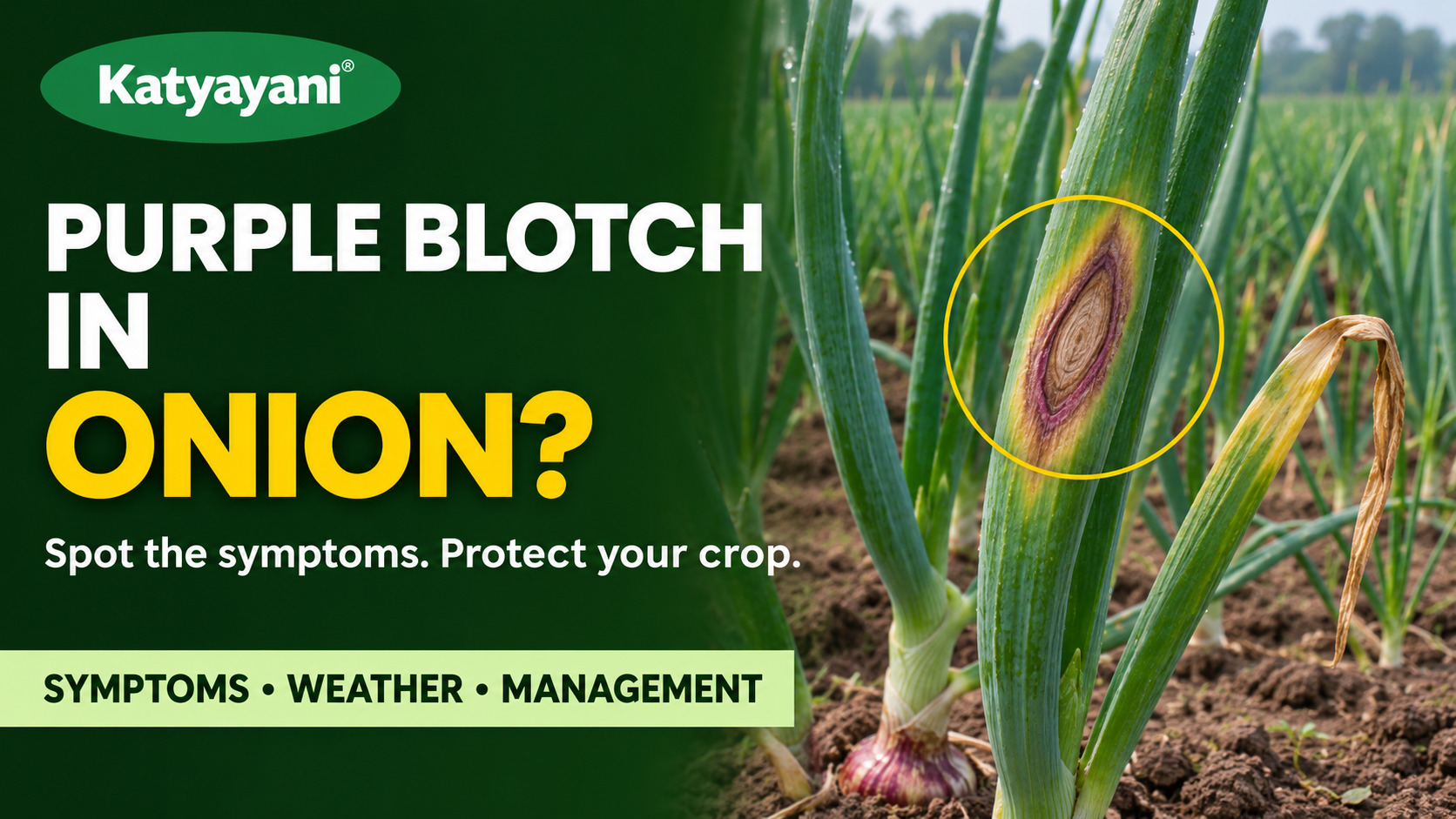
Purple blotch is a leaf disease of onion caused by the fungus Alternaria porri. It starts as small water-soaked spots with a white centre that turn brown and then purple with dark rings, and it can kill leaves and stop bulbs from filling. ICAR-DOGR co-authors cite Indian yield losses of 2.5 to 85 percent. It spreads fastest in warm, humid, wet weather, which is why kharif and late kharif crops suffer most. Thrips feeding wounds help the fungus in. No onion variety is immune: in the ICAR-IARI net-house test none of 34 onion genotypes was resistant. Start protection when the first spots show, because in the ICAR-IARI test the disease rose sharpest one to two weeks after infection and peaked at five weeks. Always read the product label and follow your state advisory.
What is purple blotch of onion and how serious is it?
Purple blotch is a fungal leaf disease of onion caused by Alternaria porri. Spots start small and water-soaked, then turn brown and purple with dark rings. It attacks leaves, seed stalks and sometimes bulbs. ICAR-DOGR co-authors call it one of the most destructive foliar diseases and cite Indian losses of 2.5 to 85 percent.
The Frontiers in Plant Science paper co-authored by ICAR-DOGR scientists describes it as a disease of all onion-growing countries, caused by a necrotrophic fungus (one that kills the tissue it feeds on). The same paper notes that chemical fungicides remain the main control, that repeated spraying has pushed up cost and led to resistant fungal strains, and that few resistance sources are known.
For a grower, the practical meaning is simple. The disease does not wait for a bad year. It sits in old leaf residue and infected bulbs, and when the weather turns humid it moves fast. This guide covers what triggers it, how to recognise it, what works in the field and what the official pesticide list actually allows. For the full crop plan, read our onion farming guide.
What causes purple blotch in onion?
The cause is the fungus Alternaria porri. It survives on infected plant debris and on bulbs from infected fields, and its spores travel on wind, rain splash and by workers or tools moving through wet leaves. It enters through the leaf pores or through small wounds, including thrips feeding marks.
TNAU's Agritech Portal says the fungus is carried over in seed bulbs taken from infected fields, spreads mainly through airborne spores, enters through stomata or wounds, and can live in plant debris for up to 8 months (TNAU onion purple blotch page; the page carries a 2015 copyright date). Oregon State adds that infection often follows an earlier injury, for example from Botrytis, or from sand and dust blown during a windstorm, and that older leaves are more susceptible (PNW Plant Disease Handbook).
- Inoculum in the field: old onion leaves, cull piles and volunteer onions.
- Inoculum on planting material: bulbs and seed stalks from an infected crop (TNAU, Oregon State).
- Entry points: leaf pores and wounds from thrips, other fungi, sand or dust.
- Spread: wind, rain and water, and people or equipment moving through wet fields.
Which weather brings purple blotch in kharif and late kharif onion?
Warm, humid and wet weather. ICAR-IARI measured an average daily temperature of 20 to 25 degrees C with relative humidity above 75 percent as ideal for the disease. TNAU gives 21 to 30 degrees C with about 90 percent humidity. Long leaf wetness from rain and heavy dew is the real trigger.
| Source | Temperature | Humidity / wetness | Context |
|---|---|---|---|
| ICAR-IARI, 2023 | 20 to 25 degrees C average daily; intro cites 28 to 32 degrees C maximum | Above 75 percent; intro cites above 85 percent | Net-house trial, kharif 2018 |
| TNAU | 21 to 30 degrees C | About 90 percent | Favourable conditions on the portal |
| CCS HAU Hisar, 1999 | Mean maximum 20 to 30 degrees C | Mean maximum RH above 75 percent; fortnightly dewfall above 1.0 mm; at least 8 hours of leaf or scape wetness for spores to germinate | Seed crop, epidemic every year in March |
| Oregon State | Germination 18 to 25 degrees C (64 to 77 F, converted); best infection 25 to 27 degrees C; infection possible from 6 to 34 degrees C | Rain or persistent dew; cooler weather needs longer wetness | Pacific Northwest, USA |
The sources do not give identical numbers because the trials differ in place, season and method. What they agree on is the pattern: moderate to warm temperature, humid air and wet leaves. In India that pattern is strongest in the rainy season. The UAS Raichur survey notes that early and late kharif each supply about 20 percent of national onion output, so a disease that hits these seasons affects prices as well as farms (UAS Raichur twister survey).
In rabi, the ICAR-IARI paper cites a lower bulb-crop loss (25.0 percent, against 87.8 percent for kharif bulb crop), but the seed crop is a different story. The 1999 CCS HAU study found purple blotch reached epidemic level every year during March in seed crops.
What are the symptoms of purple blotch on leaves, seed stalks and bulbs?
Look for small, sunken, water-soaked spots with a white or pale centre. They grow into elongated brown to purple blotches with dark concentric rings and a yellow border. Leaves then collapse from the tip or break at the spot. On bulbs it causes a watery rot at the neck.
| Stage | What you see | Source |
|---|---|---|
| Early | Small water-soaked lesions with a white centre | ICAR-IARI; Oregon State |
| Developing | Lesions turn brown to purple; leaves yellow above and below the spot; dark brown to black concentric rings | ICAR-IARI; UC IPM |
| Humid weather | Spots covered with black-purple spore growth | ICAR-DOGR co-authored paper |
| Severe | Leaf tips die back, leaves break at the lesion and hang down | TNAU |
| Seed stalk | Lesions can girdle and kill seed stems (shared with Stemphylium) | UC IPM |
| Bulb | Watery, semi-soft rot at the neck; scales turn yellow, then wine-red, then dry and papery | TNAU; Oregon State |
ICAR-IARI authors also note that the disease interrupts the signal for bulb initiation, so bulb formation and maturity are delayed. A field with many purple blotch leaves therefore gives smaller bulbs even when the bulbs themselves never rot.
How do I tell purple blotch from Stemphylium blight, downy mildew, thrips damage and anthracnose-twister?
Purple blotch has purple colour and concentric rings. Stemphylium blight gives many small dark lesions that merge. Downy mildew often comes first, and both blights then settle in its dead patches. Twister is a separate Colletotrichum disease with bent, twisted leaves. Thrips leave wounds, not spots. The two blights look alike and are managed the same way.
UC IPM describes purple blotch lesions as becoming deep purple with dark-brown concentric circles, while Stemphylium may show many small lesions that merge. It adds that both fungi are often found infecting downy mildew lesions, and that Stemphylium, a weak pathogen, often infects plants secondarily, for example in iris yellow spot lesions and on leaf tips killed by heat (UC IPM). Utah State University reports that the Alternaria lesion turns purple as spores form, while Stemphylium lesions look dark brown to black from dense spore masses, and that both need wounds to get in (Utah State Extension).
| Problem | How it differs | Source |
|---|---|---|
| Purple blotch (Alternaria porri) | Brown lesions turn purple with dark rings; optimum about 25 to 29 degrees C (77 to 85 F, converted) | Utah State |
| Stemphylium leaf blight (Stemphylium vesicarium) | Dark brown to black lesions from dense spores; optimum about 18 to 25 degrees C (65 to 77 F, converted); often more common than purple blotch in California | Utah State; UC IPM |
| Downy mildew | Often present first; both blights are commonly found infecting downy mildew lesions | UC IPM |
| Thrips feeding | Not a fungal spot, but the wounds help Alternaria and Stemphylium get in | Utah State; CCS HAU 2024 |
| Anthracnose-twister (Colletotrichum) | Separate disease of kharif onion; UAS Raichur notes bulbs become slender and rot, with a sparse, short root system | UAS Raichur |
The reason to separate them is practical. Purple blotch and Stemphylium respond to the same spray programme, according to Utah State, so mixing them up does little harm. Twister is different, and a spray plan for leaf spots will not fix it. If leaves are twisting and the neck is stretching, treat it as twister and talk to your KVK or horticulture department.
How does the disease spread and survive from one season to the next?
The fungus lives over on old leaves, cull bulbs and infected seed bulbs. In the new crop, spores form on lesions through the season and are carried to neighbouring leaves by wind and rain. Each wet spell produces a new wave. That is why one infected corner can become a whole field in two weeks.
- Carry-over: fungus survives on infected debris and bulbs (TNAU: up to 8 months in debris; Oregon State: overwinters on bulbs and debris).
- First infection: spores land on wet leaves, usually older ones, and enter through pores or wounds.
- Lesion and spore production: spots expand and produce spores in humid weather.
- Spread: wind, water and equipment carry spores to healthy plants.
- Return to the soil: dead leaves fall in the field and the cycle restarts next season.
The ICAR-IARI paper gives a useful timeline. After artificial inoculation, the biggest jump in disease index came between one and two weeks, and the highest disease was recorded at five weeks. The authors conclude that preventive measures must start as soon as symptoms appear.
How does thrips damage make purple blotch worse?
Thrips scrape leaf tissue and leave wounds the fungus can enter. In a CCS HAU controlled test, thrips-injured onion plants inoculated with Alternaria porri showed 100 percent incidence and 52 to 72 percent severity, against 30 to 40 percent incidence on uninjured plants. Controlling thrips is therefore part of controlling the disease.
| Plant treatment (14 days after inoculation) | Incidence | Severity |
|---|---|---|
| Thrips-injured | 100 percent | 52 to 72 percent |
| Mechanically injured | 60 to 70 percent | 28 to 34 percent (abstract) |
| Uninjured | 30 to 40 percent | 10 to 16 percent |
Source: CCS HAU Hisar, Frontiers in Microbiology, 2024, pot test in a screen house on cultivar Hisar Onion 2. The paper's results text gives 28 to 52 percent for mechanical injury, which differs from the abstract, so treat that row as approximate. The same study found Thrips tabaci injury produced more severe symptoms than Thrips parvispinus injury (64 to 72 percent against 52 to 60 percent severity). It is a screen-house test, not a field trial, and it does not measure yield.
In the field, this means a thrips problem and a purple blotch problem often appear together on the same leaves. Our onion farming guide covers thrips management. NHB lists the ICAR-DOGR varieties Bhima Shakti and Bhima Shweta as tolerant to thrips (NHB onion varieties sheet).
How much yield and storage loss can purple blotch cause?
Losses depend on crop stage and season. An ICAR-IARI paper, citing earlier studies, gives 100 percent in seed crop, 87.8 percent in kharif bulb crop and 25.0 percent in rabi bulb crop. ICAR-DOGR co-authors give a wider Indian range of 2.5 to 85 percent for bulb and seed crops.
| Crop stage | Reported loss | Source |
|---|---|---|
| Seed crop | Up to 100 percent (cited) | ICAR-IARI |
| Kharif bulb crop | 87.8 percent (cited) | ICAR-IARI |
| Rabi bulb crop | 25.0 percent (cited) | ICAR-IARI |
| India, bulb and seed crops | 2.5 to 85 percent | ICAR-DOGR co-authors |
| Seed crop, severe infection (compared with healthy plants) | Seed yield per plant down 97.3 percent; umbellets per umbel down 89.9 percent; 1000-seed weight down 35.7 percent | CCS HAU Hisar, 1999 |
These are worst-case figures from specific studies, not what every field loses. For storage, TNAU and Oregon State both describe a neck rot with scale discolouration that can continue after harvest. I did not find an Indian percentage for storage loss from this disease, so none is given. The practical point is that a crop weakened by disease before harvest stores worse, and neck infections should be cured and sorted out before bulbs go into the store.
Which onion varieties are tolerant to purple blotch?
No variety is immune. ICAR-IARI screened 34 onion genotypes in a 2018 net-house test and found none resistant: four were moderately susceptible, 20 susceptible and 10 highly susceptible. A separate ICAR-DOGR co-authored study found Arka Kalyan resistant and Agrifound Rose susceptible.
| Source | Method | Better reactions | Weaker reactions |
|---|---|---|---|
| ICAR-IARI, kharif 2018 | 34 onion genotypes plus Pusa Soumya (Allium fistulosum), net house, challenge inoculation; disease severity index | Pusa Soumya resistant (below 10 percent at 5 weeks); Arka Kirtiman most promising among onions | 4 moderately susceptible (Bhima Red, Bhima Super, Arka Kirtiman, Arka Niketan), 20 susceptible, 10 highly susceptible |
| ICAR-DOGR co-authored study | Two-genotype comparison after inoculation | Arka Kalyan resistant | Agrifound Rose susceptible |
Both are controlled inoculation tests, not variety recommendations, and they tested different genotypes. Pusa Soumya is a different onion species (Allium fistulosum), so it is a breeding tool and not a farm variety. In practice, treat variety reaction as a small help and do not expect any onion to stand through a wet spell without protection.
TNAU's page lists New Selection and Red Creole as resistant varieties, but the page is dated 2015, so treat it as background. For seasons, the NHB sheet says Bhima Super is suited to kharif and late kharif, and Bhima Raj to kharif and late kharif in Maharashtra, Karnataka and Gujarat (NHB). Choose by your season and region first, then use the disease reaction as a tie-breaker. Our rabi onion nursery post covers varieties for rabi.
Which cultural practices reduce purple blotch?
Use clean planting material, rotate away from onion and garlic for at least three to four years, clear crop residue, space plants so leaves dry quickly, avoid excess nitrogen, fix drainage and keep thrips low. None of these kills the disease, but together they cut how often spores find a wet leaf.
- Clean planting material. Oregon State advises pathogen-free seed, and TNAU notes the fungus is carried in seed bulbs from infected fields.
- Long rotation. Utah State advises rotating for 3 to 4 years; Oregon State advises long rotations with unrelated crops. Our crop rotation guide has workable sequences. Garlic is also a host, so do not rotate into it; see our garlic farming guide.
- Sanitation. Bury or remove culls and crop debris (Utah State, Oregon State). Do not leave leaves and rejected bulbs in a heap near the next nursery.
- Open canopy. Oregon State recommends reducing hours of leaf wetness through plant spacing, density and irrigation management. Avoid late-evening overhead irrigation if you have a choice.
- Balanced nitrogen. Utah State warns that excessive nitrogen can increase severity. Use your soil health card to set doses rather than adding urea after every spray.
- Avoid wounds. Oregon State says to avoid injuring onions during production; hoe carefully and keep thrips down.
- Drainage. The disease needs long leaf wetness, and standing water keeps humidity high. Raised or broad beds help in the rainy season; see our onion guide for bed layouts.
These steps rest on foreign extension sources and a state university. I did not find an ICAR-DOGR cultural schedule for purple blotch that opened from here, so the spacing figures are in the onion guide, not repeated here.
Should you treat onion seed and seedlings against purple blotch?
Yes, treat bulbs and seed that may carry the fungus, and keep the nursery clean. TNAU advises seed treatment with thiram. Do not take seed bulbs or planting material from a field that had purple blotch, and rogue out any spotted seedlings before transplanting.
The TNAU recommendation is a state university suggestion; read the product label before choosing a seed dressing. For nursery steps such as bed preparation, damping-off and the week-by-week schedule, use our rabi onion nursery post. For how seed treatment, drenching and spraying differ, see fungicide application methods.
In the main field, inspect the lower leaves each week from the third week after transplanting. Purple blotch begins on older leaves, so look at the oldest leaf on ten plants in different parts of the field.
When should you start spraying, and how often?
Start at the first spots, or earlier in a wet spell when the disease is already in nearby fields. ICAR-IARI found the sharpest rise in disease one to two weeks after infection and the peak at five weeks. UC IPM suggests shorter spray intervals when leaves stay wet for more than 12 hours a night.
| Situation | What the source says | Source |
|---|---|---|
| First symptoms | Preventive measures must be employed as soon as symptoms appear | ICAR-IARI |
| Disease not seen yet but weather is wet | Oregon State: begin spraying as soon as disease appears to limit spread (no routine annual programme in the Pacific Northwest) | Oregon State |
| Leaves wet more than 12 consecutive hours a night | Shorten the spray interval, following label directions | UC IPM |
| Leaves wet less than 12 hours a night | Extend the interval by several days | UC IPM |
The UC IPM leaf-wetness rule is California guidance, not an Indian schedule, but the logic holds in a monsoon: the longer the leaf stays wet, the shorter your gap should be. A spray applied just before a long wet night protects better than one applied the day after. I did not find an ICAR-DOGR kharif spray interval that opened from here, so the interval is the one on your product label.
For nozzle choice, volume and coverage on waxy onion leaves, see our guide to choosing an agricultural sprayer.
Which fungicide groups do extension sources describe for purple blotch, and what should you check first?
Extension sources describe two kinds of fungicide for purple blotch: protectants such as mancozeb, chlorothalonil and copper, and systemic groups such as triazoles, strobilurins and carboxamides, often sold as mixtures. Check the current CIB&RC registration and the product label before you buy or spray; follow your state advisory.
| Source | What it describes | Note |
|---|---|---|
| TNAU (page dated 2015) | Thiram seed treatment, then three sprays of copper oxychloride, chlorothalonil and zineb; mancozeb is also named | State university suggestion from an older page |
| ICAR-IARI paper (2023) and ICAR-DOGR co-authored paper (2022) | Chemical fungicides are the main control; heavy, repeated use raises cost and has led to resistant fungal strains. Neither paper gives a spray schedule | Research papers, not advisories |
| Oregon State | Copper (Group M1) is not recommended as a stand-alone treatment; labelled classes include carboxamides (Group 7), chlorothalonil (M5), DMI triazoles (Group 3), mancozeb (M3) and strobilurins (Group 11), with premixes also available | US labels, not Indian |
| UC IPM | Ranks products by IPM value; lists strobilurin, triazole and carboxamide products, with chlorothalonil and mancozeb as multi-site contact protectants | US labels, not Indian |
The pattern is consistent. Protectants and systemic groups are both used, premixes are common, and extension sources stress rotation and good timing over repeated sprays of one product. Whether a particular product may be used on onion is set by its label, so read the crop and disease on the pack. If you are unsure, ask your KVK or state horticulture department. Our IDM in chilli post shows how to combine cultural steps and a limited number of sprays for another crop.
Store pages that name onion purple blotch include the difenoconazole 25 EC, azoxystrobin + difenoconazole and azoxystrobin + tebuconazole pages. Each lists onion among its crops; take dose, water volume, interval and waiting period from the pack, because this guide prints no dose. Browse the wider fungicide range and the onion crop products page for other options.
How do you rotate fungicides to avoid resistance?
Alternate products with different modes of action, never repeat the same class back to back, and mix a protectant partner where the label allows. Oregon State allows at most two sequential Group 3 (triazole) sprays and only one Group 11 (strobilurin) spray before switching. Read the group number on the label.
| Fungicide class | Limit before switching (Oregon State) | Source |
|---|---|---|
| Group 3 (DMI triazoles) | No more than two sequential applications | Oregon State |
| Group 11 (strobilurins) | No more than one application before alternating | Oregon State |
| Group 7 (carboxamides) | No more than two sequential applications | Oregon State |
| Premixes containing Group 11 | Group 11 component limited to one application before alternating; other premixes generally two | Oregon State |
| California rule | No more than one application of groups 1, 4, 7, 9, 11 or 17 before rotating; two for other groups | UC IPM |
The US limits are not Indian label rules, but they show how resistance is managed elsewhere. The ICAR-DOGR co-authored paper confirms the Indian concern: heavy fungicide use has raised costs and led to resistant strains. Many fungicides are sold as mixtures of two groups, for example a triazole with a strobilurin, so repeating one mixture all season repeats both classes. Read the group numbers on the label. Alternate with a product from a different group, and count how many times you have used each.
Using a fungicide at the right growth stage and with good coverage matters as much as choosing it. Our fungicide application methods post explains coverage and timing.
Do you need a sticker or surfactant with the fungicide?
Onion leaves are upright and waxy, so spray runs off easily. A sticker or spreader can help coverage, but I did not find an ICAR or state-university dose for onion purple blotch. Use one only if the fungicide label or a local expert supports it, and follow the label for the amount.
In the ICAR-IARI experiment, stickers were mixed into the spore suspension at 5 ml per litre to spread the inoculum on leaves; that was an inoculation method, not a spray recommendation, and should not be copied. Katyayani's Catalyser silicon super spreader page describes itself as a silicon-based spreader and sticker for pesticide, fungicide and foliar sprays; the page does not name onion, so check compatibility and dose on the label. Test any new mixture on a small patch first.
Can bio-agents and organic options manage purple blotch?
They can support, but the evidence for them as a stand-alone fix is weak. Oregon State states that efficacy of labelled biological products in Oregon is unknown, and the ICAR-DOGR co-authors say biocontrol agents have had limited field-level use. Treat them as support for clean seedlings and good drainage, not a replacement.
Neither source gives a field result for Trichoderma or Pseudomonas against onion purple blotch, so treat them as support for soil and nursery health, not as the only protection. Our biopesticides explainer covers what these products can and cannot do.
Practical organic steps that do have support are the cultural ones: clean seed, rotation, residue removal, open canopy and thrips control.
What does a simple purple blotch programme look like for kharif and late kharif onion?
Build it in stages: clean nursery and seed, a variety suited to the season, an open and well-drained field, weekly scouting, a first spray at the first spots, and then alternating products by group. This outline gives the order of steps, not doses, which come from the label.
| Stage | What to do | Why |
|---|---|---|
| Before nursery | Clear old onion residue and cull piles; choose seed from a healthy crop | Removes the main source of fungus |
| Nursery | Seed treatment as advised locally (TNAU suggests thiram); raised beds; remove spotted seedlings | Keeps disease out of the main field |
| Transplanting | Season-suited variety; open spacing; field with drainage | Shortens leaf wetness |
| Weeks 3 onwards | Scout the oldest leaves weekly; watch thrips | Spots start on older leaves; thrips open the way |
| First spots or long wet spell | Spray a product whose label names onion and purple blotch, and follow the label interval | ICAR-IARI: spread is fastest in the first weeks |
| Later sprays | Alternate to a different fungicide group; shorten the gap when nights stay wet | Delays resistance; follows the leaf-wetness rule |
| Harvest and curing | Lift and dry bulbs for several days before topping; discard bulbs with neck rot | Oregon State advises proper curing to limit decay |
| After harvest | Bury or remove residue; rotate away from onion and garlic | Cuts next season's inoculum |
In a crop that is already badly spotted, sprays slow further spread but cannot restore killed leaves. That is why timing matters more than product choice.
What mistakes make purple blotch worse?
Waiting until half the leaf is purple, repeating the same fungicide group every week, ignoring thrips, over-feeding nitrogen, planting onion after onion and leaving residue in the field are the common mistakes. Each one either raises the spore load or lowers the plant's defence.
- Late first spray. ICAR-IARI shows the disease climbing fastest in the first weeks after infection.
- Same class again and again. Oregon State limits sequential use of Group 3, 7 and 11 products for this reason.
- Thrips ignored. The CCS HAU test shows how much easier infection is on wounded leaves.
- Too much nitrogen. Utah State links excess nitrogen with more severe disease.
- No rotation or sanitation. Fungus carried in debris and bulbs restarts the disease every season (TNAU, Oregon State).
- Using a product whose label does not name onion. Read the label for crop and disease before spraying.
Conclusion
Purple blotch is manageable if you treat it as a weather-and-wounds problem, not just a spray problem. Start with clean seed and nursery, pick a variety suited to your season, keep the canopy open and the field drained, and keep thrips low so the fungus has no wounds to enter. Scout the oldest leaves every week and act at the first spots, because the spread is fastest early. When you spray, choose products whose label names onion and purple blotch, and rotate groups instead of repeating one. Variety trials disagree, and no variety is immune, so do not rely on resistance alone. Confirm doses, intervals and waiting periods on the pack, and ask your KVK or state horticulture department when the label and the advice differ.
Questions Farmers Ask
What causes purple blotch in onion?
What are the symptoms of purple blotch in onion?
How can I treat purple blotch on onion?
How do I choose a fungicide for purple blotch on onion?
How is purple blotch different from Stemphylium blight?
Which weather favours purple blotch in onion?
Do thrips cause purple blotch?
Is there an onion variety resistant to purple blotch?
How much yield loss does purple blotch cause in onion?
When should I start spraying for purple blotch?
Does purple blotch affect garlic too?
Can I use Trichoderma or Pseudomonas for purple blotch?

Microbiologist
Microbiologist at Katyayani Organics. MSc in Microbiology, 2.6 years of experience.
View all authorsRead Next in Rabi & Horticulture Crop Guides

Chrysanthemum Farming in India: Types, Varieties, Propagation, Planting Time, Pinching, Disbudding, Nutrition, Pests, Diseases, Harvest and Yield

Cocoon Yield and Quality in Silkworm Rearing: Shell Ratio, Filament Length, Denier, Yield per 100 DFLs and How to Improve Them


Leave a Comment