 17 min read
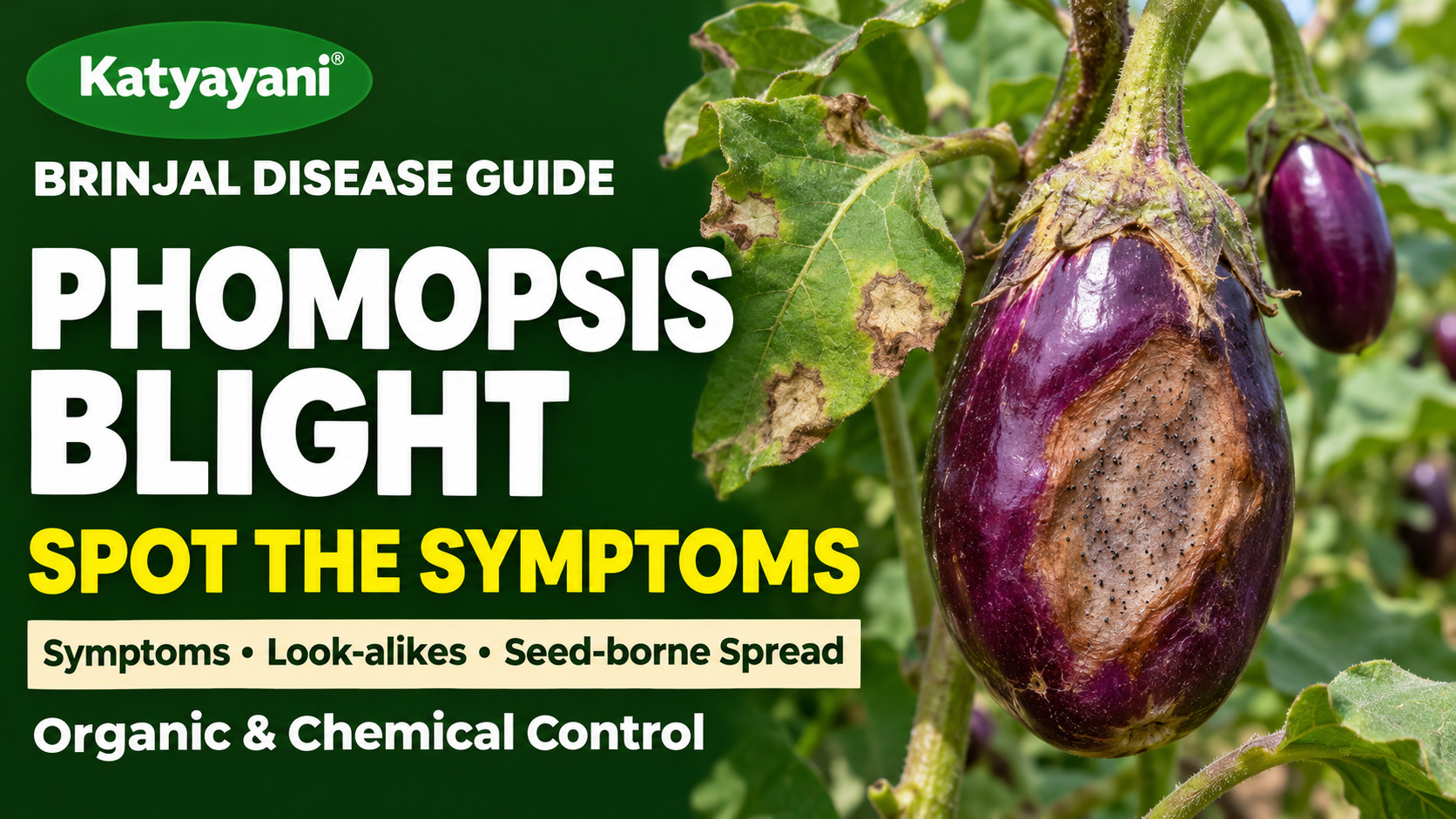
Phomopsis blight (Phomopsis vexans) shows as irregular brown spots with dark margins on brinjal leaves, petioles and stems that join into blight, and as sunken spots on fruit that turn soft, then black and mummified. The fungus lives in seed, crop debris and soil, so start clean: healthy seed, hot water or labelled seed treatment, a fresh nursery bed, removal of infected debris, crop rotation, wider spacing and irrigation timed so leaves dry fast. Trichoderma and Pseudomonas are used preventively at seed, root and soil stage. When spots spread, use a fungicide registered for brinjal on the CIB&RC list, at the label dose, and follow the pre-harvest interval on the pack.
What is Phomopsis blight in brinjal?
Phomopsis blight is a fungal disease of brinjal (baingan, eggplant) caused by Phomopsis vexans. It attacks the seedling, leaf, stem and fruit, so one pathogen shows up as blight on young seedlings in the nursery, leaf spot and stem lesions in the field and fruit rot near harvest. It is seed-borne and also lives in crop debris.
That multi-stage nature is why many growers treat it as three separate problems. A nursery bed that collapses, a plant with brown-spotted leaves and a basket of rotting fruit may all have the same fungus behind them. The TNAU disease page describes exactly this sequence, from blight on young seedlings to fruit decay.
The AGRIS record of a 2018 seed study says Phomopsis vexans seedling and fruit rot can reduce brinjal production by up to 30 percent. That is a single study's figure, not a national loss number, but it explains why seed and nursery care is the first line of defence.
What are the symptoms of Phomopsis blight on leaves, stems and fruit?
On leaves you see small circular or irregular brown spots, grey to brown with blackish margins, that merge into blight. Similar lesions appear on petioles and stems and can kill the shoot. On fruit the spots are small and sunken, then spread, the flesh turns soft and watery, and the fruit finally turns black and mummified.
| Plant part | What you see | Source |
|---|---|---|
| Seedling in nursery | Blight and damping off of young seedlings; stem girdled slightly above the soil line, so the seedling topples and dies | TNAU; NHB |
| Leaf | Small circular spots that turn grey to brown with irregular blackish margins; irregular brown spots | NHB; TNAU |
| Petiole and stem | Lesions that blight the affected part; stem lesion dark brown, turning grey in the centre as fruiting bodies (pycnidia) develop | NHB; TNAU |
| Fruit | Minute sunken spots that merge into rotten areas; fruit soft, watery and decaying, finally black and mummified with pycnidia over the surface | NHB; TNAU |
Field tip: do not judge from one leaf. Walk a diagonal across the plot, check the lowest leaves and the fruit near the soil first, and note whether spots sit in a patch (seed or debris source) or are scattered after rain.
Fruit already showing the black, pinhead-dotted surface is a source of spores for the rest of the plot. Pick it out and take it away from the field.
How do you tell Phomopsis blight from other brinjal leaf spots and fruit rots?
Look at which part is hit first and at the fruit. Phomopsis gives sunken spots on fruit that end in black mummified fruit, while Cercospora and Alternaria mainly spot leaves. Phytophthora fruit rot starts as water-soaked lesions with white cottony growth. A lab or KVK check settles doubtful cases.
| Problem | Cause (as named in the sources) | How it differs | Source |
|---|---|---|---|
| Phomopsis blight | Phomopsis vexans | Leaf, stem and fruit spots; sunken fruit spots; fruit turns black and mummified with pycnidia | TNAU; NHB |
| Cercospora leaf spot | Cercospora melongenae | Chlorotic, angular to irregular leaf lesions turning greyish-brown; severely infected leaves drop | NHB |
| Alternaria leaf spot | Alternaria melongenae | Leaf spots with concentric rings; large deep-seated spots on fruit; fruit turn yellow and drop | NHB |
| Phytophthora fruit rot | Phytophthora nicotianae | Water-soaked lesions on fruit; brown skin with white cottony growth; high humidity favours it | NHB |
These diseases need different care, which is why one spray for everything does not work. For a plot with leaf spots only and clean fruit, Cercospora or Alternaria are the next suspects. The practical test is the fruit: if fruit is clean and only leaves spot, do not assume Phomopsis.
If you grow chilli too, note that anthracnose and leaf spots there are handled in our post on integrated disease management in chilli. Brinjal and chilli share nursery pathogens and some practices, but the fungi are not the same.
How does Phomopsis blight spread? Is it seed-borne?
Yes. TNAU says the fungus survives in soil on infected plant debris and is seed-borne, and it spreads by rain splash, implements and insects. Infected seed carries it into the nursery, debris and soil carry it into the next crop, and splashed spores move from spotted leaves to fruit. A clean start matters more than any later spray.
Put simply, there are three doors: the seed in your hand, the soil and old plant residue in your plot, and the plants already infected nearby. The AGRIS study on infected seed (Priya Reddy, Jakhar and Dahiya, 2018) focused on seed because treating it is the cheapest step in the whole programme.
- Seed. NHB advises against planting seed obtained from diseased plants. Saving seed from a spotted fruit puts the disease in the next nursery.
- Debris. Leaves and fruit left in the field after the last picking carry the fungus to the next crop.
- Soil. The same bed or plot used for brinjal season after season builds up the pathogen.
- Splash and tools. Rain splash, implements and insects move spores (TNAU), so wash cutting tools after handling spotted shoots.
What temperature and weather favour the disease?
TNAU records fungal growth at 29 degrees C and the highest fruit rot in storage at 25 degrees C. In the field, rain splash is what moves spores from leaf to fruit, so wet weather and long leaf wetness raise the risk. Wide spacing and timed irrigation are the levers you control.
In a rainy-season crop you cannot stop rain, but you can stop irrigating late in the day, avoid overhead sprinkling on fruiting plants and keep rows open so leaves dry quickly.
Our post on rainy season vegetables covers the general monsoon crop plan, and the brinjal pillar guide (planned) will cover sowing windows and spacing in detail.
How do you protect the nursery? Seed and bed treatment
Use clean seed, treat it, and raise seedlings in a bed that has not carried brinjal before. TNAU lists hot water seed treatment at 50 degrees C for 30 minutes. NHB advises soil solarization under polythene sheet for 30 days before sowing for damping off. For nursery damping off, CIB&RC lists a captan drench.
| Nursery step | What the source says | Source |
|---|---|---|
| Clean seed | Do not use seed obtained from diseased plants | NHB |
| Fresh bed | Avoid raising the nursery repeatedly in the same plot | General nursery practice |
| Soil solarization | Spread polythene sheet over the bed for 30 days before sowing | NHB |
| Hot water seed treatment | 50 degrees C for 30 minutes | TNAU |
| Nursery damping off (registered use) | Captan 75 WP, brinjal listed with cabbage, cauliflower, tomato, chillies and beans: 0.25 percent as a soil drench in the nursery | CIB&RC fungicide list |
| Bio-agent in the nursery | Trichoderma viride or Pseudomonas fluorescens as seed, bed or root treatment, at the dose on the pack of the product you use | CIB&RC bio-fungicide list; product pack |
Hot water treatment needs a thermometer. Seed exposed to water hotter than 50 degrees C or for longer can lose germination. Practise on a small seed lot first and sow a germination test beside it.
Seed treatment follows the same idea as in pulses. Our post on seed treatment in chana explains the order of coating, drying in shade and keeping bio-agents away from chemical dressings; the same handling rules apply to brinjal seed.
Can Trichoderma seed treatment replace a chemical seed dressing?
In one study, in some tests, yes. A 2018 study on seed infected with Phomopsis vexans found Trichoderma viride seed treatment gave better germination than carbendazim in the blotter test and was on par in pot culture. It is one study, so treat it as supporting evidence and follow your product pack for the dose.
The AGRIS abstract tested T. viride alone, T. viride with Pseudomonas fluorescens, and T. viride with T. asperellum against carbendazim. All three bio-agent treatments beat carbendazim on germination in the blotter method and were on par in pot culture. T. viride also gave higher seedling length and dry weight than carbendazim in pots. The abstract gives no field figures.
Follow The Pack Dose: Commercial bio-agent powders differ in strength and carrier, and even the CIB&RC bio-fungicide list shows different seed doses for different product strengths. Use the dose printed on the pack of the product you buy. The Katyayani Tyson Trichoderma viride powder page, for example, states a seed treatment of 8 to 10 g per kg of seed mixed in 50 ml of water, coated evenly and shade dried.
That Tyson page lists brinjal among its crops and names wilt, root rot, damping off, collar rot, seedling wilt and seed rot as targets. It does not name Phomopsis, and the CIB&RC list shows registered Trichoderma uses on brinjal for root rot, wilt and damping off. So the honest use of the Katyayani Tyson Trichoderma viride powder is as a seed and soil protector, with a registered fungicide covering foliar infection if it comes.
What is the role of Pseudomonas fluorescens and Trichoderma in the field?
They are biocontrol agents used preventively at the seed, nursery and root zone, not leaf-spot cures. Trichoderma protects roots and seed from soil-borne fungi, and Pseudomonas fluorescens colonises roots and is used as a soil and seedling bio-agent. Apply them early, before disease shows, and follow the pack.
Trial example (not a recommendation). A two-year 2026 study from ICAR-IARI, Siksha O Anusandhan and OUAT tested integrated packages against Phomopsis vexans in Odisha. The best package combined a seed treatment, a Pseudomonas fluorescens seedling root dip, a fungicide spray at the vegetative stage and another at the fruiting stage. It gave 8.74 percent disease incidence and 377 q per ha. A second package with Pseudomonas in the soil with vermicompost, a 10 percent turmeric extract and a fruiting-stage spray gave 12.96 percent and 362 q per ha. The authors report that integrated packages did significantly better than single treatments and the untreated control.
The lesson is the layering: seed and root protection first, then well-timed sprays at the vegetative and fruiting stages. The chemicals and rates used in that trial are not given here, because they are not brinjal entries on the CIB&RC list; use the registered products in the fungicide section below.
| Katyayani product page (opened) | What the page states | Use for brinjal Phomopsis |
|---|---|---|
| Tyson Trichoderma viride powder | Brinjal listed; seed treatment 8 to 10 g per kg; wilt, root rot, damping off, collar rot, seed rot | Seed and soil protector; Phomopsis not named on page |
| Hattrick Trichoderma harzianum powder | Brinjal listed for damping off; 1 to 2 kg per acre mixed with compost around the root zone | Soil application only |
| Striker Pseudomonas fluorescens powder | Brinjal listed; foliar 5 to 10 g per litre or 1 to 2 kg per acre; seed, soil and seedling use mentioned without a rate | Preventive biocontrol agent; follow the pack |
For other bio-fungicides in the range, see the bio-fungicides collection. Our explainer on biopesticides: types, examples, advantages and limits sets out what these products can and cannot do.
Do neem and other botanicals control Phomopsis?
Not on their own. In a lab test neem seed kernel extract inhibited Phomopsis vexans by 45.66 percent at 5 percent and 51 percent at 10 percent. Garlic and turmeric extracts reached 100 percent inhibition at 5 percent in the same Petri-plate test, but lab results have not been shown to carry into the field.
The Jakatimath 2017 paper is in vitro only. It tested fungicides, botanicals and bio-agents in a plate. Carbendazim, hexaconazole and tebuconazole gave 100 percent inhibition at all concentrations from 0.25 to 1 percent, and Trichoderma harzianum-P was the best bio-agent at 70.66 percent.
How to read that: the plate shows direct killing of the fungus in controlled conditions. A field crop adds weather, spray coverage and re-infection from seed and debris, which is why the plan in this post starts with clean seed and sanitation rather than a single input.
What cultural and sanitation steps lower the disease?
Use clean seed, practise field sanitation, destroy infected plant material, rotate crops, space plants farther apart and time irrigation so leaves dry fast. NHB lists good field sanitation, destruction of infected plant material and crop rotation. These steps cost little and work best when done every season, not only after an outbreak.
- Remove infected plant parts. Pick off spotted fruit and badly blighted shoots, and carry them out of the field. Do not leave them on the bund.
- Clear debris after the last picking. The fungus survives on infected debris, so cut and destroy residue instead of leaving it to rot in place.
- Rotate crops. Move brinjal away from plots where brinjal grew recently. Chilli, tomato and potato share the Solanaceae family, so a rest from all of them is better than a switch between them. Ask your KVK how long a gap suits your area.
- Space plants wider. More air between rows means leaves dry faster.
- Irrigate early in the day. Prefer furrow or drip over overhead watering during fruiting.
- Separate tools. Wash knives or secateurs after cutting spotted shoots, because implements spread the fungus (TNAU).
Rotation And Seed: Rotation helps with the fungus in soil and debris. It does not remove infection carried on seed, so rotation never replaces clean seed and seed treatment.
Are there Phomopsis-resistant brinjal varieties?
Resistance is limited. The Assam package of practices lists Pusa Bhairav as resistant to phomopsis blight. A 114-genotype IIHR screen found immunity only in wild Solanum torvum, so no cultivated variety gives full protection, and seed of any variety still needs treating.
| Source | What it says |
|---|---|
| Assam Package of Practices 2021 | Pusa Bhairav: resistant to phomopsis blight |
| ICAR-IIHR screening (J. Hort. Sci.) | 114 genotypes screened by artificial inoculation; Solanum torvum immune (0 percent disease index); S. viarum, S. indicum and S. melongena line IIHR 629 resistant (6.67 percent); 14 moderately resistant, 47 moderately susceptible, 37 susceptible, 11 highly susceptible |
Treat Pusa Bhairav as the one with a named resistance statement in an opened source, and ask your KVK which varieties and hybrids are recommended for your state.
In practice, most commercial hybrids sold in the market are not labelled for Phomopsis. So the usual route is clean seed, nursery protection and a spray plan, with a resistant variety as a bonus where it suits your market and fruit type. The planned pillar guide will cover variety choice by fruit type and region.
When are chemical fungicides needed, and what is registered for brinjal?
Chemicals are needed when leaf or fruit spots keep spreading despite clean seed and sanitation, or when past seasons had heavy fruit rot. The CIB&RC list does not name Phomopsis on brinjal. Use a fungicide registered for brinjal on the CIB&RC list, at the label dose, and follow the pre-harvest interval on the pack.
The table below is read directly from the CIB&RC Major Uses of Pesticides: Fungicides list (up to 30/09/2026). It shows every brinjal entry in that list. Doses are per hectare as the list prints them.
| Registered active (CIB&RC list) | Brinjal use on the list | Dose per ha as listed | Waiting period to harvest |
|---|---|---|---|
| Carbendazim 50 WP | Leaf spot; fruit rot | 150 g active; 300 g product in 600 L water | Not stated for brinjal on the list |
| Zineb 75 WP | Blight | 1.125 to 1.5 kg active; 1.5 to 2 kg product in 750 to 1000 L water | Not stated for brinjal on the list |
| Captan 75 WP | Damping off in the nursery | 0.25 percent soil drench (2500 g in 1000 L) | Not applicable (nursery) |
How to use this table: carbendazim is listed for brinjal fruit rot and leaf spot and zineb for brinjal blight, which are the closest label claims to Phomopsis fruit rot and blight. Source: CIB&RC fungicide list. Popular fungicides such as copper oxychloride and mancozeb have no brinjal entry on that list, so do not assume they are labelled for brinjal.
Label First: The CIB&RC list is a guidance document, and the label on the pack is the final word. Check that the pack names brinjal, read the dose, the waiting period before harvest and the number of sprays allowed, and ask your KVK or state agriculture department what is recommended in your district. Use only genuine, labelled products; see how to identify fake pesticides.
Trials outside the registered list point the same way on the active ingredients. The BARI Bangladesh trials (three seasons 2016-17 to 2018-19) tested six fungicides and reported that the carbendazim-group products controlled Phomopsis blight and fruit rot best and gave the highest yields. That is Bangladesh, and the summary gives no incidence figures.
What is a practical stage-wise management guide?
There is no single national ICAR spray calendar, so work by crop stage: nursery, transplanting, vegetative growth, flowering and fruiting. Prevent first with seed and bed care, scout weekly from transplanting, and spray a registered fungicide only when spots appear or spread, at the label dose.
| Stage | Action | Evidence |
|---|---|---|
| Before sowing | Fresh nursery bed or 30-day polythene solarization; clean seed from healthy plants | NHB |
| Nursery | Hot water seed treatment (50 degrees C, 30 minutes) or a labelled seed treatment; bio-agent on the pack dose; captan drench if damping off appears | TNAU; CIB&RC |
| Transplanting | Discard weak or spotted seedlings; apply Trichoderma or Pseudomonas at the root zone as per the pack | Product pages; CIB&RC bio list |
| Vegetative growth | Scout weekly; remove spotted leaves; if spots are spreading, spray a fungicide registered for brinjal at the label dose | CIB&RC |
| Flowering | Keep rows open, irrigate early in the day, avoid wetting flowers and young fruit late in the day; continue scouting | Cultural practice |
| Fruiting | Pick out spotted fruit weekly; if a spray is needed, check the waiting period on the label before the next picking | CIB&RC; label |
| After last picking | Destroy residue; rotate brinjal away from that plot | NHB |
Trial example (not a recommendation): the 2026 Odisha trial timed its sprays at the vegetative stage and again at the fruiting stage, on top of seed and root treatment. That matches the stage logic above, but the trial's chemicals are not brinjal entries on the CIB&RC list.
How often to spray: the label of the product you choose sets the number of sprays and the interval. If new spots keep appearing after a spray, take a leaf and a fruit to your KVK rather than doubling the dose. Never mix products without checking compatibility on the label.
Spray quality matters as much as the product: wet both sides of the leaf, spray fruit-bearing branches, and avoid hot afternoons. The fungicide application methods post and the guide to choosing an agricultural sprayer help with that.
Can you control Phomopsis blight in brinjal organically?
You can reduce it, but the evidence for a fully organic programme is thin. Clean or treated seed, fresh nursery, sanitation, rotation, spacing, timed irrigation, Trichoderma and Pseudomonas lower the pressure. In the opened trials, the best results still included a fungicide, so a strict organic plot needs close scouting and a fallback plan.
The Kashmir study (SKUAST-Kashmir, 2021) is the closest to an integrated, lower-chemical design: it combined soil amendments, bio-agent and fungitoxicant seed treatments and fungitoxicant sprays, and framed fungicide-only control as unsustainable on cost and environment. Its best treatment gave 5.48 percent leaf blight, 0.95 percent stem blight and 5.63 percent fruit rot, and 234.38 q per ha, against 19.29, 13.59 and 20.83 percent and 163.87 q per ha for the weakest treatment.
- Layer 1, prevention. Clean seed, hot water treatment, fresh bed, rotation, sanitation. This is fully organic-compatible.
- Layer 2, bio-agents. Trichoderma at seed or soil, Pseudomonas fluorescens as a preventive soil and root bio-agent. See the Katyayani table above and the Brinjal Unnati Organic Kit, whose page lists a Trichoderma viride component for wilt, damping-off and root rot (not leaf spot or fruit rot).
- Layer 3, scouting. Remove spotted fruit weekly. This is your cheapest spray.
- Layer 4, a decision point. If fruit rot passes a level you cannot tolerate, a fungicide registered for brinjal may be needed. Organic-certified growers should check their standard first before using any chemical.
Read our post on where bio and chemical inputs each win for the broader logic, and Trichoderma for gardeners if you grow brinjal in a few pots at home.
How do you manage Phomopsis blight in a kitchen garden or pots?
Treat the same three doors: use clean seed, a fresh potting mix, and remove spotted leaves and fruit at once. Water the soil in the morning without wetting leaves, give pots space, and bin infected material instead of composting it. Bio-agents mixed into the potting mix help the roots.
In pots the main risk is leaf wetness and crowding. Keep at least a hand's gap between pots and do not reuse last year's soil from a diseased plant. The practical home-garden advice in our organic pest control for home gardens post applies here as well. For seed saving, take seed only from clean fruit on healthy plants.
If a plant is badly blighted and fruit is rotting, pulling it is usually the better choice than repeated sprays. Throw the plant out with household waste, not into the compost heap.
Common mistakes growers make with Phomopsis blight
The usual mistakes are saving seed from spotted fruit, skipping seed treatment, replanting brinjal in the same bed, leaving debris, spraying only after fruit rot appears and using bio-agents as a late rescue. Each of these is fixable at low cost if you plan before sowing.
- Using an unknown seed lot untreated. The fungus sits in the seed.
- Waiting for fruit symptoms. By then the infection is already inside the crop.
- Treating all spots as Phomopsis. Cercospora, Alternaria and Phytophthora need different care.
- Mixing bio-agents with chemical seed dressing. Order and compatibility are on the pack; do not guess.
- Copying a dose from a blog or a video. Use the dose on the label of a product registered for brinjal.
- Skipping record keeping. Note the sowing date, transplanting date and spray dates so you can compare plots next season.
What to do next: a simple checklist
Before the next nursery: buy or save clean seed, treat it, pick a bed that has not grown brinjal, and solarize it if time allows. After transplanting: scout weekly, remove spotted parts, keep rows open and irrigate early. If spots spread, take a leaf and a fruit to your KVK before you spray.
- Decide the seed treatment (hot water or a labelled product at the pack dose) and write it down.
- Prepare a fresh nursery bed and solarize for 30 days if possible.
- Apply Trichoderma or Pseudomonas at transplanting as per the pack.
- Scout one row in every ten each week, lower leaves and fruit near the soil first.
- Remove and burn or bury spotted fruit and shoots.
- Spray only a fungicide registered for brinjal, on the label dose, and respect the waiting period.
- Clear residue after the last picking and rotate brinjal away from that plot.
Conclusion
Phomopsis blight is won or lost before transplanting. The fungus rides on seed, crop debris and soil, so clean seed, a fresh nursery bed, seed treatment, sanitation, rotation, wider spacing and early-day irrigation do most of the work. Trichoderma and Pseudomonas support the root zone preventively, but the opened field trials still used fungicides alongside them. When spots spread, use a fungicide registered for brinjal on the CIB&RC list, at the label dose, follow the pre-harvest interval, and remove spotted fruit weekly. Treat Pusa Bhairav as a helpful but not complete resistance option.
Questions Farmers Ask
What is Phomopsis blight in brinjal?
What are the symptoms of Phomopsis blight on brinjal fruit?
Is Phomopsis blight seed-borne in brinjal?
How do I control Phomopsis blight in brinjal organically?
Which fungicide is used for Phomopsis blight in brinjal?
Does Trichoderma work against Phomopsis blight?
Does neem oil control Phomopsis blight?
Which brinjal varieties resist Phomopsis blight?
How is Phomopsis blight different from Cercospora leaf spot or Phytophthora fruit rot?
How long should I rotate brinjal to reduce Phomopsis?
When should I spray for Phomopsis blight in brinjal?
Can I save seed from brinjal fruit that had Phomopsis?

Senior Microbiologist and Production Executive
Senior Microbiologist and Production Executive at Katyayani Organics. BSc in Biotechnology, MSc in Microbiology, 2.5 years of experience.
View all authors



Leave a Comment