 16 min read
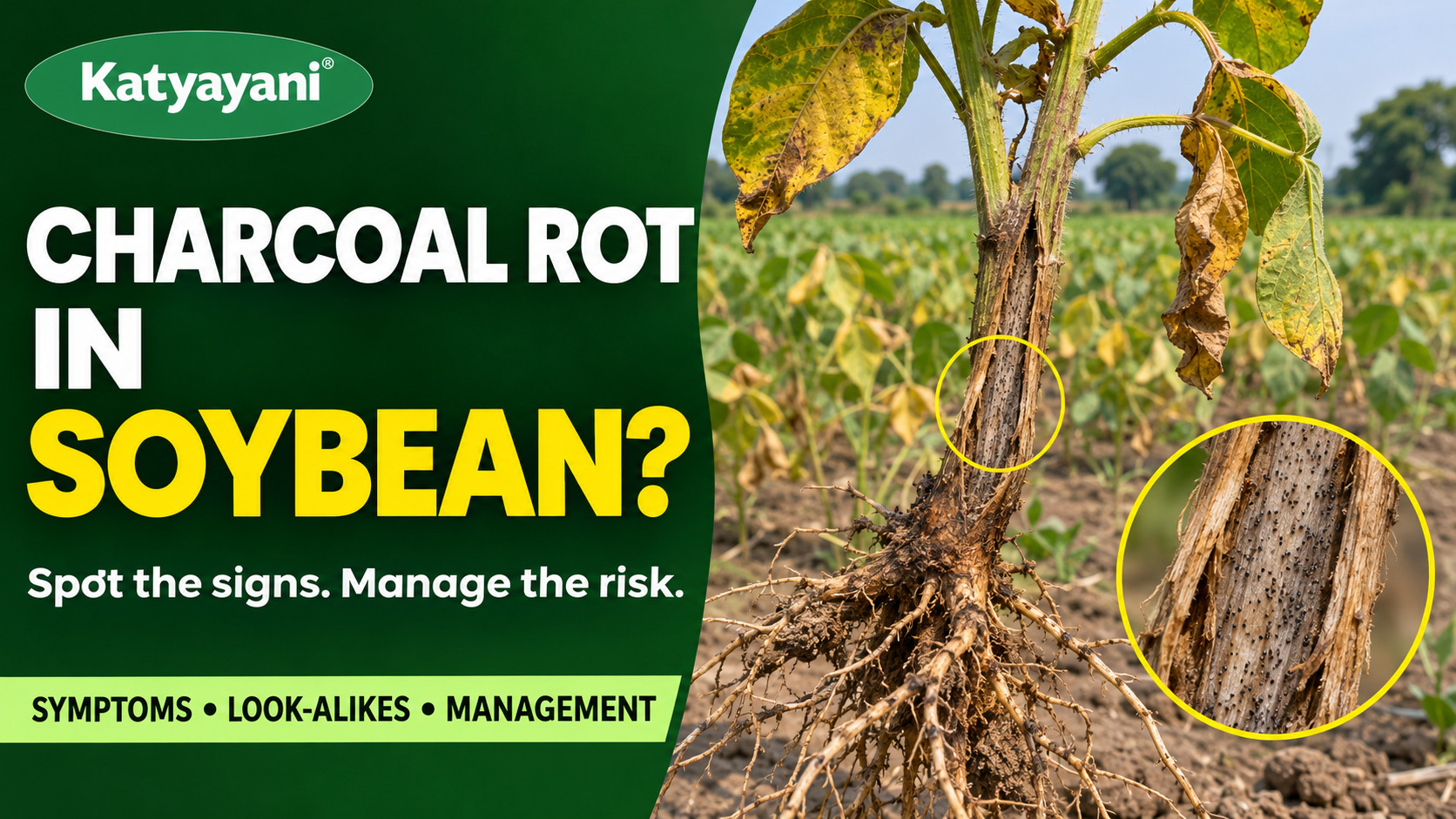
Charcoal rot is a soil-borne fungal disease (Macrophomina phaseolina) that infects soybean roots early but shows up only when heat and drought stress hit around flowering and pod fill. Plants in the driest or most compacted patches wilt and die early with leaves still hanging, and splitting the taproot shows silver-grey tissue with tiny black specks (microsclerotia). The fungus lives in soil and residue for years and can ride on seed. Nothing in the sources rescues a wilted plant, so the work is done before and at sowing: clean seed, a seed treatment backed by your state recommendation, rotation with cereals, a well-drained and not over-dense crop, and moisture protection during dry spells. Confirm the cause by splitting the stem before you spray anything.
What is charcoal rot in soybean and what causes it?
Charcoal rot is a root and lower-stem disease caused by the soil fungus Macrophomina phaseolina. It sits in the soil for years, infects soybean roots early in the season, and turns deadly when hot, dry weather stresses the crop around flowering and pod fill. The name comes from the grey, charcoal-like stem tissue.
The fungus is not fussy. The ICAR-NSRI Indore authors describe it as a polyphagous pathogen with a host range of roughly 500 plant species, and say it is both soil-borne and seed-borne (Frontiers in Plant Science, 2025). That wide host list matters later, because it limits how much crop rotation can do.
In India the disease is usually met as a patchy, mid-to-late-season problem. A farmer sees healthy green soybean in July, a dry spell in August or September, and then circular or irregular patches of plants that wilt and dry well before the rest. The cause was already in the root; the weather simply let it win.
This post is about diagnosis and management of this one disease. Questions about what fertiliser the crop needs belong to our soybean nutrition posts (planned, not yet live), and we do not repeat them here.
Is charcoal rot the same as dry root rot, ashy stem blight and collar rot?
Charcoal rot, ashy stem blight and dry root rot are different names for the same Macrophomina disease. TNAU lists all three together on one page. Collar rot is a separate disease name, so read the disease names on a product label carefully.
TNAU Agritech titles its page "Charcoal rot, ashy or stem blight or dry root rot" and calls it the most common basal stem and root disease of soybean.
Why spend time on names? Because a search for "soybean root rot" brings up pages about Fusarium, Phytophthora and Pythium as well. They are different organisms with different weather triggers, and the next sections show how to separate them.
What are the symptoms of charcoal rot in soybean at each stage?
Seedlings can show brown lesions or damping off, but the classic picture arrives after flowering: small wilted leaves, plants dying early with leaves still attached, and grey streaking on the lower stem. Splitting the taproot reveals silver-grey tissue peppered with black microsclerotia. Roots can turn black and crack.
| Stage | What you may see | Source |
|---|---|---|
| Seedling | Brown lesions on the hypocotyl of emerging seedlings; seedlings can die by damping off | Minnesota Extension; Frontiers 2025 |
| Vegetative | Usually no visible sign. The fungus is already in the roots and colonises them slowly | Crop Protection Network overview |
| Flowering to early pod | Small leaflets, patches of stunted or wilted plants, lower leaves yellow (chlorotic), wilt and dry | TNAU; Crop Protection Network |
| Pod filling (R4 to R5) | Drooping and yellowing foliage, sudden wilt, premature death with leaves still attached to the stem | Frontiers 2025; Crop Protection Network overview |
| Stem and root, after splitting | Light grey to silver tissue, black streaks, tiny black specks inside the pith, on the taproot and under the skin of the lower stem | Minnesota Extension; Crop Protection Network |
| Roots | Roots turn black and crack; black powdery fungal bodies form | TNAU |
A useful detail from the Crop Protection Network overview: colonisation of the root progresses slowly through the reproductive stages and then increases rapidly after pod fill. That is why a field can look acceptable for weeks and then fall apart late in the season.
Seed yield and seed size fall. The Crop Protection Network pages do not give a number for loss per plant, and neither do we. What you will see on the threshing floor is lighter, smaller seed from affected patches and, in the worst patches, almost nothing.
How can I confirm it is charcoal rot and not something else?
Pull two or three affected plants with their roots, split the lower stem and taproot lengthwise, and look at the pith. Tiny black specks like ground pepper inside grey tissue point to charcoal rot. Do this in the driest corner of the field and compare with a green plant nearby.
- Walk the pattern. Early signs sit in the driest parts of a field, such as slopes, sandy spots, compacted headlands and edges (Crop Protection Network).
- Pull, do not cut. Take the whole plant with taproot. The Crop Protection Network describes plants that pull out easily with rotted roots under red crown rot, a different disease.
- Split the stem and taproot. Look in the pith. Charcoal rot gives silver-grey tissue with black specks that look peppered. Brown rot inside the stem points toward brown stem rot (UNL CropWatch).
- Scrape the skin. Microsclerotia sit under the epidermis of the lower stem. A hand lens helps.
- Check the sky. Charcoal rot needs a hot, dry spell. If the last three weeks were wet and cloudy, look harder at the other diseases in the next section.
- Send a sample. If the field matters, take plants to the nearest KVK or state agricultural university plant pathology lab. Leaf symptoms alone cause misdiagnosis.
One caution from the Crop Protection Network: microsclerotia may not be visible until the plant is near maturity or dead. A green plant that is only starting to wilt can look clean inside. Re-check the same patch a week later.
What weather and field conditions trigger charcoal rot?
Hot, dry weather during the reproductive stages is the main trigger. TNAU names moisture stress, dry soil, nematode attack, soil compaction, nutrient deficiency and temperatures of about 25 to 35 degrees C. Minnesota Extension adds that disease is most severe where plants were already stressed or injured.
| Trigger | What the source says | Source |
|---|---|---|
| Heat | Temperatures of about 25 to 35 degrees C favour the disease | TNAU |
| Drought at flowering and pod fill | Prolonged high temperature and drought at the reproductive stage have increased severity in India | Heliyon 2025 (ICAR-IISR and partners) |
| Plant stress or injury | Infection can happen any time, but symptoms develop after flowering when plants become stressed | Minnesota Extension |
| Compaction and nematodes | Listed as conditions that favour the disease | TNAU |
| Dry soil | Low soil moisture favours disease; a review reports substantial yield losses at 30 to 35 degrees C with soil moisture below 60 percent | TNAU; PubMed Central review |
| High seeding rate | Excessive rates raise risk in dry seasons because plants compete for water | Crop Protection Network |
| Irrigated fields | Disease and yield loss can still occur in irrigated fields and in plants without visible symptoms | Crop Protection Network overview |
One more twist from the ICAR-IISR isolate study: isolates adapted to 30 degrees C were more virulent than those adapted to 40 degrees C. The authors do not explain it as a farm rule, so treat it as a research note, not as advice that cooler spells are safe.
How does the fungus survive and spread from season to season?
The fungus survives as microsclerotia, tiny black resting structures, in soil and in old plant residue. They stay viable for years in dry soil but only a few weeks in saturated soil. Infected seed and contaminated soil can carry the fungus to new fields.
Minnesota Extension says the fungus overwinters in host residue and survives at least two years in dry soil, and that contaminated seed and soil spread it. The Crop Protection Network overview adds that microsclerotia can sit in cracks of the seed coat or on its surface, so infected seed does not always look infected.
- Early infection. Microsclerotia germinate near roots and infect at the seedling stage, often through many hyphae, and then colonise the vascular system.
- Waiting phase. Colonisation progresses slowly through the reproductive stages.
- Death phase. After pod fill the fungus blocks the vascular tissue, the plant cannot lift water, and the plant dies.
- Re-seeding the soil. New microsclerotia form in root and stem tissue and return to the soil with residue.
Which diseases look like charcoal rot in soybean?
Sudden death syndrome, brown stem rot, Fusarium wilt, Phytophthora root rot, Rhizoctonia aerial blight and plain drought can all leave yellow, wilting or dying soybean. The reliable separator is the inside of the stem and root, plus the weather. Leaf colour alone is not enough.
| Problem | How it differs from charcoal rot | Source |
|---|---|---|
| Drought stress | Hard to tell apart in a dry year. Infected plants die faster under drought, and splitting stems shows microsclerotia | Crop Protection Network overview |
| Sudden death syndrome (SDS) | Interveinal yellowing with green veins, caused by a toxin moving up from roots; blue-grey growth sometimes on roots; light brown crown and white pith | UNL CropWatch; Crop Protection Network overview |
| Brown stem rot | Foliar yellowing similar to SDS; brown rot inside the stem when split | UNL CropWatch |
| Fusarium wilt | Irregular patches, interveinal chlorosis, early leaf drop; reddish-brown vascular discolouration extending from the root into the stem. Symptoms are often first seen in hot, dry spells and the disease is favoured by cool, wet weather that slows early growth, so weather alone does not separate it from charcoal rot | NC State Extension |
| Phytophthora root and stem rot | Dark brown lesions on outer stem tissue continuous from the roots up the lower stem | Crop Protection Network overview |
| Pod and stem blight | Larger fruiting bodies in linear rows on the outside of the stem, not inside | Crop Protection Network overview |
| Rhizoctonia aerial blight | A canopy disease that starts at pod formation and worsens to harvest; favoured by dense canopy, about 28 to 30 degrees C, relative humidity above 85 percent and well-distributed rain | Legume Research 2026 (ICAR-NSRI Indore) |
| Saprophytic fungi after death | Colonise dead tissue; no microsclerotia inside stem and root tissue | Crop Protection Network overview |
| Soybean cyst nematode | White cysts on roots, females visible about six weeks after emergence | Crop Protection Network overview |
Most of the stem-and-root descriptions above come from US extension services. We did not find an Indian source for sudden death syndrome, so we cannot say how common it is in Indian fields, and we are not claiming it is. Fusarium wilt of soybean also lacked an Indian source in our search, so the NC State description is used only for how it looks, not for how often it occurs here.
If your field is a chickpea field next season, the logic of telling wilt from root rots by splitting the stem is the same. Our chana wilt guide shows it for a different crop.
How much yield does charcoal rot cause in India?
ICAR authors report about 80 percent yield loss in farmer fields during a 1997 epidemic in central India, and 6 to 33 percent loss in susceptible cultivars. There is no single annual national loss figure we could source, so treat these as examples, not averages.
| Figure | What it is | Source |
|---|---|---|
| About 80 percent | Yield loss in farmer fields in the 1997 central India epidemic | Heliyon 2025 (ICAR-IISR and partners) |
| 6 to 33 percent | Yield loss recorded in susceptible cultivars (the paper words the conditions unclearly, so none is stated here) | Heliyon 2025 |
| About 0.25 million tons a year, 4.2 percent of total soybean disease loss | Global estimate quoted by the same authors | Heliyon 2025 |
| Minor until 2004 | Disease status in India before the recent rise | Heliyon 2025 |
For a farmer, the practical point is the shape of the loss: it is patchy, it is back-loaded to pod fill, and it is worst in the years when the weather is worst. A low-loss year is not proof that the soil is clean.
Why has charcoal rot become a bigger problem for Indian soybean?
ICAR scientists point to hotter, drier reproductive stages, a shift in cropping from soybean-wheat to soybean-chickpea, and the spread of popular susceptible varieties such as JS 335, JS 93-05 and JS 95-60. The same study found that all 55 isolates it collected from eight regions were pathogenic.
The Heliyon paper makes three points that a farmer can use. First, after 2004 the disease moved from minor to serious as heat and drought at the reproductive stage became more common. Second, the dominant varieties turned out to be susceptible. Third, the fungus itself is variable: isolates differed significantly in how aggressive they were, with the isolate (56.30 percent of the variation) mattering more than the cultivar (36.79 percent) in the disease reaction. The authors also say seed introduction was an important factor in pathogenic variability.
That last point is a reason to be careful about where seed comes from. Seed moved from one region to another can bring a different, possibly more aggressive, strain. We come back to seed in the management sections.
Can seed treatment prevent charcoal rot in soybean?
Seed treatment is the main chemical step in the sources, but it is protection, not a cure. TNAU lists Trichoderma viride, Pseudomonas fluorescens, carbendazim or thiram as seed treatments. The Crop Protection Network says no fungicide seed treatment has been identified that gives consistent control. Use it as one layer.
| Treatment | What the source says | Source |
|---|---|---|
| Trichoderma viride | 4 g per kg of seed | TNAU |
| Pseudomonas fluorescens | 10 g per kg of seed | TNAU |
| Carbendazim or thiram | 2 g per kg of seed | TNAU |
| Spot drench | Carbendazim 1 g per litre of water, or P. fluorescens or T. viride at 2.5 kg per ha mixed with 50 kg of farmyard manure | TNAU |
| Overall efficacy | No fungicide seed treatment identified that offers consistent control | Crop Protection Network overview |
| Overall efficacy (India) | Seed dressing and foliar fungicides and antagonists have had limited success against charcoal rot | Heliyon 2025 (ICAR-IISR and partners) |
Read the table's last two rows together with the rest. TNAU gives a practical package for Tamil Nadu. The ICAR-IISR authors and the US network both say the results are limited and inconsistent. We are not going to tell you a seed treatment "controls" charcoal rot, only that it is the layer the Indian recommendation includes.
Our guide to fungicide application methods explains dry treatment and slurry coating for seed. It does not cover soybean or Macrophomina, so apply its method only to a product whose label covers your crop and problem. If you also use Rhizobium on soybean, the seed-treatment order (fungicide first, bacteria after) is explained in our biofertilizer guide for pulses.
How do I check a product before I buy or spray for charcoal rot?
Check the current CIB&RC registration and the product label before you buy or spray; ask your KVK. A label should name your crop and the problem, and no product rescues a plant that is already wilting. Confirm the cause by splitting the stem first, then match the product to it.
| Check | Why it matters |
|---|---|
| Confirm the cause by splitting the stem | Drought, Fusarium wilt, sudden death syndrome and Rhizoctonia aerial blight look similar from the road but need different answers |
| Read the crop and disease names on the label | A product made for another crop or another rot is not a charcoal rot product. Disease names such as root rot, collar rot and charcoal rot are not interchangeable |
| Check the current registration (CIB&RC, Major Uses of Pesticides) and the label | Registrations and labels change, so the current official source is the reference, not a blog post |
| Ask your KVK or state agricultural university | They know the local recommendation, such as the TNAU seed treatments listed above, and which varieties have been rated |
| Treat it as one layer | The Crop Protection Network says no fungicide seed treatment has shown consistent control, and ICAR authors report limited success with seed dressing, foliar fungicides and antagonists |
We do not print label doses in this guide. The only doses shown are the TNAU recommendation, which is an agricultural university advisory for Tamil Nadu and should be checked against your own state advisory.
Does Trichoderma viride work against charcoal rot in soybean?
TNAU recommends Trichoderma viride as a seed treatment and soil drench for soybean charcoal rot. A review reports Trichoderma overgrowing and degrading the fungus in lab tests. On farms the results are less certain, so treat it as a supportive layer.
The PubMed Central review reports that Trichoderma inhibited M. phaseolina by overgrowing and degrading its hyphae, that Bacillus isolates showed important growth inhibition, and that Pseudomonas fluorescens was inhibitory in lab and greenhouse tests. Those are lab and greenhouse results, not a farm guarantee for soybean.
If you decide to use a Trichoderma viride bio-fungicide powder, the product page lists root rot among the diseases it addresses, with seed treatment and soil drenching among its uses. Follow the label, and keep biologicals away from a chemical seed dressing unless the label says they are compatible. For background on how biologicals and chemicals differ in timing, see our post on bio versus chemical inputs.
Which crop rotation helps against charcoal rot and which crops carry the fungus?
Rotation with cereals is the standard advice. TNAU and Minnesota Extension both recommend cereals, and the Crop Protection Network suggests wheat for one to two years, with longer breaks better. Rotation helps only partly because the fungus has a wide host range and survives for years.
- Better partners. Cereals and small grains (TNAU; Minnesota Extension). The Crop Protection Network names wheat and barley but warns that corn is a host.
- Poor partners. The Crop Protection Network names corn and sunflower as hosts and Minnesota Extension lists corn, sunflower and some weeds, so these are poor choices for breaking the cycle.
- Length of break. One to two years of a non-host helps; longer is better, since some strains prefer particular hosts (Crop Protection Network overview).
- Soybean after soybean. Inoculum decreased in one cited study when soybean appeared less often in the rotation (PubMed Central review). The same review says crop rotation has not been effective in controlling the pathogen, so do not rely on it alone.
ICAR authors note that cropping in India has shifted from soybean-wheat to soybean-chickpea. They do not claim the shift is the cause of rising charcoal rot, and we do not either; we simply record it as a change that coincided with the rise.
For rotation planning in general, including how long to wait before repeating a family, see our guide to crop rotation examples and plans. It is not specific to soybean.
How do irrigation, mulching and soil moisture affect charcoal rot?
Protecting soil moisture during dry spells reduces stress, and stress is what lets the fungus win. But irrigation is not a cure. The Crop Protection Network says irrigation reduces root colonisation and damage in drought, yet colonisation still occurs, and a review says irrigation did not prevent infection.
ICAR authors list "applying irrigation during drought at reproductive stages" among the recommended practices and also say the practices have had limited success (Heliyon 2025). So the sensible reading is: give protective irrigation at flowering and pod fill if you can, because water stress at that time is the trigger, but do not expect it to clean the field.
- Time the water. Dry spells at flowering to pod fill are the risk window. Protective irrigation in that window is the one place where water directly lowers the trigger.
- Mulch or conserve moisture where it makes sense. Our mulching guide explains that mulch reduces evaporation and keeps soil cooler in summer. It is written for gardens and horticulture, not for rainfed soybean fields, so use it as a principle, not a recipe.
- Drainage. TNAU asks for a well-drained field as part of its cultural package.
On organic matter: TNAU's spot-drench package mixes the biocontrol agent with 50 kg of farmyard manure per treatment. We found no opened source giving a tested organic-matter dose for charcoal rot, so we do not give one.
Do plant density and tillage affect charcoal rot?
Yes, in the US evidence. Excessive seeding rates raise risk in dry seasons because plants compete for water, and reduced tillage is linked with fewer symptoms. Indian recommendations differ: TNAU asks for deep summer ploughing. The sources do not settle which wins for a given Indian soil.
Minnesota Extension says reduced seeding rates may reduce drought stress and charcoal rot, and that reduced tillage may reduce the disease, perhaps through cooler soil and less moisture stress. The Crop Protection Network adds that reduced rates do not prevent colonisation but can reduce stress and yield loss, and that no-till fields typically have lower charcoal rot levels and conserve soil moisture.
TNAU's advice for the Indian crop is deep ploughing in summer. These recommendations pull in different directions, and the reasons are not explained in the pages we opened. Our suggestion is to follow your state recommendation on tillage and to treat seed rate as the part you can tune yourself: sow at the recommended rate, not above it, particularly on light soils in dry belts.
Field Rule: Do not raise the seed rate to "make up" for expected losses. In a dry spell a thick stand drinks the soil dry faster and makes charcoal rot worse (Minnesota Extension; Crop Protection Network).
Are there charcoal rot resistant soybean varieties in India?
No fully resistant variety is established. Minnesota Extension says none are fully resistant, a review says only partial resistance is known and no R-gene based resistance, and ICAR-NSRI scientists report candidate sources, including the line PI 159923, that still need validation. Do not buy a variety on a resistance claim alone.
The Frontiers 2025 paper screened soybean germplasm in a glasshouse and in the field across 2021 to 2023 at Indore. It named PI 159923 as resistant under both field and glasshouse conditions and listed other lines that did well, and the authors call these "previously unreported novel resistance sources" that need validation. They are research lines, not varieties on a seed shelf.
What a farmer can do today is smaller. Ask your state agricultural university or KVK whether a locally recommended variety has been rated for charcoal rot, avoid repeating the same susceptible variety every year, and remember that the ICAR study found JS 335, JS 93-05 and JS 95-60 susceptible.
What should I do with crop residue and seed from a field that had charcoal rot?
Destroy or remove infected stubble, as TNAU advises, and do not keep seed from badly affected patches. The fungus overwinters in residue, and infected seed can carry it. No source we opened gives a safe-seed threshold, so use certified seed or seed from a healthy plot instead.
- Residue. TNAU says to destroy the previous year's infected stubble. Minnesota Extension says the fungus overwinters in host residue, and the Crop Protection Network says new microsclerotia return to the soil with it.
- Seed. Microsclerotia may sit in seed-coat cracks or on the surface, so seed from a patchy field can look clean and still carry the fungus (Crop Protection Network overview).
- Move seed carefully. The ICAR-IISR isolate study says seed introduction was an important factor in the variability of the pathogen, which is a reason to prefer local, certified seed lots.
- Mark the patches. Note where the bad patches were. Next year, give those areas a non-host crop first.
What can I do once soybean plants are already wilting from charcoal rot?
Very little. Minnesota Extension and the Crop Protection Network describe the work as prevention and stress reduction, not in-season rescue. TNAU offers a spot drench, and Indian authors list foliar fungicides, but they also report limited success. Use the moment for diagnosis, not for panic spraying.
- Confirm the cause. Split stems and roots as described above. Many farmers spray fungicide on drought or Rhizoctonia aerial blight problems that need a different answer.
- If it is aerial blight, it is a different problem. It is a canopy disease that starts at pod formation. Ask your KVK or ICAR-NSRI for the current advisory. We do not print doses here.
- If it is charcoal rot, protect the rest. Where the crop is not yet wilting and a dry spell is running, protective irrigation reduces stress. TNAU's spot drench is the Indian recommendation for patches; follow your state recommendation and label.
- Write it down. Record the patch location, variety, sowing date, seed source and weather. This is the data you need for rotation and seed decisions next season.
- Plan the next crop. Put a non-host crop on the worst patches.
What does a season-long prevention plan look like?
Start in summer with ploughing and residue clean-up, choose clean seed and a rotation break, treat seed with a measure your state recommends, sow at the recommended rate, and watch the weather at flowering and pod fill. Each step cuts a little risk. None is a guarantee.
| When | Action | Why | Source |
|---|---|---|---|
| Summer (before kharif) | Deep ploughing; destroy previous stubble; make sure the field drains | Lowers inoculum in residue and removes standing-water problems | TNAU |
| Before sowing | Choose certified seed; avoid a susceptible variety year after year; plan a non-host crop break for patchy fields | Seed can carry the fungus; hosts keep it alive | Crop Protection Network; Minnesota Extension; Heliyon 2025 |
| At sowing | Seed treatment as recommended by your state; sow at the recommended rate | Early protection; less competition for water | TNAU; Minnesota Extension |
| Vegetative | Keep weeds and compaction in check; avoid injuring roots | Stressed or injured plants suffer most | Minnesota Extension; TNAU |
| Flowering to pod fill | Watch the forecast. Give protective irrigation in a long dry spell if you can | This is when the fungus turns lethal | Heliyon 2025; Crop Protection Network |
| R4 to R5 and after | Scout patches; split stems; record weather and location | Confirms the cause and informs next year | Frontiers 2025 |
| After harvest | Remove or destroy infected stubble; put a non-host crop on the bad patches | Cuts the microsclerotia carry-over | TNAU; Minnesota Extension |
Soil nutrition also plays a part. TNAU lists balanced fertilisation, and a review reports that phosphorus fertilisation reduced severity while nitrogen increased it in the studies it cites. How much and when is the job of our soybean nutrition posts (planned, not yet live); we do not repeat doses here, and we do not claim a fertiliser dose controls the disease.
What mistakes do farmers make with charcoal rot?
The common mistakes are spraying without diagnosing, treating it like a leaf disease, raising the seed rate, saving seed from affected patches and expecting one seed treatment to be a cure. Each one is avoidable once you know the disease starts below ground and is triggered by stress.
- Calling every drying patch a fungus. Drought, compaction and other diseases look similar. Split the stem first.
- Spraying leaves for a root disease. Charcoal rot lives in the root and lower stem.
- Buying on a label that does not name your crop and problem. Check the label and the current registration, and ask your KVK.
- Going thick to beat the losses. A dense stand uses up soil moisture faster.
- Saving seed from the bad patch. The fungus can sit in seed-coat cracks.
- Planting corn or sunflower after bad soybean and expecting a clean break. The Crop Protection Network names both as hosts.
- Treating one dry year as the end of the story. The fungus waits in the soil for the next hot, dry spell.
Conclusion
Charcoal rot is a disease of stress. The fungus is in the soil and often in the root long before you see a problem, and it takes over when heat and drought hit at flowering and pod fill. The Indian ICAR evidence says it can cost up to 80 percent of the yield in a bad year, that it has become more serious since 2004, and that most single measures give only limited control. So the plan is layers: split the stem to confirm the cause, start with clean seed and a rotation break, use the seed treatment your state recommends (and check the current registration, the label and your KVK before you buy), sow at the recommended rate, protect moisture in the dry-spell window, and clear out the stubble. Where the evidence runs out, such as resistant varieties and biological agents on farms, we have said so rather than guess.
Questions Farmers Ask
What causes charcoal rot in soybeans?
How do you prevent charcoal rot in soybeans?
What does charcoal rot look like in soybean?
Is charcoal rot the same as dry root rot in soybean?
What seed treatment does TNAU recommend for charcoal rot in soybean?
What is the treatment for charcoal rot in soybean?
Does Trichoderma viride control charcoal rot in soybean?
How much yield loss does charcoal rot cause in India?
How do you tell charcoal rot from sudden death syndrome?
Can charcoal rot be mistaken for drought?
Which crops should not follow soybean after charcoal rot?
Are there charcoal rot resistant soybean varieties?

Senior Microbiologist and Production Executive
Senior Microbiologist and Production Executive at Katyayani Organics. BSc in Biotechnology, MSc in Microbiology, 2.5 years of experience.
View all authorsRead Next in Organic & Bio Inputs

Biofertilizers and Organic Manures in Marigold: FYM, Vermicompost, Azotobacter, PSB, Doses per Acre and an Integrated Nutrient Plan
Phomopsis Blight in Brinjal: Symptoms, Look-alikes, Seed-borne Spread and Organic and Chemical Control


Leave a Comment