 15 min read
All three are worth growing, but for different conditions. Button needs a cool room (16 to 18 C for fruiting), compost and the most capital and skill. Oyster is the easiest and cheapest: any cereal straw, no composting, species that fruit from about 15 to 32 C, a published production cost of about Rs 35 per kg and a price of Rs 100 to 120 per kg (KVK Deoria, 2020). Milky is the hot-weather choice: 30 to 35 C, straw-based, 40 to 70 kg per 100 kg dry straw, and 3 to 4 days of keeping quality at room temperature. Start with oyster, add milky for the hot months, and take button only if you can hold the cool temperature.
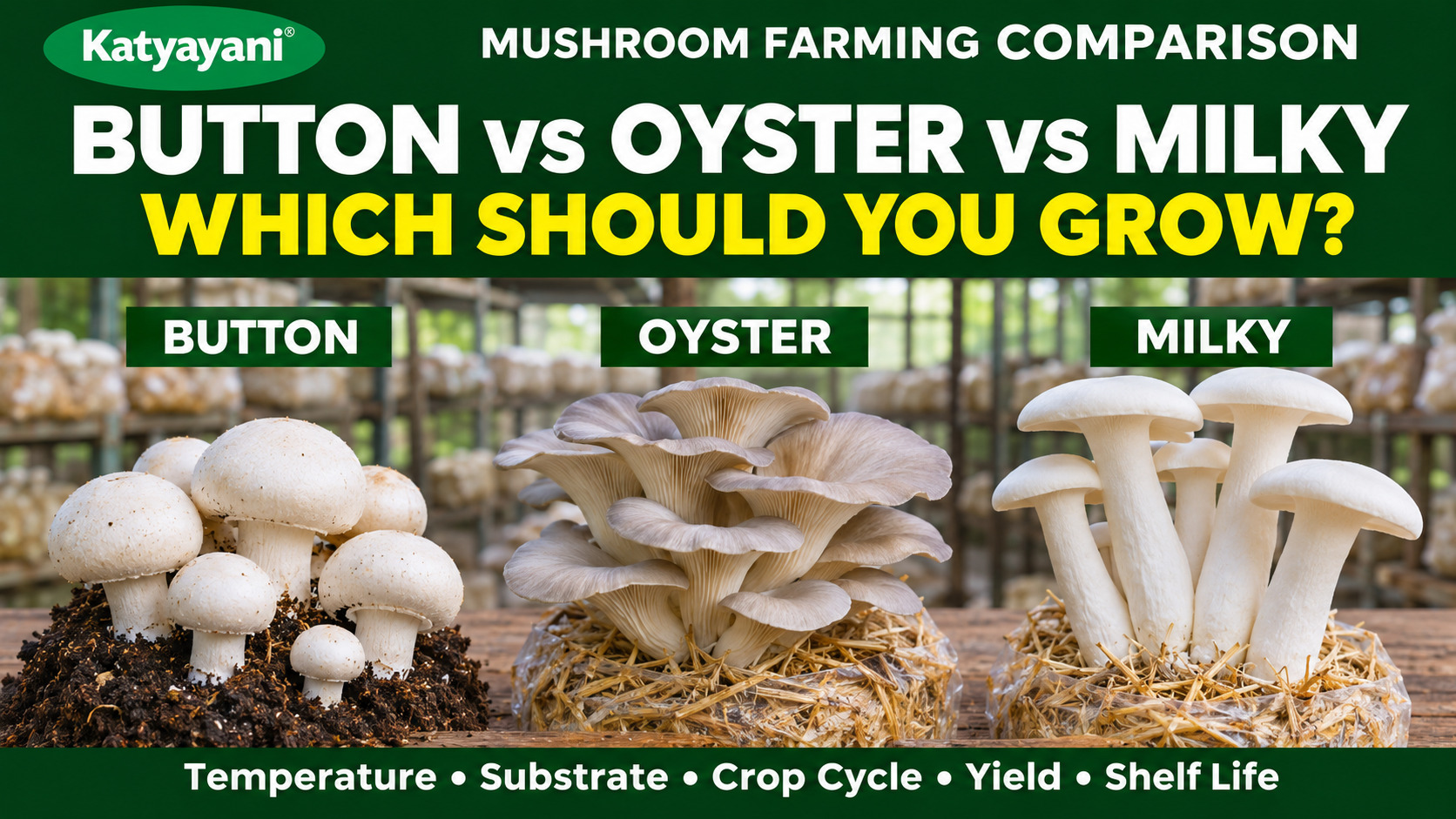
Button vs oyster vs milky mushroom: which one should you grow?
Grow oyster if you want the cheapest, easiest start. Grow milky if your summers are hot and you have straw. Grow button only if you can hold a cool room at 16 to 18 C and manage composting. Temperature and capital decide this first, so match the mushroom to your shed, then check the cost and returns tables below.
| Point | Button (Agaricus bisporus) | Oyster (Pleurotus spp.) | Milky (Calocybe indica) |
|---|---|---|---|
| Fruiting temperature | 16 to 18 C | Species-wise: about 15 to 18 C up to 24 to 32 C | 30 to 35 C |
| Substrate | Composted wheat or paddy straw plus chicken manure, gypsum, urea | Pasteurised cereal straw and other cellulosic waste | Pasteurised paddy or wheat straw and other straws |
| Composting needed | Yes (16 to 17 days short method) | No | No |
| Casing layer | Yes | No | Yes (3 to 4 cm) |
| Spawn dose | 0.5 to 1 percent of compost | 2 to 3 percent of wet straw | 4 to 5 percent of wet straw |
| Yield (fresh) | 18 to 22 kg per 100 kg compost | 50 to 100 kg per 100 kg dry straw | 40 to 70 kg per 100 kg dry straw |
| Published cost and returns | Model room: running cost about Rs 92 per kg, price Rs 120 per kg, profit Rs 83,100 a year | Cost about Rs 35 per kg, price Rs 100 to 120 per kg (2020) | Grower profit Rs 33,570 to 93,570 a year (2018) |
| Keeping quality | Short; cool to 4 to 8 C after picking | 3 to 6 days cool or refrigerated (TNAU) | 3 to 4 days at room temperature (NIOS) |
| Skill and capital | Highest | Lowest | Medium |
Sources for the table: NIOS button lesson, NIOS oyster lesson, NIOS milky lesson, TNAU Agritech, the Bihar Horticulture Directorate model report, Indian Horticulture and the Haryana milky study. The sections below take each row in turn. For a full oyster set-up, cost and selling guide, read our post on oyster mushroom farming in India, because this article does not repeat it.
What is the main difference between button, oyster and milky mushrooms?
Button is a cool-season, compost-grown mushroom and the most widely grown in India. Oyster is a fast, flexible straw mushroom with many colours and species. Milky is a tropical, white, thick-stalked straw mushroom that tolerates heat. They are three different crops with different rooms, not three varieties of one crop.
The NIOS lesson says button accounts for about three-fourths of total mushroom production in India and is grown seasonally in winter in hills and North Indian plains, and all year in commercial units. It calls oyster the second most important mushroom. Milky was collected and first cultivated in India, and is most popular in Tamil Nadu, Karnataka and Andhra Pradesh. A Bihar Horticulture Directorate model report also puts white button above 70 percent of Indian production.
What you actually notice on the farm is the process. Button is a two-stage job: first you make compost, then you grow on it. Oyster and milky skip composting and go straight to pasteurised straw. Milky adds a casing layer like button does. That one difference, casing, is why milky is harder than oyster even though both use straw.
What temperature does each mushroom need?
Button fruits at 16 to 18 C. Milky grows at 30 to 35 C. Oyster depends on the species: P. ostreatus fruits around 15 to 18 C, P. sajor-caju 22 to 30 C, P. djamor 24 to 32 C. The spawn run stage is warmer for all three, around 24 to 25 C for button and oyster.
| Stage | Button | Oyster | Milky |
|---|---|---|---|
| Spawn run | Room 23 to 24 C, bags about 25 C | 24 plus or minus 2 C | 25 to 35 C, 80 percent humidity |
| Casing run | About 25 C for around 10 days | Not applicable | 30 to 35 C, 80 to 90 percent humidity |
| Fruiting | 16 to 18 C, humidity 85 to 95 percent, CO2 1,000 to 1,500 ppm | Below 20 C or about 25 C by species; humidity above 85 percent | 30 to 35 C, humidity 80 to 90 percent |
Oyster species differ in the NIOS table as follows: P. ostreatus 15 to 18 C, P. sajor-caju 22 to 30 C, P. citrinopileatus 24 to 28 C, P. djamor 24 to 32 C, P. eous 22 to 28 C. The species you buy sets your season. Always ask the spawn supplier which Pleurotus species is in the bottle.
Field Tip: Put a thermometer and a humidity meter in the room for one week before you commit. If the room sits above 30 C most afternoons, do not plan on button. If it rarely goes above 25 C, milky will struggle. The temperature log decides, not the brochure.
Which season suits each mushroom?
Button suits winter in the North Indian plains and the hills, unless you have controlled rooms for all-year cropping. Oyster suits the cool to mild months, roughly September to March in the TNAU guidance. Milky suits the hot months, because it needs 30 to 35 C. Together they can cover the year.
NIOS says button is grown seasonally in winter in hilly regions and plains of North India, while commercial units grow it through the year under controlled conditions. TNAU says oyster does best from September to March in Bihar-type conditions, with production dropping from about 25 December to 14 January unless cold-tolerant strains are used. NIOS describes milky as a tropical mushroom for 30 to 35 C and says in summer, when moisture loss is high, you must spread sand on the floor, mist 3 to 4 times a day and check casing moisture by touch to hold at least 80 to 85 percent humidity.
| Season | Natural-condition fit | Source |
|---|---|---|
| Winter (North India plains and hills) | Button, oyster (cold-tolerant strains in the coldest weeks) | NIOS, TNAU |
| Mild months (about September to March) | Oyster | TNAU |
| Hot months, humid regions | Milky; oyster species that tolerate 28 to 32 C | NIOS, NIOS oyster table |
| Rainy season | Milky needs controlled watering, once a day may be enough | NIOS |
What substrate does each mushroom grow on?
Button grows on composted material: wheat straw with chicken manure, gypsum and urea. Oyster and milky grow on pasteurised cereal straw, with paddy or wheat straw being the easy choices. Oyster accepts more waste types, such as sugarcane bagasse and cotton waste. Fresh, dry straw not exposed to rain works best for both straw mushrooms.
The NIOS button lesson gives a long-method recipe of 1,000 kg wheat straw, 500 kg chicken manure, 35 kg gypsum and 18 kg urea, with nitrogen at the start of composting kept at 1.5 to 1.75 percent. The oyster lesson says oyster can grow on any cellulosic waste and that the straw must be fresh and not rained on. TNAU lists paddy straw, sawdust with rice bran, corncobs, cotton waste, sugarcane bagasse and water hyacinth leaves. The milky lesson lists paddy, wheat, ragi, maize, bajra, cotton stalks and leaves, sugarcane bagasse and cotton or jute waste, with straw chopped to 2 to 4 cm.
| Mushroom | Main substrate | Treatment before spawning | Source |
|---|---|---|---|
| Button | Wheat or paddy straw with chicken manure, gypsum, urea | Composting: long method 28 to 30 days, short method 16 to 17 days (outdoor phase I plus controlled phase II) | NIOS |
| Oyster | Cereal straw and many other cellulosic wastes | Hot water at 60 to 65 C, steam, or chemical soak; no composting | NIOS |
| Milky | Chopped paddy or wheat straw | Soak 8 to 16 hours, then hot water for 40 minutes, steam at 65 C for 5 to 6 hours, or autoclave | NIOS |
If you have a lot of paddy straw after harvest and no use for it, oyster and milky are the natural fit. Our post on parali management with a decomposer covers the other route for standing straw, which is returning it to the field.
Which mushroom is easiest for a beginner?
Oyster is the easiest. It needs no composting, no casing layer, and the NIOS lesson calls its cultivation method the easiest of the group. Milky is the next step up because of casing and the higher spawn dose. Button is the hardest, as it needs composting, a cool room and tight hygiene.
Oyster also has the shortest wait. Ready-to-fruit bags are available, and the NIOS lesson says that with such bags you can get the first crop within about 10 days of opening. That makes oyster a low-risk way to learn spawn handling, humidity and picking before you spend on a bigger room. One caution from the same lesson: oyster produces many spores, so wear a mask in the cropping room, as a few people are allergic.
A companion post on low-cost mushroom farming for beginners will go deeper on budget set-ups. Until it is live, start from the oyster mushroom farming guide.
How long is the crop cycle for each mushroom?
Adding the stage times from NIOS gives about 5 to 7 weeks to the first harvest for button after compost, about 5 weeks to the first picking for milky, and about 3 weeks for oyster. These are worked sums from the published stage times, and your room will shift them by days.
| Stage | Button | Oyster | Milky |
|---|---|---|---|
| Composting | 16 to 17 days (short), 28 to 30 days (long) | None | None |
| Spawn run | 12 to 15 days | About 2 weeks at 24 plus or minus 2 C | About 20 days |
| Casing run | About 10 days | None | About 10 days for mycelium to reach the top of the casing |
| Pinheads to first pick | Mushrooms within 3 to 4 days of lowering temperature, then flushes | TNAU: primordia 3 to 4 days after opening bags, harvest 2 to 3 days later | Fruit bodies start within 3 to 5 days of fresh air; mushrooms appear within two weeks |
| Flushes | 3 to 5 flushes in 4 to 6 weeks; commercial units take 2 to 3 | 3 to 4 flushes | Appear in flushes |
| Worked sum, spawning to first pick | About 4 to 5 weeks (12 to 15 plus about 10 plus a few days) | About 3 weeks (about 2 weeks plus about 1 week) | About 5 weeks (about 20 plus about 10 plus 3 to 5 days) |
Add the composting time to button for the full cycle. A button crop therefore runs close to two months from the start of composting to the first pick, and the flushes take four to six weeks after that. NIOS notes that seasonal button growers in the plains may take 5 to 7 flushes, while commercial units move to two or three because later flushes give little yield for the labour. In a typical commercial pattern the lesson records that about 50 percent of the yield came in the first flush, 35 percent in the second and 15 percent in the third.
How much does each mushroom yield?
Compare yield as biological efficiency: kilograms of fresh mushroom per 100 kg of dry substrate. On that basis oyster gives 50 to 100 kg and milky 40 to 70 kg. Button is quoted per 100 kg of finished compost, where it gives 18 to 22 kg, so it sits on a different base from the two straw mushrooms.
| Mushroom | Yield (fresh) | Basis | Source |
|---|---|---|---|
| Button, standard model | 18 to 22 kg (20 kg used in the model) | Per 100 kg compost, about 60 days per crop | Bihar Horticulture Directorate |
| Button, practice trial | 16.33 to 24.62 kg depending on compaction, depth, perforation and bag reversal | Per 100 kg compost | Mushroom Research (ICAR-DMR) |
| Oyster | 50 to 100 kg in 3 to 4 flushes | Per 100 kg dry straw | NIOS |
| Oyster, ICAR-DMR trials | 66.7 to 79.8 for P. djamor and P. ostreatus var. florida, with grain or straw spawn | Percent of substrate | Mushroom Research 2023 |
| Milky, grower practice | 40 to 70 kg | Per 100 kg dry substrate | Indian Journal of Extension Education, 2018 |
| Milky, ICAR-DMR trials 2017 to 2020 | 52.6 (DMR Milky-334) to 55.7 (DMR Milky-985) | Biological efficiency, percent | Mushroom Research 2020 |
The 2025 ICAR-DMR button study shows how much small handling choices move yield. It reported 16.33 kg per 100 kg compost with 12-inch pressed compost, 21.23 kg at 18-inch depth, 18.98 kg with twenty holes in the bag and the highest figure, 24.62 kg, when the bag was reversed after the second flush. Use these as a direction for your own trials.
Worked example, one tonne of dry straw. NIOS says the short method gives more than 2.5 tonnes of compost from one tonne of dry straw. At 18 to 22 kg per 100 kg compost that is 450 to 550 kg of button mushroom, before the manure and gypsum you buy on top. Oyster at 50 to 100 kg per 100 kg is 500 to 1,000 kg from the same tonne. Milky at 40 to 70 kg is 400 to 700 kg. Per tonne of straw the three are close. They separate on price, shelf life and what the room costs to run.
What does each mushroom cost to set up?
Button costs the most to set up: a compost yard, pasteurisation and a room held at 16 to 18 C. A small button room in the Bihar Horticulture Directorate model costs Rs 2.10 lakh; the NHB model for a large commercial unit costs Rs 102.11 lakh. Oyster and milky need a closed shed, racks, bags and spawn, which is the cheapest route.
| Unit | Size | Capital | Source |
|---|---|---|---|
| Button, small room (model report) | One 200 sq ft cropping room, 3 tonnes of compost per crop, 5 crops a year | Rs 2.10 lakh in all, of which the insulated room is Rs 1.60 lakh | Bihar Horticulture Directorate |
| Button, commercial unit (model report) | 8 growing rooms, 8,640 sq ft; compost and casing unit Rs 7 lakh, production unit Rs 30 lakh | Rs 102.11 lakh; Rs 106.99 lakh with 5 percent contingency | NHB |
For an oyster or milky shed, build the figure from five lines priced at local rates: the room or shed, racks, a drum and fuel for pasteurising straw, bags and spawn, and power and labour. Add spawn at the dose in this article for every 100 kg of dry straw you plan to run.
| Cost item | Button | Oyster | Milky |
|---|---|---|---|
| Compost making (yard, turning, gypsum, manure) | Yes; biggest cost line | No | No |
| Pasteurisation (hot water, steam, or tunnel) | Phase II tunnel or room at 58 to 59 C for 4 to 6 hours in commercial units | Hot water at 60 to 65 C, or chemical soak | Hot water 40 minutes, or steam at 65 C |
| Cooling or heating to hold temperature | Cooling in warm areas; the cost that decides viability | Little in the right season | Heating or insulation in winter; humidity control in summer |
| Casing material, sterilised | Yes | No | Yes, often autoclaved or treated with 2 percent formaldehyde |
| Spawn per kg of dry straw or compost | Low (0.5 to 1 percent) | Medium (about 100 g per kg dry straw) | Highest (4 to 5 percent of wet straw) |
| Cold storage and transport | Needed (4 to 8 C) | Useful | Less critical |
Spawn dose is a cost line people overlook. NIOS says milky needs almost double the oyster spawn dose: about 200 g for a bag holding 5 kg wet straw, which is 2 kg dry straw. Oyster, at 2 to 3 percent of wet weight, works out to about 100 g per kg dry straw. For button the dose is 0.5 to 1 percent of compost. For loan and subsidy support on any of the three, see our post on mushroom cultivation subsidy in India; it covers MIDH, NHB and how to apply, so the figures are not repeated here.
What is the market price of button, oyster and milky mushrooms?
Published reference prices are Rs 100 to 120 per kg for oyster (KVK Deoria, ICAR-IIVR, 2020) and Rs 120 per kg for button in the Bihar Horticulture Directorate model report. For milky, set the price from your own buyer. In every case take a written weekly rate for the form you sell: fresh, packed or dried.
| Mushroom | Reference price | Source |
|---|---|---|
| Button | Rs 120 per kg (price used in the model project) | Bihar Horticulture Directorate |
| Oyster | Rs 100 to 120 per kg (2020) | Indian Horticulture, KVK Deoria |
| Milky | Use your buyer's weekly rate in the method below | Your buyer |
Ask the buyer to write down the rate, the form (fresh, packed or dried) and the pick-up point, because the same crop sells at different prices in each form. Our sibling post on types of edible mushrooms, their cost, yield and market demand will cover market channels in more detail once it is live.
Which mushroom keeps longest after picking?
Milky keeps best at room temperature, 3 to 4 days according to NIOS. Oyster stays fresh for about 3 to 6 days when cool or refrigerated, according to TNAU. Button is the most perishable and needs 4 to 8 C soon after picking, with refrigerated transport. Shelf life decides how far you can sell.
| Mushroom | Shelf life | Handling | Source |
|---|---|---|---|
| Button | Short; no days quoted in the lesson | Cool to 4 to 8 C right after harvest, refrigerated vans, punnet packing; do not water bags before picking because wet mushrooms keep less | NIOS |
| Oyster | 3 to 6 days if refrigerated or cool | Twist to harvest, do not water bags before harvest; can be sun-dried below 60 C | TNAU, NIOS |
| Milky | 3 to 4 days at room temperature | Harvest at about 10 cm; before cooking, boil 10 to 15 minutes and discard the water because of the strong aroma | NIOS |
ICAR-DMR has also released a Macrocybe strain, DMR-Macrocybe-1, that does not have the off smell of milky and can be stored up to 10 days in a refrigerator and 3 to 4 days at 20 to 26 C, per the NIOS lesson. If a long-distance market is part of your plan, ask a KVK whether it is available as spawn in your area.
Which mushroom is more profitable?
Per kilogram, oyster shows the widest published margin: cost about Rs 35 and price Rs 100 to 120, so Rs 65 to 85 a kilogram. Button earns a thinner margin per kilogram but the Bihar model room returns Rs 83,100 a year. Milky growers in Haryana earned Rs 33,570 to 93,570 a year. Compare the figures below, then run your own numbers.
| Mushroom | Cost | Price | Return | Source and year |
|---|---|---|---|---|
| Button, 200 sq ft room, 5 crops a year | Running cost Rs 2.769 lakh a year (raw materials Rs 1.609 lakh, power Rs 0.36 lakh, labour Rs 0.80 lakh) for 3,000 kg | Rs 120 per kg | Sales Rs 3.60 lakh; profit Rs 83,100 a year | Bihar Horticulture Directorate model report |
| Oyster | About Rs 35 per kg | Rs 100 to 120 per kg | Rs 65 to 85 per kg | KVK Deoria, ICAR-IIVR, 2020 |
| Milky | Calculate with the method below | Your buyer's rate | Rs 33,570 to 93,570 a year per grower | Haryana growers trained 2015 to 2017, published 2018 |
| Button and oyster, Kangra growers | Average input per crop: button Rs 2.73 lakh, oyster Rs 1.73 lakh | Average output: button Rs 3.27 lakh (6-month crop, two harvests), oyster Rs 1.97 lakh (3-month crop) | Output of 119 percent of input for button and 113 percent for oyster | Mushroom Research, 2023 |
Worked example, button, using the Bihar model's own inputs. Running cost Rs 2.769 lakh divided by 3,000 kg gives about Rs 92 per kg. At the model price of Rs 120 the margin is about Rs 28 per kg, and Rs 3.60 lakh of sales less Rs 2.769 lakh of running cost leaves Rs 83,100. Loan interest and depreciation are not in that figure. Worked example, oyster: Rs 100 to 120 price less Rs 35 cost is Rs 65 to 85 per kg. The Kangra growers found button needs more capital per crop, while oyster is a three-month crop with a lower cost of production.
For milky, and for any shed of your own, use this method. It needs only quotes and a week of price checks.
- Fix the batch. For oyster and milky, 100 kg of dry straw. For button, 100 kg of finished compost.
- Cost the inputs. Straw or compost, spawn at the dose in this article, bags, casing material, fuel or power for pasteurisation, labour, packing.
- Estimate output at the low end. Use the lower yield from the yield table (50 kg per 100 kg dry straw for oyster, 40 kg for milky) and subtract 5 to 10 percent for failed bags. NIOS notes that in 5 to 10 percent of milky bags treated by the chemical method, spawn run may not complete.
- Use the weekly buyer rate, not the best price you heard. Price the mushroom at the rate for the form you will sell.
- Cost per kg = batch cost divided by output in kg. Compare it with the price. For button, if the gap is thin, the cold chain decides the result.
The same NIOS lesson notes that value addition helps profit. Oyster can be sun-dried, powdered or pickled; milky is good for pickles; button can be canned, freeze-dried or pickled. Drying and pickling spread the sale of a crop that spoils in days.
Which mushroom is best for your region?
Choose by your hottest and coldest months, not by trend. North Indian plains and hills in winter suit button and oyster. Hot, humid South India suits milky, where NIOS says it is most popular. Eastern and north-eastern states have long grown oyster. If you have no temperature control, oyster in the cool months is the safest first crop.
| Your situation | First choice | Why |
|---|---|---|
| North Indian plains, winter only, no cooling | Oyster (then button if you can manage compost) | Cool months match oyster; button is a winter crop in the plains per NIOS |
| Hills, cool summers | Button; oyster as a second crop | Natural 16 to 18 C range is reachable |
| Tamil Nadu, Karnataka, Andhra Pradesh, hot humid belts | Milky | NIOS names these states as where milky is most popular |
| Hot summers, plenty of paddy straw | Milky in summer, oyster in the cool months | Milky needs 30 to 35 C; TNAU gives September to March for oyster |
| Anywhere with a controlled, cooled room and a cold chain | Button | Controlled units grow it all year (NIOS) |
| Urban or terrace, small quantity | Oyster ready-to-fruit bags | First crop within about 10 days of opening bags (NIOS) |
Oyster is particularly popular in India's north-east, Chhattisgarh and Bihar, according to the ICAR-DMR Solan 2023 oyster paper. If your area already has oyster growers and buyers, a working local market is worth more than a slightly better yield figure.
Which mushroom is best for your budget?
With a very small budget, start with oyster in a closed room using bags and racks. With a medium budget and hot weather, add milky. Button belongs to growers who can fund a compost yard, pasteurisation and a cool, controlled room, and who have a buyer who needs the cold chain.
| Budget | Start with | Add later |
|---|---|---|
| Small | Oyster in bags, one room, cereal straw | Milky in the hot months using the same straw store |
| Medium | Oyster plus milky, so the shed works all year | Value addition: drying, pickles |
| Large, with cold chain | Button in controlled rooms | Oyster or milky as a second shed for seasons when button is not viable |
The budget question is also a loan question. A bank will ask for a cost sheet and a buyer. Our guide to PMEGP loan for agriculture business and the list of low-investment agriculture business ideas help you frame it, and the post on how to start an agriculture business in India covers registration basics.
What goes wrong with each mushroom?
Contamination and wrong humidity cause most losses. Button crops fail when compost is badly made or the room is too warm or too rich in CO2. Oyster fails when straw is not properly pasteurised. Milky fails when moisture is too high or the casing is not sterilised. Hygiene and clean substrate matter for all three.
- Button. Compost should have 64 to 66 percent moisture and ammonia below 10 ppm before spawning (NIOS). Too much CO2 during fruiting hurts pin formation, so fresh air is lowered to 1,000 to 1,500 ppm.
- Oyster. Do not skip pasteurisation. If the straw is exposed to rain before use it carries unwanted moulds. Do not water bags before picking.
- Milky. Moisture of about 60 percent in the substrate is important; higher moisture leads to incomplete spawn run. After the chemical soak method, a Coprinus mushroom may appear in the 5 to 10 percent of bags where spawn run is incomplete.
- All three. Keep the spawning area clean, use fresh spawn from a trusted supplier, and keep records of the date and temperature for every batch so you can trace failures.
Can you grow more than one type in the same shed?
Yes, and many growers do. Oyster and milky use the same pasteurised straw and the same bag routine, so a shed can run oyster in cool months and milky in hot months. Button needs a separate cooler room and compost yard, so keep it apart from straw mushrooms to avoid cross-contamination.
The practical benefit is spreading risk and keeping the shed busy all year. TNAU's September to March window for oyster and NIOS's 30 to 35 C range for milky are complementary. Keep different bags in separate rooms or at least separate shelves, label each batch, and clean between types. Spent straw from one type should not sit in the cropping room while the next batch fills. Our oyster guide covers what to do with leftover straw.
Is there a subsidy or training for mushroom farming?
Yes. Government schemes support mushroom units under horticulture missions, and ICAR-DMR Solan, state agricultural universities and KVKs run mushroom training. Rules, rates and caps differ by state and year, so check the latest MIDH or NHB guideline and your state horticulture office before you plan on a subsidy figure.
We have a separate post on the mushroom cultivation subsidy in India that explains the schemes, loan routes and how to apply. A broader overview is in agriculture subsidy schemes in India.
Conclusion
Match the mushroom to the room you have. Oyster is the cheapest and easiest start and fits mild months. Milky is the heat-tolerant straw option with the longest room-temperature shelf life. Button pays only if you can hold 16 to 18 C, make good compost and cool the crop after picking. Log your room temperature for a week, price your inputs for a 100 kg batch, check the live mandi rate, and start with one type before adding a second.
Questions Farmers Ask
Which is better, button, oyster or milky mushroom?
What is the difference between oyster mushroom and button mushroom?
Which mushroom grows in summer in India?
What temperature does milky mushroom need?
What substrate is used for milky, oyster and button mushroom?
How long does it take to harvest each mushroom?
How much yield does milky mushroom give?
How much does oyster mushroom yield per kg of straw?
Which mushroom has the longest shelf life?
Which mushroom is best for beginners?
Is button mushroom farming profitable in India?
How much does oyster mushroom farming cost?

Microbiologist
Microbiologist at Katyayani Organics. MSc in Microbiology, 2.6 years of experience.
View all authorsRead Next in Rabi & Horticulture Crop Guides
Chrysanthemum Farming in India: Types, Varieties, Propagation, Planting Time, Pinching, Disbudding, Nutrition, Pests, Diseases, Harvest and Yield
Purple Blotch in Onion: Causes, Symptoms, Weather, Resistant Varieties and How to Manage It

Leave a Comment