 17 min read
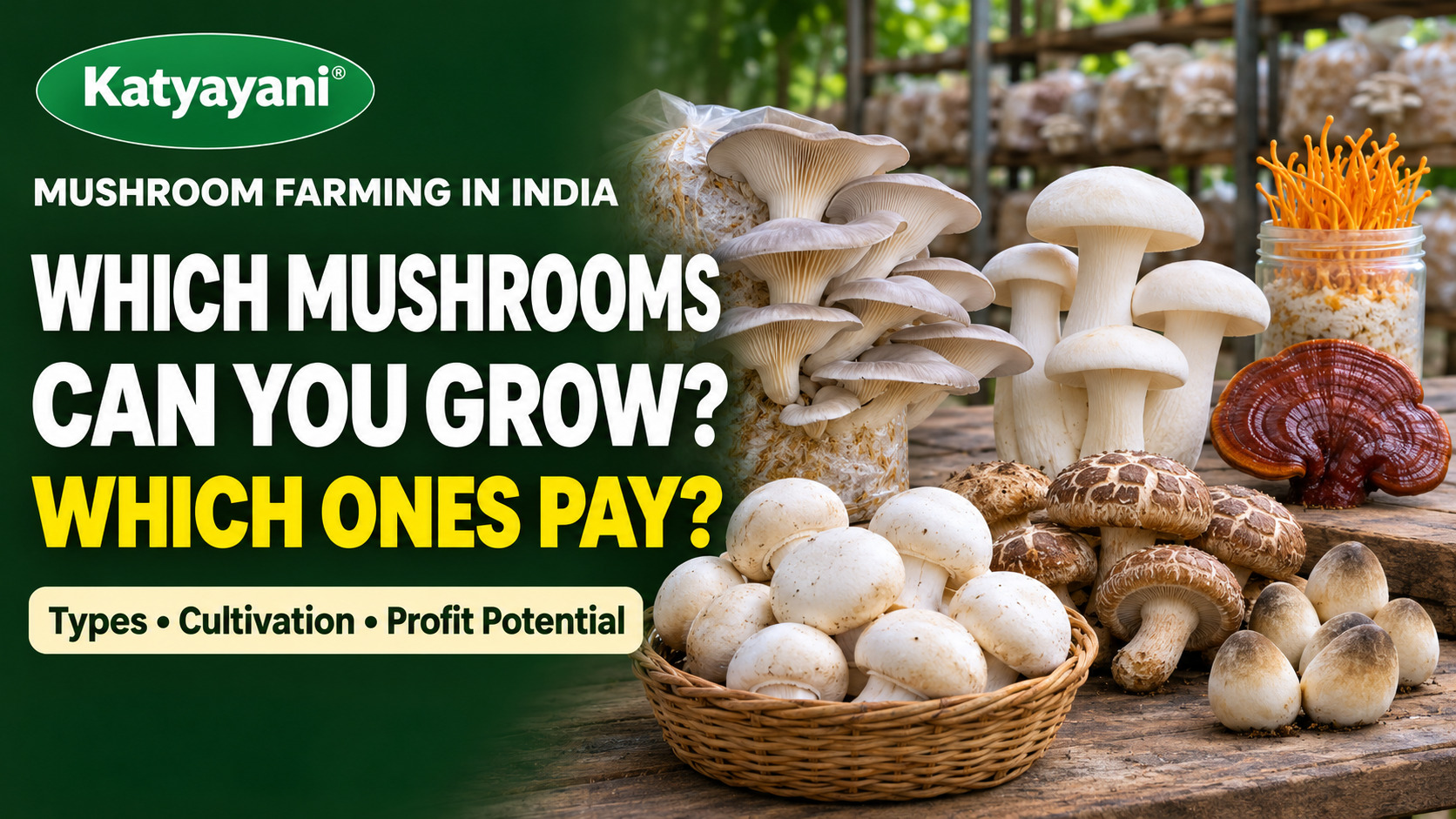
India farms mainly four mushrooms: white button (cool season, compost and a cooling-friendly room), oyster (easiest, straw, wide temperature range), paddy straw (hot and humid, very fast) and milky (warm climates, needs a soil casing layer). Shiitake, reishi, cordyceps militaris, lion's mane and enoki are niche, controlled-environment crops that sell to a small, premium market. Button was 73 percent of Indian output in ICAR data (another ICAR article says more than 85 percent), oyster 16, paddy straw 7, milky 3. Beginners start with oyster, or paddy straw and milky in hot regions. Never eat a wild mushroom on a guess: India has about 1,200 documented species and only 300 to 315 are considered edible.
What are the main types of edible mushrooms in India?
Five mushrooms make up most of what Indians eat and farm: white button, oyster, paddy straw, milky and shiitake. Growers also try medicinal and gourmet types such as reishi, cordyceps, lion's mane and enoki. The ICAR Mushroom Research abstract on mushrooms in India names the first five as the commonly eaten ones.
The reason a single list is not enough is that these mushrooms are different crops. Button needs compost and a cool room. Oyster grows on plain straw. Paddy straw is a hot-weather, bed-style crop. Shiitake and reishi grow on sawdust or wood. Cordyceps grows on cooked rice in jars. Choosing the type is half the decision, so the table below puts them side by side before the sections go deeper.
| Mushroom | Botanical name | Climate it likes | Main raw material | Farmable in India? |
|---|---|---|---|---|
| White button | Agaricus bisporus | Cool; 22-28 C spawn run, 15-18 C fruiting | Wheat or paddy straw compost with manure | Yes, mostly winter in north India, year-round only with cooling |
| Oyster (dhingri) | Pleurotus spp. | Wide; 20-30 C | Wheat or paddy straw | Yes, the easiest |
| Paddy straw | Volvariella volvacea | Hot, humid; 25-35 C | Paddy straw | Yes, in warm and coastal regions |
| Milky | Calocybe indica | Warm; fruits at 30-35 C | Straw with a soil casing layer | Yes, in warm regions |
| Shiitake | Lentinula edodes | Cool | Sawdust or wood logs; wheat straw tested | Yes, in a small way; not yet at scale (ICAR-DMR, search summary) |
| Reishi | Ganoderma lucidum | Warm, humid, controlled | Sawdust or wood | Yes, a medicinal crop with a niche market |
| Cordyceps (militaris) | Cordyceps militaris | Controlled; about 20-25 C mycelium, 18-23 C fruiting (press report) | Brown rice in jars | Yes, ICAR technology exists |
| Lion's mane | Hericium erinaceus | Cool to moderate | Sawdust or similar | Yes, grown by a few specialist units |
| Enoki | Flammulina velutipes | Cool | Sawdust-based | ICAR-DMR holds strains; Indian farming is rare |
Sources for the table are given in each section below. Temperatures for shiitake, lion's mane and enoki are left broad because no opened Indian source gave a clean number.
Which edible mushrooms are grown commercially in India, and how much does each contribute?
Four mushrooms carry the market. In ICAR data, white button is 73 percent of production, oyster 16 percent, paddy straw 7 percent and milky 3 percent, out of roughly 0.13 million tonnes. Everything else, including shiitake, adds up to about 1 percent. Another ICAR article puts button at over 85 percent.
The ICAR Mushroom Research abstract on production status gives 73, 16, 7 and 3 percent, growth of 4.3 percent a year from 2010 to 2017, and per-capita consumption below 100 g a year. The 2023 ICAR nutrition paper repeats the split and adds that 'other mushrooms' including shiitake are about 1 percent, and that India's share of the world's 43 million tonnes in 2018-19 was 2.25 lakh tonnes. The 2018 Indian Farming article from ICAR-DMR says white button is more than 85 percent of production.
The two figures cannot both be right for the same year. The 73 percent number appears in more recent ICAR writing and in several secondary sources, so it is used as the working figure here, with the higher number kept in view. The practical point is the same either way: button leads by a wide margin, oyster is a distant second, and paddy straw and milky are small, regional crops.
| Mushroom | Share of Indian output (ICAR abstract) | Where it is strongest (ICAR) |
|---|---|---|
| White button | 73 percent (over 85 percent in a 2018 ICAR article) | North India |
| Oyster | 16 percent | Southern states |
| Paddy straw | 7 percent | Odisha and neighbouring states |
| Milky | 3 percent | Tamil Nadu and warm regions |
| Shiitake and others | About 1 percent | North-eastern states for shiitake |
The regional pattern comes from the ICAR Mushroom Research overview of mushrooms and the 2018 article, which names paddy straw mushroom in coastal Odisha, milky in Tamil Nadu, shiitake in the north-eastern states and white button in northern India as long-practised local systems.
What is white button mushroom and can you farm it in India?
White button (Agaricus bisporus) is the mushroom in most supermarkets, pizzas and canned packs. It is farmed in India, mostly in winter in the north, on composted straw and manure. It is the most profitable and the most demanding common mushroom, because compost, a casing layer and cool temperatures all have to be managed.
The 2023 Indian Farming article gives the conditions: 22 to 28 C for spawn run, 15 to 18 C for fruiting, and 85 to 90 percent relative humidity. Compost takes the form of straw, additives and water; after pasteurising, spawn is mixed in at 0.5 to 0.75 percent of compost weight, the bed runs for about 12 to 14 days, and a 3 to 4 cm casing layer is added to trigger fruiting. The first crop comes about three weeks after casing. Over a two-month harvest, 10 to 14 kg of fresh mushrooms per 100 kg of compost is reported.
The 2018 DMR article describes how north Indian farmers do it cheaply: temporary bamboo and paddy-straw huts in Haryana and Punjab, a season from October to February, long-method compost made over 28 to 30 days, and 16 to 18 tonnes of compost in one shed giving 2 to 2.5 tonnes of fresh button mushrooms. A temporary shed cost Rs 80,000 to Rs 1,00,000 in that survey, and about the same amount again went on materials, wages and transport. That figure is from the survey period and should be treated as a guide to the structure of costs, not a current quote.
When Button Goes Wrong: The 2018 DMR article names wet bubble, green mould and brown plaster mould as the diseases that cause heavy losses, and says many farmers move the shed site every year to cut soil-borne disease. Hygiene, not just temperature, decides button profits.
What is oyster mushroom and why is it called the easiest to grow?
Oyster mushroom (Pleurotus, called dhingri in Hindi) grows on plain chopped straw at 20 to 30 C. It needs no compost and no casing layer, which is why beginners start here. The CIWA guide reports about 1.5 kg per bed on average and up to 3 kg in a favourable climate.
The ICAR-CIWA guide lists 80 to 85 percent humidity, light during the vegetative stage and a slightly darker reproductive stage, and November to February as the best season in that region. This hub does not repeat the step-by-step method. For the full process, spawn rate and cost, see our oyster mushroom farming guide.
Where it fits among the types: oyster is the most forgiving, tolerates a wide temperature range, and can be sold fresh or dried. The ICAR abstract says it is mostly preferred in southern states. Its downside is that, as a common crop, it sells on price in local markets.
What is paddy straw mushroom and where does it grow best?
Paddy straw mushroom (Volvariella volvacea) is a hot-weather mushroom grown on beds of paddy straw. It wants 25 to 35 C and 75 to 80 percent humidity in a film house, and gives 1 to 2 kg from 10 kg of straw on TNAU's figures. It is very fast, but it must be picked at the button stage.
The TNAU paddy straw mushroom page describes a bed about 1 m long and 0.75 m wide using 10 to 15 kg of straw. Tiny buttons appear 6 to 10 days after spawning, and they should be harvested at the button stage because opened mushrooms turn fibrous. The CIWA guide gives a wider range of 25 to 38 C, an average of 800 g per bed and up to 1.5 kg in a good climate, and says March to October is the best season there.
The two sources differ on temperature range and per-bed yield because the bed size and the climate differ. Treat them as ranges. Paddy straw mushroom is the cheapest to start and the fastest to harvest, but it keeps poorly after picking, so it needs a nearby market.
What is milky mushroom and is it worth growing?
Milky mushroom (Calocybe indica) is a white, firm, long-lasting mushroom for hot regions. TNAU runs spawn at 22 to 25 C and fruiting at 30 to 35 C. It needs a casing layer of sterilised soil and gives 350 to 400 g per 250 g of dry straw. It is a reasonable second crop for warm-region growers.
The TNAU milky mushroom page uses 60 x 30 cm polythene bags, builds beds in five spawned layers, and puts a 1 cm casing layer of sterilised soil on top. Pinheads appear about 10 days after casing, the first harvest comes roughly a week later, and further harvests follow about every 10 days. TNAU recommends a maximum of three harvests for commercial cultivation.
The yield on the TNAU page works out to roughly 1.4 to 1.6 kg per kg of dry straw, which is high compared with the other bed-grown mushrooms and is a figure from a single institutional page, not a field average. A Telangana study also found a bad failure rate in April versus July, a reminder that milky mushroom is sensitive to heat and moisture management. Keep expectations at the low end until you have run a few batches.
What is shiitake and can it be farmed in India?
Shiitake (Lentinula edodes) is a savoury, premium mushroom grown on hardwood logs or sawdust blocks in cool conditions. It can be farmed in India, mainly in the cooler north-eastern and hill regions, but it is not yet grown at scale. It is a slower, more technical crop than oyster.
The ICAR nutrition paper lists Lentinula edodes among the minor cultivated species making up about 1 percent of output. Shiitake needs a specific strain, substrate and temperature range, so ask the Directorate of Mushroom Research or your KVK for advice before you invest.
A Kerala press report on one functional mushroom unit gives a four to six month growth period on sawdust and rubber-wood pellet logs, with harvests continuing for up to a year. It is one company's account, so use it as a sign of the time scale, not a benchmark. If you are a beginner, shiitake is a second-stage crop.
What are reishi (Ganoderma) and cordyceps mushrooms? Are they edible?
Reishi (Ganoderma lucidum) and cordyceps are medicinal mushrooms, not table mushrooms. Reishi is a hard, woody fungus that is dried and used as tea or powder. Cordyceps militaris is grown on rice and sold dried. Both are cultivated in India by specialist units for a niche supplement market.
ICAR-DMR lists a Ganoderma cultivation technology (seen in a search listing, not opened), and the ICAR Mushroom Research journal carries a paper on its successful cultivation in India (R. D. Rai, ICAR-NRCM, 2003). For Cordyceps militaris, the ICAR technology page describes brown rice as the base, optimised temperature, humidity and light, fruiting in 35 to 40 days and 12 to 14 g of mushrooms from a 500 ml jar. It rates the technology at the highest readiness level and says training takes about three days.
A Kerala press report describing a working unit gives a longer 75-day growth cycle, around 4 g of dried mushroom per jar, 20 to 25 C during the mycelium phase and 18 to 23 C during fruiting. The gap with the ICAR figure is probably a difference between fresh and dried weight and between the fruiting window and the full cycle. It is not reconciled here.
No Health Claims: Reishi and cordyceps are sold with strong health claims. This guide does not repeat them. None of the ICAR sources opened for this article supports using these mushrooms to treat a disease. Check labelling and licences before you sell them as a supplement.
What are lion's mane and enoki, and are they grown in India?
Lion's mane (Hericium erinaceus) and enoki (Flammulina velutipes) are gourmet mushrooms. Lion's mane is a white shaggy mushroom, and enoki a thin, long-stemmed white one. Both are mainly imported or grown in small controlled units in India. ICAR-DMR holds strains of both, but neither is a mainstream farm crop.
The ICAR nutrition paper analysed enoki from ICAR-DMR strain DMRO-253, so the crop is in the Solan strain bank. ICAR-DMR's list of technologies includes lion's mane (monkey head mushroom) cultivation, seen in a search listing and not opened. The Kerala press report names lion's mane among the premium mushrooms in its portfolio.
No opened Indian source gave a reliable substrate recipe, yield or climate range for either, so none is given here. If someone offers you a kit or a course for these two, ask for the strain source and a written yield trial first. For most farmers they are not the place to start.
Which mushroom suits which climate and season in India?
Match the mushroom to your temperature. Button wants a cool room for fruiting (15 to 18 C), oyster tolerates 20 to 30 C, and paddy straw and milky want 25 to 35 C. In hot plains, paddy straw and milky fit summer and monsoon, button fits winter, and oyster fits most of the year with care.
| Mushroom | Temperature (source) | Humidity | Best season noted |
|---|---|---|---|
| White button | 22-28 C spawn run, 15-18 C fruiting (Indian Farming 2023) | 85-90 percent | October to February in north Indian plains (ICAR-DMR) |
| Oyster | 20-30 C (CIWA) | 80-85 percent (CIWA) | November to February in the CIWA region |
| Paddy straw | 25-35 C (TNAU); 25-38 C (CIWA) | 75-80 percent (TNAU); 85-90 percent (CIWA) | March to October (CIWA) |
| Milky | 22-25 C spawn run; 30-35 C fruiting (TNAU) | 85-90 percent run; 80-85 percent fruiting | Warm months; failure in cool, dry spells |
| Cordyceps militaris | About 20-25 C mycelium; 18-23 C fruiting (press report) | Controlled | Indoors, not seasonal |
| Shiitake, lion's mane, enoki | Cool; no opened Indian source gave exact values | Controlled | Cool months or climate-controlled rooms |
The humidity figures for paddy straw differ between TNAU and CIWA, which is another reminder that numbers depend on the structure. A film house holds humidity better than an open hut. Your KVK will know what works in your district.
What substrate does each mushroom need?
Straw is the base for button, oyster, paddy straw and milky. Button needs it composted with manure and additives, the others use soaked or treated straw. Shiitake, reishi, lion's mane and enoki use sawdust or wood. Cordyceps militaris grows on brown rice. The substrate is the biggest cost and quality factor.
| Mushroom | Substrate | Extra step |
|---|---|---|
| White button | Composted wheat or paddy straw with manure, bran and gypsum | Composting, pasteurising and a 3-4 cm casing layer (Indian Farming 2023) |
| Oyster | Chopped straw | Soaking and disinfecting; CIWA uses formalin or Bavistin soak for 12 to 16 hours |
| Paddy straw | Paddy straw bundles on raised beds | Spawn placed around the bed margin; dhal powder or bran as a supplement |
| Milky | Straw layered in polythene bags | 1 cm sterilised soil casing |
| Shiitake | Hardwood sawdust or logs; wheat straw tested by ICAR-DMR | Sterilised blocks; slow colonisation |
| Reishi | Sawdust or wood | Sterilised blocks |
| Cordyceps militaris | Brown rice with nutrients | Sterile jars and a clean room (ICAR/PSA) |
Straw availability is the practical test. If you have a lot of wheat or paddy straw, any of the first four fit. If you have none, sawdust-based mushrooms mean sourcing raw material and a way to sterilise it. Our post on managing paddy straw (parali) covers what to do with the straw you do not use.
How do the mushrooms compare on yield and difficulty?
Yield figures are given in different units for each mushroom, so they cannot be ranked directly. Button gives 10 to 14 kg per 100 kg of compost. Oyster gives about 1.5 kg per bed (CIWA). Paddy straw gives 1 to 2 kg per 10 kg of straw. Milky gives 350 to 400 g per 250 g of dry straw (TNAU).
| Mushroom | Reported yield | Source | Difficulty for a beginner |
|---|---|---|---|
| White button | 10-14 kg fresh per 100 kg compost over about two months | Indian Farming 2023 | High: compost, casing, cooling |
| Oyster | About 1.5 kg per bed; up to 3 kg in a conducive climate | ICAR-CIWA | Low |
| Paddy straw | 1-2 kg per 10 kg substrate (TNAU); about 800 g per bed, up to 1.5 kg (CIWA) | TNAU, CIWA | Low to medium: heat and quick picking |
| Milky | 350-400 g per 250 g dry straw | TNAU | Medium: casing, three harvests only |
| Cordyceps militaris | 12-14 g per 500 ml jar (ICAR/PSA); about 4 g dried per jar (press) | ICAR/PSA | High: sterile, controlled |
| Shiitake, reishi, lion's mane, enoki | No opened Indian source gave a yield | - | High |
'Difficulty' is our reading of the steps each source describes, not a figure from any of them. The honest conclusion: the three or four straw mushrooms are accessible, the rest are specialist crops. Biological efficiency and net returns are covered in the cost and profit articles, not here.
What is the market demand for edible mushrooms in India?
Demand is growing from a low base. The ICAR abstract puts per-capita consumption below 100 g a year and growth at 4.3 percent a year from 2010 to 2017. Demand is seasonal, with a winter and wedding-season peak for fresh button. Canned and frozen button is exported, and spawn is a business of its own.
The ICAR production-status abstract reports exports of 1,054 quintals of white button, canned and frozen, worth Rs 7,282.26 lakh in 2016-17. It estimates spawn demand at 8,000 to 10,000 tonnes a year and says public-sector organisations supply only about 10 percent, with private units supplying the rest. The 2018 DMR article notes that increased hotel consumption and marriage-season demand raise winter prices, and growers send mushrooms by night to cities such as Delhi, Chandigarh, Amritsar and Shimla.
For a new grower the lesson is local. Fresh mushrooms keep only a few days, so the first question is who will buy within a day's travel. Hotels, caterers, vegetable markets and local retailers are the usual answer. We do not quote a per-kg price here: it changes by city and season, and the sources opened do not give a current benchmark.
How nutritious are edible mushrooms? A species comparison
Mushrooms are about 87 to 92 percent water. On a dry-weight basis, ICAR-DMR strains tested at 15 to 39 percent protein, 30 to 40 percent dietary fibre and under 4 percent fat. They are low in fat and rich in fibre, but a fresh serving gives far less protein than the dry figures suggest.
| Per 100 g dry weight (ICAR-DMR strains, 2020-21) | Button | Milky | Enoki | Oyster (P. florida) | Paddy straw |
|---|---|---|---|---|---|
| Protein (percent) | 30.64 | 16.85 | 15.27 | 23.61 | 38.75 |
| Fat (percent) | 0.97 | 3.88 | 0.91 | 1.05 | 0.84 |
| Carbohydrate (percent) | 52.26 | 65.17 | 69.60 | 53.37 | 39.33 |
| Dietary fibre (percent) | 30.51 | 34.68 | 37.88 | 40.48 | 30.22 |
| Energy (kcal) | 340.4 | 363.1 | 347.6 | 346.4 | 319.9 |
| Moisture, fresh (percent) | 92.44 | 87.02 | 88.52 | 90.79 | 90.39 |
These come from the ICAR Indian Journal of Agricultural Sciences paper, which also notes that earlier reports for the same species vary widely (button protein from 18.4 to 41.06 percent, for example). So use the table to compare types, not to quote an exact label value. The 2023 Indian Farming article adds that mushrooms supply vitamins of the B group, and that sun-drying adds vitamin D to dried products.
This is a farming guide, so for diet and health advice ask a dietitian.
Are all mushrooms safe to eat? How do you tell edible from poisonous?
No. Only some mushrooms are safe, and you cannot reliably tell them apart by sight, smell or any home test. India has about 1,200 documented species and only 300 to 315 are considered edible. Eat only cultivated mushrooms from a trusted source, and never eat a wild one on a guess.
The 2018 Frontiers in Pharmacology study tested six wild Kerala mushrooms in cells and in mice and concluded they warrant caution. It reports that the monsoon, when mushrooms bloom, sees many poisoning cases, that in Kerala the main cause was misidentification, that the toxic species closely resemble edible ones, and that there is no universal rule for telling toxic from edible. A review also ties most poisonings in India to look-alikes such as Amanita, Galerina and Lepiota.
- Do not rely on folk tests. Colour, smell, peeling, silver spoons and cooking do not make a toxic mushroom safe. The Frontiers paper says there is no universal rule.
- Buy cultivated mushrooms from a known seller. Button, oyster, paddy straw and milky from a farm or a licensed vendor are the safe route.
- Do not pick and eat after rain. The monsoon is when wild mushrooms appear and when most cases are reported.
- Get help fast. If someone has eaten a wild mushroom and feels unwell, go to a hospital and take a sample of the mushroom with you. Do not wait for symptoms to settle.
Also keep growing rooms clean. Green and other contaminant moulds can ruin a batch, and a contaminated batch should be discarded, not eaten or sold. This is a quality rule as much as a safety one.
Which edible mushrooms are commercially viable in India?
Button, oyster, paddy straw and milky are the commercially proven four, because they have established technology, spawn supply and buyers. Of these, oyster is the lowest-risk start. Button earns the most but needs the most skill and capital. Shiitake, reishi and cordyceps are niche; they pay only if you have a buyer before you grow.
| Mushroom | Commercial status in India | Best for | Main risk |
|---|---|---|---|
| White button | Mass market; the largest share of output | Growers with winter climate or cooling, and market access | Compost quality, disease, high capital |
| Oyster | Mass market; second largest | Beginners, women's groups, small rooms | Local price competition |
| Paddy straw | Regional; small share | Hot, humid regions with paddy straw | Very short shelf life |
| Milky | Regional; smallest of the four | Warm regions, longer shelf life | Heat and moisture failures |
| Shiitake | Niche; ICAR says not yet at scale | Cool regions with sawdust | Slow cycle and a thin market |
| Reishi, cordyceps, lion's mane | Niche; sold against orders (press report) | Trained, well-funded units with a buyer | Regulation, claims and price swings |
The Kerala press report says its unit grows the functional types only against advance orders, which is the right discipline. A premium price does not help if there is nobody to buy at that price. If you are comparing cost and profit across the three common types in detail, the separate button vs oyster vs milky guide will have the numbers.
How do you choose the right mushroom to start with?
Decide in this order: your temperature, your raw material, your nearest buyer and your budget. Cool region with winter demand: button. Straw and a small room: oyster. Hot and humid: paddy straw or milky. Do not start with a premium medicinal mushroom unless you have a trained team and a signed buyer.
- Temperature first. If you cannot hold the range in the table, you cannot grow that mushroom without paying for cooling or heating.
- Raw material next. Straw within a few kilometres cuts cost. Sawdust-based mushrooms add sourcing and sterilising.
- Buyer before batch. Fresh mushrooms keep only a few days. Line up two or three buyers before the first harvest.
- Start with a small trial. Run one or two batches before building a shed, and keep notes on temperature and humidity.
- Get trained. ICAR-DMR and Krishi Vigyan Kendras run mushroom training, and the training also helps with a subsidy application.
Where do you get spawn and training?
Buy spawn only from a recognised source: ICAR-DMR Solan, a state agricultural university, a KVK or a reputed private spawn unit. The ICAR abstract says private units supply about 90 percent of spawn in India, so quality varies. Ask for the strain name and the date the spawn was made.
Spawn goes stale and contaminated quickly, which is why a good-looking bag of low-quality spawn is the most common reason for a failed first batch. Ask the seller for a strain code (ICAR-DMR strains carry names such as NBS-5 for button, DMRP-136 for oyster and DMRO-484 for paddy straw, as listed in the nutrition paper). For training, contact your nearest KVK or the Directorate of Mushroom Research at Solan; ask them for current course dates and fees.
Is there a government subsidy for mushroom farming?
Yes. Mushroom units can get support under MIDH and NHB schemes, usually as a credit-linked back-ended subsidy, and some states add their own help. Rates, project-cost norms and the application route are covered in our separate subsidy guide, so check that page rather than relying on a number here.
See our guide on the subsidy for mushroom cultivation in India for MIDH and NHB rates and the application steps. For other routes, our posts on the PMEGP loan for agriculture-based businesses and agriculture subsidy schemes in India cover the wider set. Rates and eligibility change, so confirm on the official portal before you invest.
Can mushroom farming fit into a bigger farm or agri business plan?
Yes. Mushroom farming uses little land and turns farm straw into a cash crop. It fits next to a field enterprise, a greenhouse or a small food-processing business. The question is scale and market, not space. Start with a trial room and expand only after you have buyers and notes from a few batches.
If you are still choosing between ideas, our low-investment agriculture business ideas and the guide on how to start an agriculture business in India help compare options. If you are interested in controlled-environment growing more broadly, see greenhouse farming in India and vertical farming and hydroponics business models. The CIWA and ICAR sources used here describe mushroom growing as a way for small farmers, landless people and women to add income, but they do not promise a profit figure and neither do we.
Conclusion
India farms four mushrooms at scale: white button for cool seasons, oyster for almost any room with straw, paddy straw for hot and humid weather, and milky for warm regions with a soil casing. Shiitake, reishi, cordyceps, lion's mane and enoki are niche crops for trained, well-funded units with a buyer. Pick by temperature, raw material and market, buy spawn only from a recognised source, start small, and never eat a wild mushroom on a guess.
Questions Farmers Ask
What are the main types of edible mushrooms?
Which mushrooms can be farmed in India?
Which is the easiest mushroom to grow?
Which mushroom is most produced in India?
What temperature does each mushroom need?
What is the difference between oyster, milky and paddy straw mushroom?
Can shiitake be grown in India?
Is reishi or cordyceps an edible mushroom?
How can you tell an edible mushroom from a poisonous one?
How nutritious are edible mushrooms?
Which mushroom is best for commercial farming?
Is there a subsidy for mushroom farming in India?

Microbiologist
Microbiologist at Katyayani Organics. MSc in Microbiology, 2.6 years of experience.
View all authorsRead Next in Rabi & Horticulture Crop Guides
Chrysanthemum Farming in India: Types, Varieties, Propagation, Planting Time, Pinching, Disbudding, Nutrition, Pests, Diseases, Harvest and Yield
Purple Blotch in Onion: Causes, Symptoms, Weather, Resistant Varieties and How to Manage It

Leave a Comment