Government Schemes
Information about government agricultural schemes and subsidies for farmers.
47 articles
 13 min
Karpoori Thakur Kisan Samman Nidhi (Bihar): Amount, Documents, How to Check Status and Where to Get Official Updates
The Karpoori Thakur Kisan Samman Nidhi is a Bihar scheme announced in the Bihar Budget 2026-27. The state gives Rs 3,000 a year on top of the Rs 6,000 a year that PM-KISAN pays, so a farmer can receive Rs 9,000 a year in total. Because it comes on top of PM-KISAN, the best preparation is to keep your PM-KISAN record complete: e-KYC done, bank account linked with Aadhaar, land record correct and mobile number working. Official updates appear on the Bihar DBT Agriculture portal and at your district agriculture office. Never pay anyone for a form.
 15 min
Uzhavar Sandhai (Tamil Nadu Farmers Market): How Many Markets, Who Can Sell, Farmer ID Card, Stall, Prices and Timings
Uzhavar Sandhai means "farmers' market" in Tamil. It is a Tamil Nadu government scheme, started in 1999, where identified farmers sell their own vegetables and fruits directly to buyers, with no commission and a free shop. To sell, you need the photo identity card issued through the Horticulture Department process and you approach the Agricultural Officer of the nearest Sandhai. Prices are fixed daily by a committee, roughly above wholesale and below retail. The market count is not settled: official pages say 103, 131 and 141, a 2022 report says 180. Confirm today's count, hours and rent at your local market office.
 16 min
Spices Board Schemes and Subsidies for Spice Farmers: Cardamom Replanting, Post-Harvest Machines, Organic Certification, Eligibility and How to Apply
Spices Board help for farmers comes mainly through the SPICED scheme: replanting, planting material and water structures for small and large cardamom, subsidised post-harvest machines (threshers, turmeric boiler, polisher, drier), support for organic certification and group projects for FPOs. Apply online on the ServicePlus portal, or through a Board office if you cannot apply online, with land papers, Aadhaar, bank passbook and a quotation. A Board officer inspects before money is paid into your bank account. Subsidy rate and ceiling are set in the Board's current scheme guidelines, so get the latest from the Spices Board regional office or indianspices.com before you apply.
 16 min
Watershed Development under PMKSY 2.0 (WDC-PMKSY): Objectives, Funding, Components and What Rainfed Farmers Can Get
Watershed development under PMKSY 2.0 (WDC-PMKSY 2.0) is a Centrally Sponsored Scheme run by the Department of Land Resources, Ministry of Rural Development. It funds soil and water conservation, rainwater harvesting, plantations and livelihood work on rainfed and degraded land, village by village, through a Gram Sabha-backed Watershed Committee. The approved target for 2021-26 is 49.50 lakh hectares with an indicative central outlay of Rs 8,134 crore. Funding is 60:40 Centre to State (90:10 for North Eastern and hill states). The norm is Rs 22,000 per hectare in plains and Rs 28,000 in hilly and difficult areas. It is a village project, not an individual subsidy.
 15 min
Atal Bhujal Yojana (ATAL JAL): States, Districts, Budget, What Farmers Get and Status After 2025
Atal Bhujal Yojana (ATAL JAL) was a Rs 6,000 crore central sector scheme for community-led groundwater management, with half the money from a World Bank loan. It covered 8,203 water-stressed gram panchayats in 229 blocks of 80 districts in seven states: Gujarat, Haryana, Karnataka, Madhya Pradesh, Maharashtra, Rajasthan and Uttar Pradesh. Villages built water budgets and Water Security Plans, and states earned incentive money for results. Farmers did not get cash directly; they got training, data and support for drip, sprinkler and crop change. Per the Ministry of Jal Shakti, the scheme ran from 1 April 2020 to 15 October 2025 as a pilot and is now closed.
 15 min
Micro Irrigation Subsidy in Tamil Nadu: Drip and Sprinkler Subsidy Rates, Eligibility, Documents and How to Apply
In Tamil Nadu the micro irrigation (drip and sprinkler) subsidy is shown on the department portal as 100 percent for small and marginal farmers and 75 percent for other farmers. Small and marginal farmers are covered up to 2 hectares and other farmers up to 5 hectares, and the Tamil Nadu Government absorbs the 12 percent GST on the system. The central PMKSY Per Drop More Crop pattern is 55 and 45 percent. You apply through the MIMIS portal of the Horticulture department or at the taluk Horticulture or Agriculture office, pick an approved micro irrigation firm, get a quotation and field inspection, and the firm installs the system. Other farmers pay their share. The same farm cannot claim again for 7 years. Your quotation on MIMIS shows the exact amounts before work starts.
 11 min
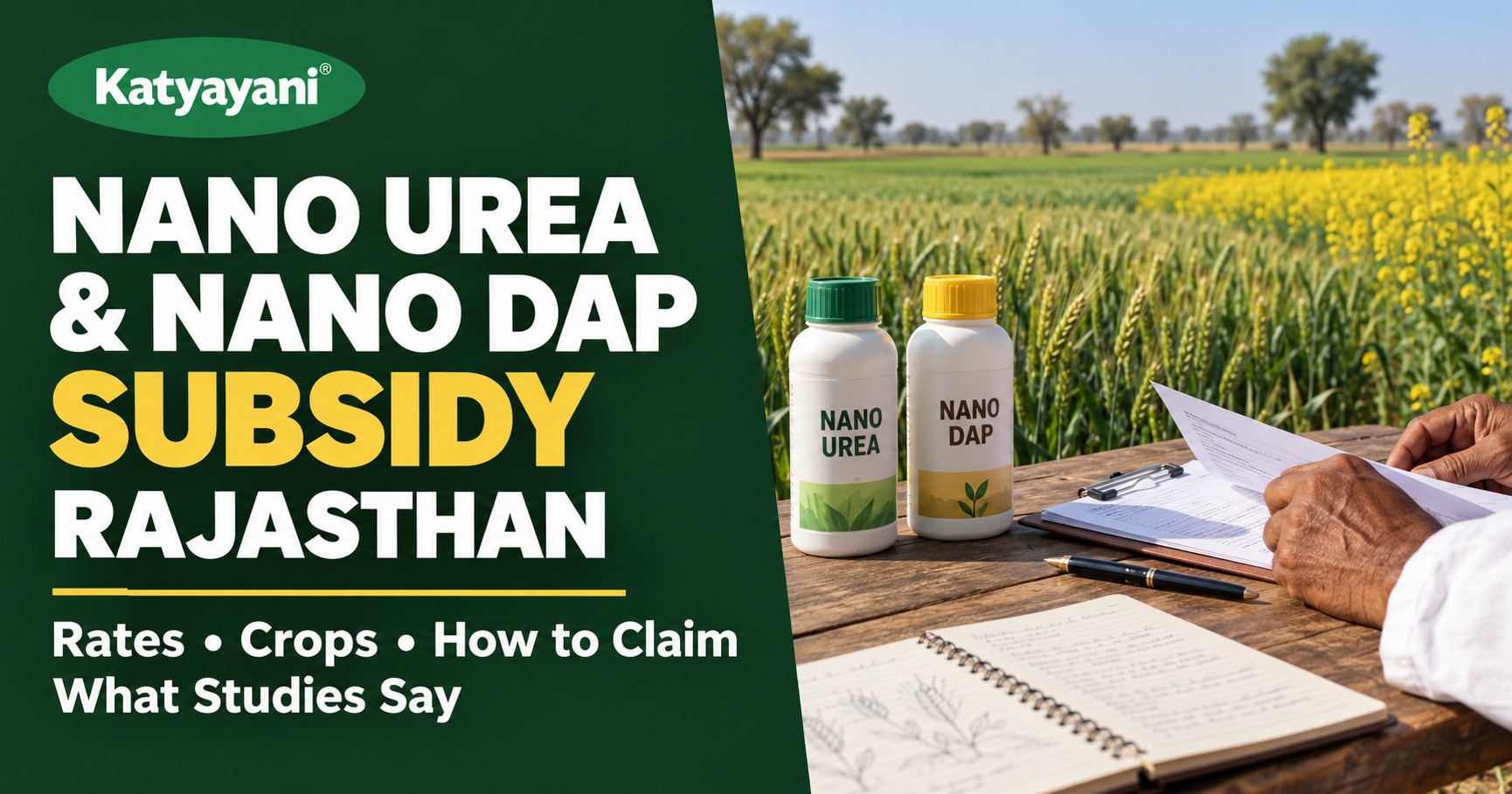
Nano Urea and Nano DAP Subsidy in Rajasthan: Rates, Crops, How to Claim and What Studies Say
Yes, for this rabi season. As reported on 25 Oct 2026, Rajasthan is paying half of a fixed spray cost under its 2026-27 budget announcement, run through RKVY: Rs 1,000 per hectare for nano urea (cost fixed at Rs 2,000) and Rs 1,450 per hectare for nano DAP (cost fixed at Rs 2,900). That is about Rs 405 and Rs 587 per acre. Reported crops are wheat, barley, mustard, gram and cumin. You must be in a village cluster of at least 10 farmers, with 0.4 to 10 hectares sprayed under the supervision of the agriculture department, and the money comes by DBT after the field check. It is not a discount at the shop: you still buy the bottle at the printed price. Contact your Krishi Paryavekshak or the nearest agriculture office to join a cluster, because each district has a limited target. We could not read the official order, so confirm the rates there before you spray.
 12 min
Subsidy for Mushroom Cultivation in India: MIDH, NHB, Loan and How to Apply
The main national scheme is MIDH (Mission for Integrated Development of Horticulture). For a private mushroom unit it gives 40 percent of the cost norm as a credit linked, back ended subsidy. It is 50 percent in North Eastern and Himalayan states, Scheduled Areas, vibrant villages and the islands. The cost norms are Rs 30 lakh for a production unit, Rs 20 lakh for a spawn unit and Rs 30 lakh for a compost unit, so the top subsidy is Rs 12 lakh, Rs 8 lakh and Rs 12 lakh in general areas. A small 200 sq ft unit gets 50 percent of Rs 2 lakh, up to 5 units. You take a bank loan, build, and the subsidy is adjusted in your loan account after inspection. Apply through your District Horticulture Officer or the state horticulture portal. Rates and ceilings come from the 2025 guidelines, so confirm the current state circular before you start building.
 8 min
Krishi Vistara Yojana Karnataka 2026: What the Chief Minister's Scheme Offers and What Is Still Unknown
The Chief Minister's Krishi Vistara scheme is a Karnataka Budget 2026-27 announcement: Rs 100 crore over the next three years to strengthen work after harvest, such as processing, value addition, value chain development, recycling of farm waste and market linkages. The aim, in the budget's words, is stable and additional income for rural farmers. As of 26 October 2026 we found no guidelines, eligibility rules, subsidy rates or application process. Do not pay anyone to apply. Keep your FRUITS ID and land record ready, think about joining a group, and watch Raitamitra and your Raitha Samparka Kendra.
 12 min
Krishi Bhagya Scheme Karnataka: Farm Pond (Krishi Honda) Subsidy, Sizes, Eligibility and How to Apply in 2026
Krishi Bhagya is running in 2026-27. The Karnataka Department of Agriculture issued its 2026-27 guidelines on 8 May 2026, with Rs 100 crore set aside. It pays 80% for general farmers and 90% for SC and ST farmers on the farm pond (krishi honda), and on field bund, pump set and polythene lining. Fencing gets 40% and 50%. Ponds come in five sizes, from 10 x 10 x 3 m to 21 x 21 x 3 m. You apply at your Raitha Samparka Kendra, where staff enter your application in the K-KISAN system. Seats are limited each year and are given in order of application date. Krishi Honda is just the Kannada name for the pond, so it is not a different scheme.
 9 min
FRUITS ID Registration in Karnataka: Step-by-Step Guide for Farmers
FRUITS stands for Farmer Registration and Unified Beneficiary Information System. It is the Karnataka government farmer database. You register once with your Aadhaar, fetch your land from Bhoomi, pick an approving officer and get a FRUITS ID (FID) after approval. Registration is online through Citizen Login on fruits.karnataka.gov.in, or in person at a Raitha Samparka Kendra or the taluk Horticulture office. Keep ready: Aadhaar with a linked mobile, RTC for each survey number, an Aadhaar-seeded bank passbook, and a caste certificate only if you want a category recorded. The official FAQ does not mention a fee. Check with your office before you pay anyone.
 13 min
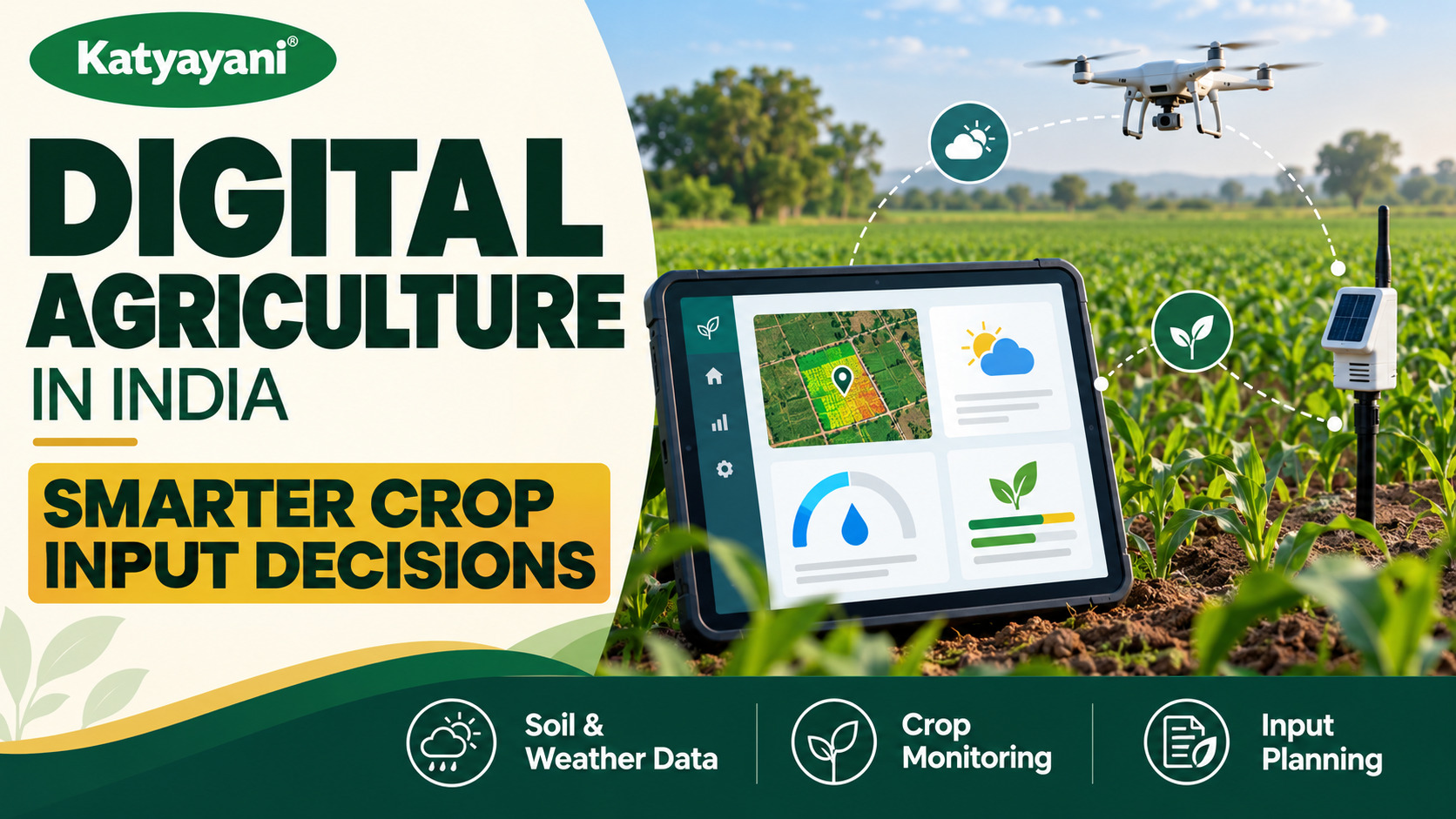
Digital Agriculture in India: How Technology Is Changing Crop Input Decisions
Digital agriculture means using phones, data, satellites, sensors and drones to decide what to put on a field, how much, and when. In India the base is public: the Digital Agriculture Mission (approved 2 September 2024, Rs 2,817 crore, seven years) is building AgriStack with a Farmer ID, a Krishi Decision Support System and soil profile maps. For a farmer, the most useful tools today are a soil test (Soil Health Card), a weather advisory app such as Meghdoot, a mandi price source such as e-NAM, and a drone service for spraying. Data does not replace local advice. It helps you choose the right input, the right dose and the right day, and avoid buying what the field does not need.