 15 min read
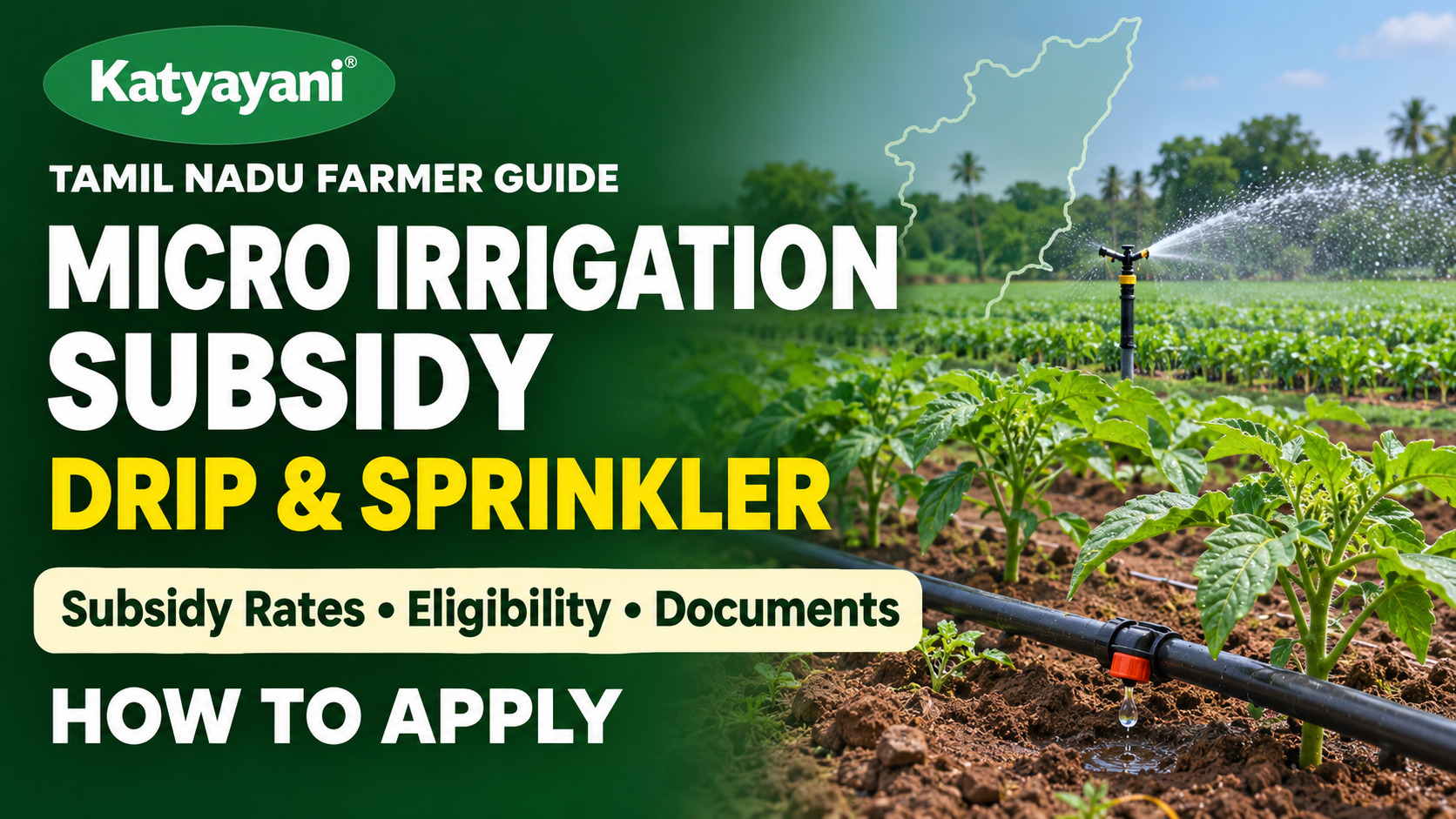
In Tamil Nadu the micro irrigation (drip and sprinkler) subsidy is shown on the department portal as 100 percent for small and marginal farmers and 75 percent for other farmers. Small and marginal farmers are covered up to 2 hectares and other farmers up to 5 hectares, and the Tamil Nadu Government absorbs the 12 percent GST on the system. The central PMKSY Per Drop More Crop pattern is 55 and 45 percent. You apply through the MIMIS portal of the Horticulture department or at the taluk Horticulture or Agriculture office, pick an approved micro irrigation firm, get a quotation and field inspection, and the firm installs the system. Other farmers pay their share. The same farm cannot claim again for 7 years. Your quotation on MIMIS shows the exact amounts before work starts.
What is the micro irrigation subsidy in Tamil Nadu?
It is a state-run scheme that pays for drip and sprinkler systems in farmers' fields, so that crops get water drop by drop or as a fine spray instead of flood irrigation. The Horticulture department runs it through the MIMIS portal, and it is linked to the central Per Drop More Crop component of PMKSY.
Micro irrigation means delivering water to the root zone through pipes, emitters or nozzles. The PMKSY guidelines define drip as irrigating plants at the root zone through emitters fitted on a network of pipes, and sprinkler as water sprayed under pressure through nozzles on HDPE pipes, simulating rainfall. The aim in both is higher water use efficiency at the farm, which is the whole point of the phrase Per Drop More Crop.
In Tamil Nadu the work is done by the Tamil Nadu Horticulture Development Agency (TANHODA), which also invites micro irrigation firms to register. The farmer deals with three parties: the department (taluk Assistant Director of Horticulture or Agriculture), an approved private firm that designs and installs the system, and the bank account where the subsidy or the balance is settled.
One caution before you read on. Rates, caps and document lists in this scheme change by government order. We quote what the official portals say today. Your block office and your MIMIS quotation give the final figure for your file.
How much subsidy do small and marginal farmers get, and how much do other farmers get?
The MIMIS portal states a 100 percent subsidy for small and marginal farmers and 75 percent for other farmers, for drip and for sprinkler. The central PMKSY pattern is lower, at 55 percent and 45 percent, so the Tamil Nadu Government pays the higher share. Other farmers therefore pay the balance, about 25 percent, themselves.
| Farmer category | Tamil Nadu rate (MIMIS) | Central PMKSY pattern | Source |
|---|---|---|---|
| Small and marginal farmer | 100 percent | 55 percent | MIMIS, PMKSY FAQ |
| Other farmer | 75 percent | 45 percent | MIMIS, PMKSY FAQ |
The Krishnagiri district page shows the same two sets of numbers side by side: it gives 100 percent for small and marginal farmers and 75 percent for big farmers, and then repeats the central 55 and 45 percent pattern. The 55 and 45 percent figures are the combined Centre and State assistance under PMKSY, and the Tamil Nadu rate is the one shown on the state portal for farmers here.
Under the central scheme, the cost is shared 60:40 between the Centre and the State for most states (90:10 for North Eastern and Himalayan states), according to the PMKSY FAQ. The subsidy is also limited to the unit costs set in the guidelines. If your system costs more than the approved unit cost, say because you add extra filters, the extra is yours, not the department's.
Read The Rate On Your Quotation: Your quotation on MIMIS shows the subsidy amount and the farmer contribution before work starts. That number, not a blog or a dealer's promise, is what you will actually pay. Ask for it in writing.
Who is a small or marginal farmer for this scheme?
The department decides this through a small or marginal farmer certificate issued by the Tahsildar, which MIMIS lists as a required document for the 100 percent rate. The certificate, not a self-declaration, decides your category. Get it first.
The practical rule is simple. If your Tahsildar office issues you a small or marginal farmer certificate, you are in the 100 percent group. If it does not, you are in the other group at 75 percent. Land holding is judged by the revenue records (chitta and adangal), so mismatched names or old joint pattas are the usual reasons for delay.
- Apply for the certificate early. It is issued by the Tahsildar, and it is the one document you cannot produce on the same day.
- Check the name on the chitta. Names, survey numbers and area should match across chitta, adangal and Aadhaar.
- Joint patta. The Horticulture page lists a co-owner no-objection letter as a requirement in some cases. Ask your block office which applies.
What is the maximum area covered by the subsidy?
The Tamil Nadu agriculture portal states that small and marginal farmers get the 100 percent subsidy up to 2 hectares and other farmers get the 75 percent subsidy up to 5 hectares. The central guidelines also set an overall ceiling of 5 hectares per beneficiary, which can be spread across one block or several locations.
The central rule in the operational guidelines says the land of a beneficiary may be in one contiguous area or at different locations, but assistance is limited to 5 hectares overall. A farmer cannot split one plot of the same crop into small pockets to claim more. If a farmer grows different crops with different spacing in separate fields, assistance is given per crop spacing, with the combined area not above 5 hectares.
For intercropping, assistance is given for only one crop of the farmer's choice, at the prescribed plant spacing. So if you grow banana with a vegetable between the rows, the system is planned and paid for as per the main crop.
Cooperative and group farming bodies, such as societies and growers' associations, can also receive assistance through their own body. Even then the individual member stays within the 5 hectare ceiling.
Which crops are covered under drip and sprinkler subsidy?
Drip is meant for wide-spaced crops such as orchards, plantation crops, banana, sugarcane and vegetables planted in rows. Sprinkler suits crops with high plant density such as cereals, pulses, seeds, spices and many field crops. The central guidelines say priority should go to water-guzzling crops. Your exact crop list is fixed in the state plan.
| System | What it suits (central guidelines) | Note |
|---|---|---|
| Drip | Row and orchard crops where plants are spaced out | Subsidy is worked out per crop spacing |
| Mini and micro sprinkler, portable and semi-permanent sprinkler | Crops with dense plant stand: cereals, pulses, seeds, spices and field crops | Assistance is capped to the cost of HDPE pipes even if you use aluminium pipes |
| Rain gun (large volume sprinkler) | Large areas; the guidelines say it is not suited to most small beneficiaries, but a farmer who wants it can claim as per rain-gun unit cost | Indicative rain-gun costs are listed per area and pipe size in the guidelines |
The older TNAU Agritech page split crops between agencies: the Agriculture department handled coconut and sugarcane in private mills, the Sugar department handled sugarcane in cooperative mills, Agricultural Engineering handled fruit trees, and Horticulture handled vegetables, flowers, spices, medicinal plants and banana. That page is from the 2007-09 era, so use it only to understand why you may be sent to a different office for coconut, sugarcane or fruit trees.
If you grow sugarcane or banana, our crop guides on sugarcane farming and G9 banana farming per acre explain the water and feeding side that a drip system is designed around.
What documents are required to apply for the micro irrigation subsidy?
The MIMIS portal lists the farmer's photograph, family card copy, chitta and adangal copies, land map, well document, water and soil test report, small or marginal farmer certificate from the Tahsildar, and Aadhaar copy. Leased land needs a registered lease of at least 7 years. Keep scans ready before you open the portal.
| Document | Why it is needed | Source |
|---|---|---|
| Aadhaar copy | Beneficiary identity; the central scheme pays by DBT and requires Aadhaar | MIMIS, central guidelines |
| Family (ration) card copy | Household identity | MIMIS |
| Chitta and adangal copy | Proof of land ownership and cultivation | MIMIS |
| Land map (FMB sketch) | Plot shape and layout for the design | MIMIS; Krishnagiri page |
| Well document | Proof of water source | MIMIS |
| Water and soil test report | Water quality and soil check before design | MIMIS |
| Small or marginal farmer certificate (Tahsildar) | Needed for the 100 percent rate | MIMIS |
| Farmer photograph (three passport photos on the Krishnagiri page) | Application record | MIMIS; Krishnagiri page |
| Registered lease agreement, minimum 7 years | Only for leased land | MIMIS; central guidelines |
| Consent letter from a nearby owner | If you have no well of your own | MIMIS |
The MIMIS list does not mention a bank passbook, but because subsidy and refunds move through bank accounts, carry the first page of your passbook anyway.
Practical tip: get the soil and water test done at the nearest agriculture office or soil testing laboratory before you apply, since it takes time and the report is a required attachment. The water test also tells you if the water is hard or salty, which decides what filter you will need. Our guide on water-soluble fertiliser for drip users covers the clogging side.
How do you apply for the micro irrigation subsidy online? Step by step
Open the MIMIS portal of the Tamil Nadu Horticulture department, choose Micro Irrigation Scheme Subsidy Registration, enter your details and upload the documents, then select drip or sprinkler and an approved firm. A quotation follows, then field inspection, work order and installation. You can also go to your taluk Horticulture or Agriculture office to register in person.
- Gather the documents listed above and scan them.
- Open MIMIS at tnhorticulture.tn.gov.in:8080, or use the link labelled Micro Irrigation (MIMIS) on the department home page. A MIMIS mobile app is also linked on the department home page.
- Register for the subsidy. Choose the type of irrigation and an approved micro irrigation firm, and submit your documents.
- Receive the price quotation. The firm and the department plan the system for your land area and the portal shows the subsidy and your contribution.
- Field inspection and approval. After inspection and your approval, a work order goes to the chosen firm.
- Installation. The firm completes the work according to the approved estimate and work order.
- Pay your share. The portal has a service to pay the farmer contribution and to track your application.
- Raise a grievance if stuck. The portal also has a complaint and grievance service.
The department home page also links the general TN-HORTNET subsidy portal and a scheme registration option in the Uzhavar app. For micro irrigation, MIMIS is the portal named for the scheme.
The two routes are the department site and your local Horticulture or Agricultural Engineering office. If the web link does not open, use the office.
Can you apply through the Uzhavan app?
The Tamil Nadu agriculture portal offers the Uzhavan app for download on Android and iOS, and the Horticulture home page lists a scheme registration option in the Uzhavar app. The scheme file itself is opened and tracked on MIMIS, so use MIMIS or your block office for micro irrigation.
The TNAGRISNET portal shows the Uzhavan app download links and an Uzhavar login page, and lists a Micro Irrigation link under its Officers Corner that points to the same Horticulture department portal. That link points to the MIMIS site, so the scheme file lives there.
So the practical answer is: the app is a good place for scheme information and registration, but the file for your drip system is opened and tracked on MIMIS. If a dealer says he has applied for you through the app, ask for the MIMIS application number and check it yourself with your Aadhaar or mobile number on the portal.
What is the process and timeline from application to subsidy release?
The portal shows four stages: application, price quotation with inspection, work order, and work completion, with SMS updates at each stage. The time each stage takes depends on your block office and the firm, and the portal keeps you updated by SMS. Subsidy under the central scheme is released electronically by Direct Benefit Transfer after the system is installed and checked.
| Stage | What happens | Who acts |
|---|---|---|
| 1. Application | Farmer chooses system, approved firm and submits documents | Farmer |
| 2. Price quotation | System planned for land area; subsidy and farmer contribution shown | Firm and department |
| 3. Work order | After field inspection and farmer approval, work order goes to the firm | Department |
| 4. Work completion | Firm installs as per the estimate and work order | Firm |
| After installation | Joint inspection, geo-tagging and subsidy release under central rules | Department |
Plan the installation well before your planting window, because inspections and approvals happen in sequence. The department keeps a record of the farmer's biometric registration and geo-tags the installed system, and joint inspection teams sample installed systems within three years of installation. If your file seems stuck, use the status search on MIMIS (by Aadhaar or mobile number, or by survey and sub-division number), then contact the Assistant Director at the taluk.
How do you choose an empanelled micro irrigation company?
Pick only from the list of approved firms shown on MIMIS. The central guidelines say a company is registered for 5 years, only BIS-marked components may be supplied, and the company must give free after-sales service for at least 3 years. Compare quotations on the portal and ask for the service centre list before you decide.
MIMIS carries the empanelled firm list, firm contact details and a service centre list, and the list changes as the Horticulture agency (TANHODA) registers new firms. The department home page currently invites new firms to apply for registration by 20 November 2026, 5 pm. Always check the current list on MIMIS.
- BIS mark. Ask to see the BIS mark on laterals, drippers, filters and fittings. The guidelines allow only BIS-marked items.
- Compare the bill of quantities. The guidelines state that the unit cost is indicative and that all compulsory components must be provided to the farmer. Check the filter, fertigation unit and valves are in the estimate.
- Service promise. Free after-sales service for 3 years, and a toll-free complaint number, are part of the central rules. Ask where the nearest service centre is.
- Do not pay cash up front for the subsidised part. Pay only your contribution through the route the portal shows.
What does the farmer actually pay, and is GST included?
Small and marginal farmers on the 100 percent rate pay nothing for the approved scope. Other farmers pay their 25 percent share, and anything above the approved unit cost. The Tamil Nadu Government absorbs the 12 percent GST on micro irrigation systems, so you do not pay it for the approved system.
The central guidelines say the unit cost for subsidy purposes is exclusive of taxes and fiscal levies. The TNAGRISNET scheme list states that the 12 percent GST applicable on micro irrigation systems is absorbed by the Tamil Nadu Government.
What To Check On The Quotation: Look for four lines: total system cost, subsidy amount, your contribution, and taxes. The approved system should carry no GST charge to you. Anything extra you add, such as extra filters, is outside the approved scope.
What is the link between the Tamil Nadu scheme and PMKSY Per Drop More Crop?
Per Drop More Crop is the micro irrigation component of the central Pradhan Mantri Krishi Sinchayee Yojana. It sets the pattern of assistance, the 5 hectare ceiling and the rules for firms. Tamil Nadu implements it through TANHODA and offers higher subsidy percentages to farmers than the central pattern.
PMKSY was launched on 1 July 2015, according to the guidelines. They state that the subsidy is paid by Direct Benefit Transfer, that Aadhaar details are needed to claim the benefit, that registration of manufacturers is open round the year for five years at a time, and that biometric registration and geo-tagging should be compulsory. The Per Drop More Crop component uses the state's own plan, drawn from district irrigation plans.
| Point | Central PMKSY rule | Tamil Nadu portal |
|---|---|---|
| Small and marginal farmer | 55 percent | 100 percent |
| Other farmer | 45 percent | 75 percent |
| Area ceiling per beneficiary | 5 hectares | 2 ha (small and marginal) and 5 ha (others), per the TNAGRISNET scheme list |
| Re-claim on same farm | After 7 years | Follow the central 7-year rule |
| Subsidy payment | DBT | Quotation, work order, completion on MIMIS |
| Firm rules | BIS-marked items, 5-year registration, 3-year free service | Firm empanelment by TANHODA |
Can tenant farmers and leaseholders get the subsidy?
Yes, if they hold a registered lease agreement of at least 7 years. MIMIS lists a registered lease agreement of at least 7 years as the document for leased land, and the central guidelines say leaseholders and contract farmers are eligible with a lease of minimum seven years from the date of approval. A verbal or annual lease will not do.
The seven-year figure matches the life of the system. The guidelines treat the projected life of a micro irrigation system as 7 years. A farmer who takes the subsidy cannot claim again for the same land until that period ends, so the lease has to cover the same period.
MIMIS also lists a consent letter from a nearby owner if you do not have a well of your own. For tenants this is often the hardest paper. Ask the neighbour early, and state in the letter that water will be shared for the area you are putting under drip.
Realistically, many tenants in Tamil Nadu have annual or informal leases. If that is you, the scheme is hard to claim. Ask your Assistant Director whether the landowner can apply, or whether a longer registered lease is possible, before you invest money in registration.
Can you claim the subsidy again? What is the 7-year rule?
Under the central guidelines, a farmer who has already taken subsidy for a farm cannot get assistance for it again for seven years, the projected life of the system. After that period the same land is eligible again. The rule is tied to the farm, so a different plot of the same farmer may still qualify, inside the 5 hectare ceiling.
This matters in two cases. First, farmers who put drip on part of their land and want to extend later: the extension counts within the 5 hectare ceiling. Second, farmers whose old system has failed early. The rule says re-eligibility comes only at the end of projected life, so a damaged system is a warranty matter with the firm, not a reason to reapply.
The old TNAU page from the earlier scheme had conditions that you may still hear about: not to sell, donate or lend the system for 3 years, and to accept official inspections for 3 years. The central guidelines also provide for joint inspection teams drawing random samples within three years of installation. Treat the three-year inspection window as a current expectation, and keep the system installed and working.
What should you do before and after installing the system?
Before: get the soil and water report, fix your crop and spacing, settle the lease and certificate, and pick the firm. After: check every component against the bill of quantities, keep the BIS-marked packing and invoices, learn flushing and filter cleaning, and keep the system running for inspection. A badly maintained system loses its benefit within a season.
- Match the estimate. Count laterals, drippers, filter and valves against the bill of quantities on the day of installation.
- Photograph the work. Take dated photos of the field, the head unit and the main line before the trenches are covered.
- Keep the paperwork. The invoice, work order and warranty card are needed if you need free service.
- Learn flushing. Flush laterals regularly and clean the filter. Hard or salty water clogs emitters fast.
- Use the toll-free number. The firm must run a complaint number and a service centre. Use them in writing if the first call is ignored.
Once the system is working, fertigation is the usual next step: feeding the crop through the drip line. Our guides on water-soluble versus granular fertiliser and mulching explain how to use the saved water well, since mulching under drip cuts evaporation further.
What other water and irrigation schemes can you combine it with?
Micro irrigation pairs well with a solar pump, a farm pond or a protected cultivation structure, each of which has its own scheme and rules. Whether two schemes can be claimed for the same land depends on the department, so ask before applying. Credit and insurance can run alongside because they are separate.
| Need | Related scheme or guide | Note |
|---|---|---|
| Pumping water without grid power | PM-KUSUM solar pump subsidy | Central scheme; state apply links differ |
| Storing water on the farm | Karnataka farm pond subsidy | Karnataka scheme; useful to understand how farm ponds work, not valid in Tamil Nadu |
| Greenhouse or shade net with drip | polyhouse and shade-net subsidy | Separate scheme, own rules |
| Working capital for installation share | Kisan Credit Card | A KCC loan can fund the farmer's share |
| Crop loss cover | weather based crop insurance | Separate cover; irrigation does not replace insurance |
| Seeing all schemes together | agriculture subsidy schemes in India, agri schemes calendar | Overview pages |
Two further guides in this water-scheme group are planned: one on watershed development under PMKSY 2.0 for rainfed farmers and one on the Atal Bhujal Yojana for groundwater management. Together with this page they cover on-farm saving, village-level watershed work and aquifer management.
For a state-process comparison, the Rajasthan guide on Raj Kisan Saathi login and subsidy status shows how another state runs online subsidy applications, which helps if you farm across state borders.
Why do some applications get delayed or rejected?
The usual causes are mismatched land records, a missing small or marginal farmer certificate, an expired or unregistered lease, no water source proof, a soil or water report not attached, and applying for land that already took the subsidy in the last seven years. Fixing the papers before you register is faster than correcting them afterwards.
| Cause | How to avoid it |
|---|---|
| Name or survey number mismatch between chitta, adangal and Aadhaar | Correct the records at the village office first |
| No small or marginal farmer certificate | Apply to the Tahsildar before registering |
| Lease shorter than 7 years or not registered | Register a seven-year lease |
| No soil and water test report | Get both tests before you register |
| Land already took the subsidy within 7 years | Check with the Assistant Director; pick a different plot |
| Choosing a firm that is not approved | Pick only from the MIMIS empanelled list |
| Pay cash outside the portal route | Pay your contribution only through the route the portal shows |
Conclusion
The Tamil Nadu micro irrigation scheme is simple on paper and fiddly in practice. The portal shows 100 percent subsidy for small and marginal farmers and 75 percent for others, against a central 55 and 45 percent pattern, with area limits of 2 and 5 hectares, GST absorbed by the state and a 7-year gap before the same farm can claim again. Get your Tahsildar certificate, soil and water reports, clean land records and a seven-year lease if you are a tenant. Then register on MIMIS, choose an approved firm, check the quotation line by line, and keep the system working for inspection. Your MIMIS quotation shows the exact amounts before any work starts.
Questions Farmers Ask
What is the subsidy for drip irrigation in Tamil Nadu?
Who is eligible for the micro irrigation subsidy in Tamil Nadu?
How do I apply for drip irrigation subsidy online in Tamil Nadu?
What documents are required for the micro irrigation subsidy in Tamil Nadu?
How much land is covered by the micro irrigation subsidy?
Is the micro irrigation subsidy 100 percent in Tamil Nadu?
Can I apply for the micro irrigation subsidy through the Uzhavan app?
Which crops get drip and sprinkler subsidy in Tamil Nadu?
How long does it take to get the micro irrigation subsidy in Tamil Nadu?
Can tenant farmers get the micro irrigation subsidy?
Can I claim the subsidy again on the same land?
How do I choose an approved micro irrigation company in Tamil Nadu?

Senior Microbiologist and Production Executive
Senior Microbiologist and Production Executive at Katyayani Organics. BSc in Biotechnology, MSc in Microbiology, 2.5 years of experience.
View all authorsRead Next in Government Schemes
Karpoori Thakur Kisan Samman Nidhi (Bihar): Amount, Documents, How to Check Status and Where to Get Official Updates

Uzhavar Sandhai (Tamil Nadu Farmers Market): How Many Markets, Who Can Sell, Farmer ID Card, Stall, Prices and Timings


Leave a Comment