 16 min read
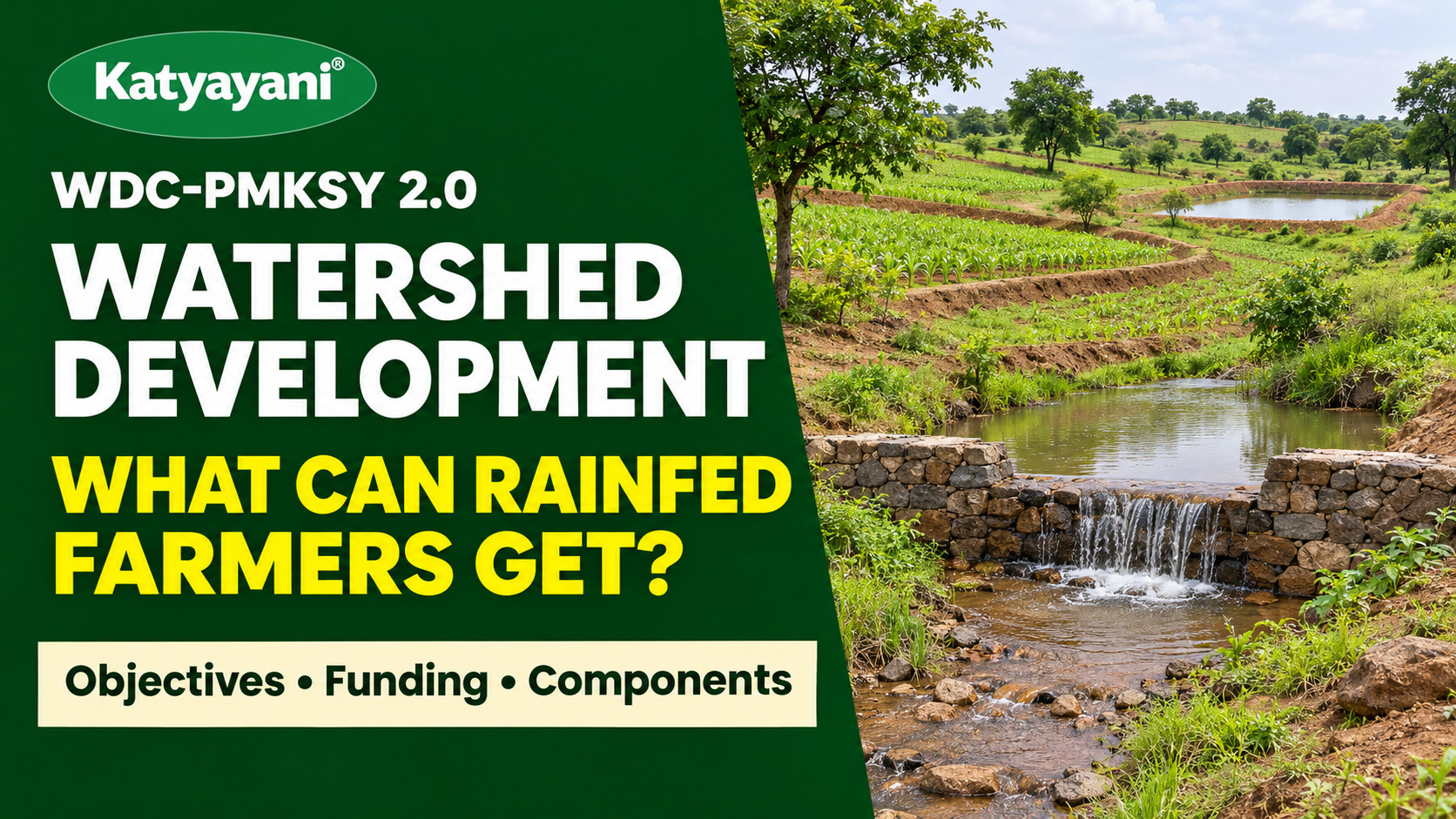
Watershed development under PMKSY 2.0 (WDC-PMKSY 2.0) is a Centrally Sponsored Scheme run by the Department of Land Resources, Ministry of Rural Development. It funds soil and water conservation, rainwater harvesting, plantations and livelihood work on rainfed and degraded land, village by village, through a Gram Sabha-backed Watershed Committee. The approved target for 2021-26 is 49.50 lakh hectares with an indicative central outlay of Rs 8,134 crore. Funding is 60:40 Centre to State (90:10 for North Eastern and hill states). The norm is Rs 22,000 per hectare in plains and Rs 28,000 in hilly and difficult areas. It is a village project, not an individual subsidy.
What is watershed development under PMKSY 2.0 (WDC-PMKSY 2.0)?
Watershed development under PMKSY 2.0 is the Watershed Development Component of the Pradhan Mantri Krishi Sinchayee Yojana. The Department of Land Resources runs it to treat rainfed and degraded land village by village, with soil and water conservation, plantations and livelihood support. The government continued it on 15 December 2021 for the years 2021 to 2026.
The official name is WDC-PMKSY 2.0, and the guidelines also call the projects "new generation watershed development projects". It replaced the older Integrated Watershed Management Programme, which was one of the schemes merged into PMKSY when it began (the PMKSY FAQ lists IWMP of the Department of Land Resources as one of the merged schemes).
The key idea is the word watershed. A watershed is the land that drains rain into one stream or tank. Treat it from the ridge down to the valley, and the water, soil and vegetation of the whole area improve together. That is why the scheme works on a cluster of villages and common land, not on one farmer's plot.
The WDC-PMKSY portal confirms the headline numbers: a project period of 2021 to 2026, a physical target of 49.50 lakh hectares, and an indicative central outlay of Rs 8,134 crore. It also says DoLR has sanctioned projects covering the entire physical target, and that central grant release is under way.
Where does watershed development sit inside PMKSY?
PMKSY has four parts: the Accelerated Irrigation Benefit Programme (AIBP), Har Khet Ko Pani (HKKP), Per Drop More Crop (micro-irrigation), and Watershed Development. The watershed part treats rainfed land to conserve soil and moisture. The other parts create canals, repair water bodies, or subsidise drip and sprinkler systems.
The PIB backgrounder on PMKSY describes the Watershed Development component as focused on managing runoff water and conserving soil and moisture through ridge area treatment, drainage line treatment, rainwater harvesting and in-situ moisture conservation on a watershed basis. The same document says the Cabinet approved PMKSY for 2021-26 with an outlay of Rs 93,068 crore, and that AIBP, HKKP and Watershed Development were approved for continuation.
| PMKSY part | What it does | Who typically uses it |
|---|---|---|
| AIBP | Funds major and medium irrigation projects and their command area | State irrigation departments |
| Har Khet Ko Pani | Surface minor irrigation, repair and renovation of water bodies, groundwater development | State water resources and minor irrigation departments |
| Per Drop More Crop | Micro-irrigation (drip, sprinkler) and farm-level water management | Individual farmers, through state agriculture or horticulture departments |
| Watershed Development (WDC-PMKSY) | Soil and water conservation, rainwater harvesting and livelihoods on rainfed land | Villages and watershed communities, through the Gram Sabha and a Watershed Committee |
In short, only one of the four, Per Drop More Crop, is mainly an individual farmer scheme. The watershed part is a community project. We explain the difference in the farmer-benefit section below.
What are the objectives of WDC-PMKSY 2.0?
The guidelines set three objectives: improve the productive potential of rainfed and degraded land through integrated watershed management, strengthen community-based institutions for livelihoods and watershed sustainability, and improve project efficiency through cross-learning and an incentive system. The guiding principles are better economy, ecology and equity in rainfed regions.
Para 3.0 of the DoLR guidelines then spells these out under three heads. On the economy side: protect farm income against drought spells through crop and livestock diversification, harvest and hold rainwater in the soil, and give all project members fair access to water. On ecology: community groups manage groundwater, soil and common resources, with low-cost technology that builds on local knowledge. On equity: shared access to the land, water and biomass created, more income chances for the landless, and women and differently-abled people taking part in village institutions.
The guidelines also explain why rainfed land gets this attention. They state that rainfed agriculture covers 51 percent of net sown area and produces 40 percent of total food, but average yield is about 1.1 tonnes per hectare against about 3 tonnes per hectare in irrigated areas. They also cite the Desertification and Land Degradation Atlas of India 2021, which puts land degradation at 97.85 million hectares, or 29.77 percent of the country's area.
What is the funding pattern for WDC-PMKSY 2.0?
The Centre and State share costs 60:40 in most states. In North Eastern and hill states the split is 90:10, and Union Territories without a legislature get 100 percent central funding. Central funds are released against each state's annual action plan, so a state must add its own share before money reaches projects.
| Region | Centre : State | Source |
|---|---|---|
| Most states | 60 : 40 | Guidelines, Para 21.0 |
| North Eastern and hill states | 90 : 10 (or as modified by government orders) | Guidelines, Para 21.0 |
| Union Territories without legislature | 100 percent Centre | Guidelines, Para 21.0 |
| Union Territories with legislature | Existing funding pattern followed | Guidelines, Para 21.0 |
Release is staged. For a five-year project the guidelines show 25, 25, 25, 15 and 10 percent of total project cost across the five years, and a three-year project gets its funds in three years. In a financial year, the first instalment is 60 percent of the annual action plan after adjusting unspent balance, and the second comes after the state has spent 90 percent of its opening balance and at least 50 percent of the first instalment.
Every state must send its annual action plan to the national nodal agency by the end of February, and certify that it will put in its matching share. Interest earned on released funds must be remitted back to the Consolidated Fund of India, and it cannot be adjusted against future releases.
How much money does a watershed project get per hectare?
The unit cost is Rs 22,000 per hectare in plain areas and Rs 28,000 per hectare in hilly and difficult (desert) areas, and up to Rs 28,000 per hectare in LWE and IAP districts. States may spend more than this, but the extra must come from state funds or from convergence with other schemes.
These norms are the basis for each project's DPR. The guidelines add that the cost norm is expected to cover in-situ and ex-situ soil and water conservation on private land, integrated farming systems, livelihood support, secondary agriculture, crop alignment, climate adaptation and strengthening FPOs. Large water harvesting works on community land, plantations on common land and similar items are expected to come mostly from MGNREGS and afforestation schemes.
| Illustration (our arithmetic) | Plain area at Rs 22,000/ha | Hilly area at Rs 28,000/ha |
|---|---|---|
| Typical project of 5,000 hectares | Rs 11 crore | Rs 14 crore |
| Maximum administration at 10 percent, per hectare | Rs 2,200 | Rs 2,800 |
| Natural resource management at 47 percent, per hectare | about Rs 10,340 | about Rs 13,160 |
| Central share per hectare at 60 percent (plains) or 90 percent (hill) | Rs 13,200 | Rs 25,200 |
The 5,000-hectare size is an average used in the guidelines for staffing: they provide one Watershed Development Team for each project covering an average area of 5,000 hectares. The money illustration is only arithmetic on the official norm. Real project sizes and costs are fixed by each state and appear in the sanctioned DPR.
How is the project budget split between heads?
The guidelines fix a percentage budget: 10 percent administration, 2 percent monitoring and evaluation, 6 percent for the preparatory phase, 79 percent for the works phase and 3 percent for consolidation. The works phase is the big one, with 47 percent for natural resource management and 15 percent each for production systems and livelihoods.
| Head | Sub-head | Share of budget |
|---|---|---|
| Administrative management | PIA, committee costs, Secretary's salary | 10 percent |
| Monitoring and evaluation | 2 percent | |
| Preparatory phase | Entry point activity | 2 percent |
| Preparatory phase | DPR preparation | 1 percent |
| Preparatory phase | Institution and capacity building | 3 percent |
| Works phase | Natural resource management | 47 percent |
| Works phase | Production system | 15 percent |
| Works phase | Natural resource management and governance | 2 percent |
| Works phase | Livelihood activities for the asset-less, micro enterprises, business development | 15 percent |
| Consolidation and withdrawal phase | 3 percent | |
| Total | 100 percent |
Para 20.4 of the guidelines also lets states keep up to 25 percent of the annual scheme outlay as a flexi-fund for local needs, innovations or relief after natural calamities, subject to approval of the state sanctioning committee. Savings in any sub-head, except institution and capacity building, can be moved to other heads with SLNA approval, but not into administration.
One rule worth knowing: buying vehicles and equipment and constructing buildings is strictly prohibited. Computers and related software are allowed. This stops the money from being spent on offices and cars instead of fields.
What work is done in a watershed project? (Components)
A project works on three streams together: ecosystem regeneration and production, natural resource governance, and services and livelihoods. On the ground that means field bunds, contour bunds, terracing, farm ponds, check dams, fodder and horticulture plantations, pasture, integrated farming systems, climate-risk tools and income activities for landless families.
Para 19.2.4 of the guidelines lists the suggested works. In plain words:
- Land development and in-situ moisture conservation: field bunds, contour and graded bunds with plantation, terracing in hills, and drainage management.
- Multi-purpose trees and nurseries: fodder, nitrogen-fixing and biomass trees, with local species given priority.
- Integrated Farming System models: crops, horticulture, livestock and agro-forestry planned on a water budget.
- Pasture development, veterinary services and, where water lasts, fisheries in tanks and ponds designed after a hydro-geological check.
- Crop alignment and demonstrations: new crops and varieties, soil health card-based nutrient management, micro-irrigation and practices that cut pest, disease and weather risk.
- Climate-risk tools: custom hiring centres, portable micro-irrigation, drought and flood tolerant varieties, protected cultivation, seed banks and fodder banks.
- Secondary agriculture and livelihoods: value addition, and for landless people, mushroom, bee-keeping, backyard poultry, compost making and small ruminants.
- Energy saving and bio-fuel plantations, where they suit local conditions.
The guidelines also ask projects to protect marked common land such as pasture and forest land from open grazing and use for at least three years while it regenerates, and to arrange fodder meanwhile.
Hilly states get one more item: spring-shed development. The guidelines note that nearly half of an estimated 4 to 5 million springs have been drying up, and the PIB backgrounder confirms the 2021-26 programme includes a specific provision for spring-shed development.
Who benefits from WDC-PMKSY 2.0, and who is eligible?
The scheme targets rainfed, degraded and drought-prone areas and the people living in them. Farmers with land inside a sanctioned watershed benefit through soil and water works, and landless families benefit through livelihood funds, wages and group enterprises. Eligibility is by village and watershed, not by an individual application.
Equity is built into the design. The guidelines say project data must be recorded separately for landless people, small and marginal farmers, women and SC/ST members, and the third objective is to improve conditions for the resource-poor, asset-less, differently-abled and women. A fixed 15 percent of the project budget is set aside for livelihoods of the asset-less.
| Group | How it benefits |
|---|---|
| Small and marginal farmers on rainfed land | Soil and moisture works on private land, access to water structures, crop and farming-system demonstrations, a lower contribution rate (5 percent of NRM work cost) |
| Landless families | Livelihood activities, micro-enterprises through SHGs, wage work on project works, a share in common-land produce |
| Women | At least two seats on the Watershed Committee, a woman Chair or Co-Chair, SHG-based enterprises, nursery work |
| SC/ST families | At least two seats on the Committee, lower contribution rate, priority in area selection criteria |
| Livestock keepers | Pasture development, fodder banks and veterinary services |
| Farmers with irrigated land already | Limited direct gain. They may benefit indirectly through better groundwater recharge in the same watershed |
How are watershed areas and projects selected?
Projects are taken up mainly in the most vulnerable rainfed districts, by ranking micro-watersheds. Selection looks at how often drought occurs, drinking water scarcity, groundwater over-use, degraded land, falling vegetation index, soil and aquifer status, crop productivity, social backwardness and whether the village community is willing to contribute and follow rules.
Para 16.0 of the guidelines lists the criteria that may be used:
- Frequency of drought occurrence
- Acute scarcity of drinking water and degree of over-exploitation of groundwater
- Share of degraded land and wasteland
- Decline in the Normalized Difference Vegetation Index (NDVI)
- Soil health, aquifer characteristics and topography
- Surplus runoff from the watershed and contiguity to an already treated watershed
- High proportion of SC/ST and other socially and economically backward population
- Low productivity of major crops compared with district or state average
- Willingness of the village community to make voluntary contributions, adopt rules for common property and share benefits fairly
The last point is the one farmers can influence. A village that is ready to contribute to the Watershed Development Fund and agree on water-use rules is more likely to fit the criteria. Funds are allocated to districts using the state's perspective plan, the share of net rainfed cultivated area, and the share of wasteland, degraded and panchayat land.
The guidelines also name the National Rainfed Area Authority, under the Ministry of Agriculture and Farmers Welfare, as the knowledge partner that helps prioritise areas using a composite index.
How does a watershed project run? The three phases
A project lasts three to five years in three phases. The preparatory phase (up to one year) builds committees, data and the plan. The works phase (two to three years) carries out the soil, water, production and livelihood work. The consolidation phase (up to one year) hands over assets and withdraws support.
| Phase | Duration | Main activities |
|---|---|---|
| I. Preparatory | Up to 1 year | Community mobilisation, Watershed Committee, FPO and SHG formation, baseline survey and mapping, Participatory Watershed Development Plan, DPR, entry point activity |
| II. Works | 2 to 3 years | Land development, water harvesting, plantations, farming-system demonstrations, livelihood activities, institution strengthening |
| III. Consolidation and withdrawal | Up to 1 year | Completion of works, handover of assets to the Gram Panchayat, strengthening of user groups and FPO, project closure |
The plan is built by the village with technical help from the project team. The Participatory Watershed Development Plan shows year-wise actions, goes to the Gram Sabha for approval, and then goes to the district Watershed Cell cum Data Centre (WCDC) for sanction. Before the plan is submitted, the FPO, user groups and SHGs must already be in place and their profile included.
Mapping is done on a 1:5,000 or 1:10,000 scale, and the DPR is based on GIS layers. District and state authorities check geo-tagged locations using GIS and remote sensing. The portal links to a Bhuvan-based tool called Srishti-WDC 2.0 for this tracking.
Who runs the project on the ground? PIA, WDT and Watershed Committee explained
Three bodies share the work. The Project Implementing Agency (PIA) is the organisation chosen to run the project. The Watershed Development Team (WDT) is its technical team, with at least four members. The Watershed Committee (WC), set up by the Gram Sabha, takes the main responsibility for planning and carrying out the work.
The PIA can be a line department, a government institute, a Panchayat, a voluntary organisation, or a CSR-backed development agency. Private and NGO applicants must be registered for at least five years with a record of watershed or natural resource work, among other conditions. The WDT must include at least one woman and cover agriculture, forestry, soil health, water management and community mobilisation, and no fund can be released to the PIA or committee unless a WDT is in place.
Who sits on the Watershed Committee?
The Gram Sabha forms the committee, either as a registered society or as a sub-committee of the Gram Panchayat chaired by the Sarpanch. It has a minimum of eleven members including the Secretary: five from user groups and SHGs, three from the FPO, one Gram Panchayat member and one from the WDT. At least two must be women and at least two SC/ST. The Chair or Co-Chair must be a woman.
What does the committee do?
It approves works as per the DPR and state rates, keeps a joint bank account, submits utilisation certificates, supports user groups, SHGs and the FPO, does a twice-yearly water budgeting exercise to set water-use rules, and finally hands the assets to the Gram Panchayat. The Secretary is a paid local resource person whose pay comes from the administrative head.
What are user groups, SHGs and FPOs in a watershed project?
User groups are small groups of people who share one resource, such as a pond, pasture or irrigation source, and agree rules for using and maintaining it. SHGs run livelihood activities and credit. The FPO is the member-owned business body that handles inputs, marketing and services. Together they carry the project after funding ends.
The guidelines say the Watershed Committee should set resource-use agreements among user groups before an activity starts, based on equity and sustainability, and user groups are responsible for keeping to those norms and maintaining the asset. For example, a decision to develop a pasture can involve the ratio of fodder trees to grasses and the species chosen.
On FPOs, the guidelines ask the PIA to form or strengthen an FPO as an entry point activity. It is registered once it reaches a threshold of 300 to 500 memberships with paid share capital. If you want to understand which body suits which purpose, our post on SHG vs FPO compares them, and the FPO Credit Guarantee Scheme explains one source of loans for an FPO.
What must farmers contribute? The Watershed Development Fund
Villages must put in a contribution to a Watershed Development Fund (WDF). Under the guidelines a farmer pays 10 percent of the cost of natural resource management works done on private land, or 5 percent if the farmer is SC/ST or a small or marginal farmer, in cash or as voluntary labour. The fund later pays for repair and upkeep of common assets.
Para 26.1 of the guidelines calls this contribution a mandatory condition for selecting villages. The money sits in a separate bank account operated jointly by the Gram Panchayat chair and a PIA representative. It is usually invested in long-term deposits, and the committee can use it for eligible activities from the third year.
A second, higher rate applies to individual livelihood activities on private land, such as horticulture, animal husbandry, agro-forestry or aquaculture (Para 26.9). There the beneficiary pays 20 percent of the activity cost, or 10 percent for SC/ST members, and the project fund adds no more than twice the per-hectare cost norm. Both contributions go into the Watershed Development Fund. Ask your district WCDC for the exact rate and the state order that applies in your project.
The fund cannot be used for activities on private land that benefit only one person. When an asset is built on private land, the committee signs an agreement with the owner that the asset will serve the community, and the Gram Panchayat keeps the record.
What can an individual farmer actually get from a watershed project?
A farmer does not receive a cash subsidy. The benefits come as works and services: soil and moisture conservation on your field, access to water harvesting structures, plantation support, farming-system demonstrations, training and FPO membership. The value is better soil moisture and a more reliable crop, plus income options for the family.
- On-farm soil and water work: bunds, terraces and other in-situ moisture conservation, as the project plan decides for your plot.
- Shared water assets: ponds, check dams and recharge structures, which user groups manage by agreed rules.
- Crop and farming-system advice: demonstrations on new crops, varieties and soil health card-based nutrient plans. Read our guide on how to read your soil health card before the first meeting.
- Climate-risk tools: custom hiring centres, seed and fodder banks, and drought or flood tolerant varieties.
- Income options: livestock support, nurseries, mushroom, bee-keeping and other group enterprises, mainly for landless and weaker households.
- Collective marketing: membership in the project FPO.
The guidelines expect the projects to produce results like higher cropping intensity, more protective irrigation and more family income. Para 5.0 sets success criteria, but the exact figures for any one project sit in its DPR, so ask for that document at the Gram Sabha.
How can a village or farmer apply or take part?
The guidelines do not describe an individual application form. Projects are sanctioned by the state for selected watersheds, and the village takes part through the Gram Sabha, Watershed Committee, user groups and SHGs. Farmers should ask the Gram Panchayat, the block agriculture office or the district Watershed Cell cum Data Centre whether their watershed is on the state list.
- Ask the Gram Panchayat or block office if a WDC-PMKSY 2.0 project is running or planned in your micro-watershed.
- If yes, attend the Gram Sabha meetings where the Participatory Watershed Development Plan is discussed. This is where you can ask for works on your land.
- Join the relevant user group, SHG or FPO. Women and SC/ST members have reserved committee seats.
- Record your WDF contribution (cash or labour) and keep the receipt.
- Check progress on the project portal and ask the Secretary for the asset and works register.
The project list is decided at the state level, so the district Watershed Cell cum Data Centre is the place to confirm whether your micro-watershed is on it.
How is WDC-PMKSY 2.0 linked to Per Drop More Crop?
Per Drop More Crop is the micro-irrigation part of PMKSY. It subsidises drip and sprinkler systems for individual farmers. The watershed guidelines ask projects to converge with it, so that water stored in ponds and tanks is used through micro-irrigation and low-water-duty crops. The two schemes are separate and apply separately.
The guidelines say the Participatory Watershed Development Plan should be harmonised with the District Irrigation Plans under PMKSY, and that the convergence to promote is Per Drop More Crop, to raise water use efficiency by linking water bodies to micro-irrigation systems and by promoting low-water-duty crops and varieties. They also suggest linking PM-KUSUM solar pumping with the protective irrigation plan; read our post on PM-KUSUM solar pump subsidy for that.
For the subsidy itself, the rate depends on the farmer category and the state, so ask your state agriculture or horticulture department for the current pattern. Our planned post on micro-irrigation subsidy in Tamil Nadu covers one state in detail.
| Point | WDC-PMKSY 2.0 (watershed) | Per Drop More Crop |
|---|---|---|
| Run by | Department of Land Resources (Rural Development) | Agriculture and horticulture departments |
| Who applies | Village, through Gram Sabha and Watershed Committee | Individual farmer, through state portal |
| What you get | Soil and water works, plantations, livelihoods | Subsidy on drip, sprinkler and similar systems |
| Money flows to | Project account of the Watershed Committee | Farmer, by DBT after installation |
| Best for | Rainfed clusters with degraded land | A farmer with a water source and a crop to irrigate |
How is WDC-PMKSY 2.0 different from Atal Bhujal Yojana?
Atal Bhujal Yojana was a separate Central Sector pilot scheme of the Ministry of Jal Shakti for community-led groundwater management in seven states, with water budgeting and village water security plans. It closed on 15 October 2025. WDC-PMKSY 2.0 is a Centrally Sponsored Scheme of the Rural Development ministry that treats rainfed land. Both relied on village institutions and can complement each other.
| Point | WDC-PMKSY 2.0 | Atal Bhujal Yojana |
|---|---|---|
| Ministry | Rural Development (DoLR) | Jal Shakti |
| Scheme type | Centrally Sponsored Scheme, 60:40 / 90:10 | Central Sector Scheme, 50 percent World Bank loan and 50 percent central assistance, passed to states as grants |
| Focus | Soil and water conservation, rainfed land, livelihoods | Groundwater management, water budgeting, demand-side measures |
| Where | Rainfed districts across India | Seven states: Gujarat, Haryana, Karnataka, Madhya Pradesh, Maharashtra, Rajasthan, Uttar Pradesh |
| Outlay and period | Rs 8,134 crore indicative central outlay, 2021-26 | Rs 6,000 crore; implemented 1 April 2020 to 15 October 2025 as a pilot, now closed |
| Village unit | Watershed Committee | Gram Panchayat water security plan, Water User Associations |
The PIB backgrounder on Atal Bhujal Yojana says it was approved on 24 December 2019 and lists micro-irrigation and crop diversification among its demand-side measures. As reported by the Ministry of Jal Shakti to Parliament on 30 July 2026, it was implemented as a pilot from 1 April 2020 to 15 October 2025 across 8,203 gram panchayats in 229 blocks of 80 districts, with a minimum of 33 percent women in active decision-making.
The WDC-PMKSY guidelines do not name Atal Bhujal, so the link between them is ours: both want groundwater demand managed locally. A village in a former Atal Bhujal area that also has a watershed project can use the watershed works for recharge and its existing water security plan for budgeting. Our planned post on Atal Bhujal Yojana covers the groundwater scheme in detail.
What progress has WDC-PMKSY 2.0 reported so far?
The scheme portal shows cumulative progress against the 49.50 lakh hectare target: about 11.29 lakh hectares of degraded or rainfed land covered, about 1.28 lakh water harvesting structures created or rejuvenated, about 3.43 lakh hectares added under protective irrigation and about 24.9 lakh farmers benefited. These are the portal's own totals, with an update date of 05/10/2026.
| Indicator on the portal | Figure shown | Rounded |
|---|---|---|
| Soil and moisture conservation area | 332,721.50 ha | about 3.33 lakh ha |
| Plantation area (horticulture and afforestation) | 149,028.34 ha | about 1.49 lakh ha |
| Water harvesting structures created or rejuvenated | 128,435 | about 1.28 lakh |
| Additional area under protective irrigation | 342,832.29 ha | about 3.43 lakh ha |
| Degraded land covered and rainfed area developed | 1,129,206 ha | about 11.29 lakh ha |
| Employment generated | 28,934,954 mandays | about 2.89 crore mandays |
| Farmers benefited | 2,494,492 | about 24.9 lakh |
The portal home page also links dashboards for MIS, mid-term evaluation, Watershed Yatra, Watershed Mahotsav and target-versus-achievement. For comparison, the PIB backgrounder states the 2021-26 goal of bringing an additional 2.50 lakh hectares under protective irrigation, and the portal figure for that line is already above it. These are administrative figures, not an independent evaluation. The mid-term evaluation dashboard is the place to look for outcome results.
What can you do on your own farm to complement a watershed project?
Watershed works hold water in the landscape, but your own field practices decide how much of it your crop uses. Keep the soil covered with mulch, build organic matter, follow a soil test, rotate crops, and match crop choice to the rainfall you get. These steps support the same goal as the scheme: more water kept in the soil.
- Cover the soil. Mulch cuts evaporation and runoff; see our guide to the benefits of mulching, types and depth.
- Know your soil. Black, red and alluvial soils hold water differently; the post on types of soil in India helps you plan crops and moisture work.
- Rotate crops. A cereal-pulse rotation spreads risk in dry years; see crop rotation examples and plans.
- Insure the risk that remains. Rainfed crops stay exposed to rainfall shocks, so read about PM Fasal Bima Yojana and weather based crop insurance.
- Add farm-level storage where schemes allow. Karnataka's farm pond scheme is one state example; see Krishi Bhagya farm pond subsidy.
- If you irrigate with drip, plan fertigation properly; our water-soluble fertilizer guide for drip users explains what to buy.
For a wider list of central and state schemes with their eligibility, our agriculture subsidy schemes in India guide is the hub post.
What are the limits and common problems of watershed projects?
Watershed projects work only when the village runs them. Common problems are weak community buy-in, delays in state matching funds, poor upkeep after handover, and fields outside the project boundary that miss out. The guidelines try to address these with the Watershed Development Fund, user group agreements and a staged fund release.
- Matching share: central funds flow only if the state adds its share, so a state that is slow on funds slows the project.
- Upkeep: assets are handed to the Gram Panchayat. The WDF exists to pay for repair, but it can be used for eligible activities only from the third year.
- Boundaries: benefits follow the watershed map, so a field just outside the sanctioned area may not get works.
- Cost norm limits: the per-hectare norm is modest, which is why the guidelines push convergence with MGNREGS for larger structures.
- Data quality: the portal reports activity totals, not independent results. Ask for the mid-term evaluation of your state.
The current phase runs for 2021 to 2026. The Department of Land Resources portal is where any successor phase will be announced.
Conclusion
WDC-PMKSY 2.0 is a village-level scheme for rainfed land, funded 60:40 by the Centre and States (90:10 in North Eastern and hill states) at Rs 22,000 to Rs 28,000 per hectare, and run through a Gram Sabha-backed Watershed Committee. A farmer gains through soil and water works, shared water assets, training and group enterprises, not through a cash subsidy. To benefit, find out whether your micro-watershed is sanctioned, attend the Gram Sabha, join a user group, SHG or FPO, and use Per Drop More Crop separately for drip or sprinkler subsidy.
Questions Farmers Ask
What is WDC-PMKSY 2.0?
What is the funding pattern of watershed development under PMKSY 2.0?
How much money is given per hectare under WDC-PMKSY 2.0?
What are the objectives of the watershed development component of PMKSY?
Who benefits from the watershed development scheme?
How long does a watershed project under PMKSY 2.0 last?
What is a Watershed Committee and who are its members?
Does a farmer have to pay anything under WDC-PMKSY 2.0?
Can I apply individually for the watershed scheme?
What is the difference between watershed development and Per Drop More Crop?
How is WDC-PMKSY 2.0 different from Atal Bhujal Yojana?
What works are carried out in a watershed project?

Senior Microbiologist and Production Executive
Senior Microbiologist and Production Executive at Katyayani Organics. BSc in Biotechnology, MSc in Microbiology, 2.5 years of experience.
View all authorsRead Next in Government Schemes
Karpoori Thakur Kisan Samman Nidhi (Bihar): Amount, Documents, How to Check Status and Where to Get Official Updates

Uzhavar Sandhai (Tamil Nadu Farmers Market): How Many Markets, Who Can Sell, Farmer ID Card, Stall, Prices and Timings


Leave a Comment