 15 min read
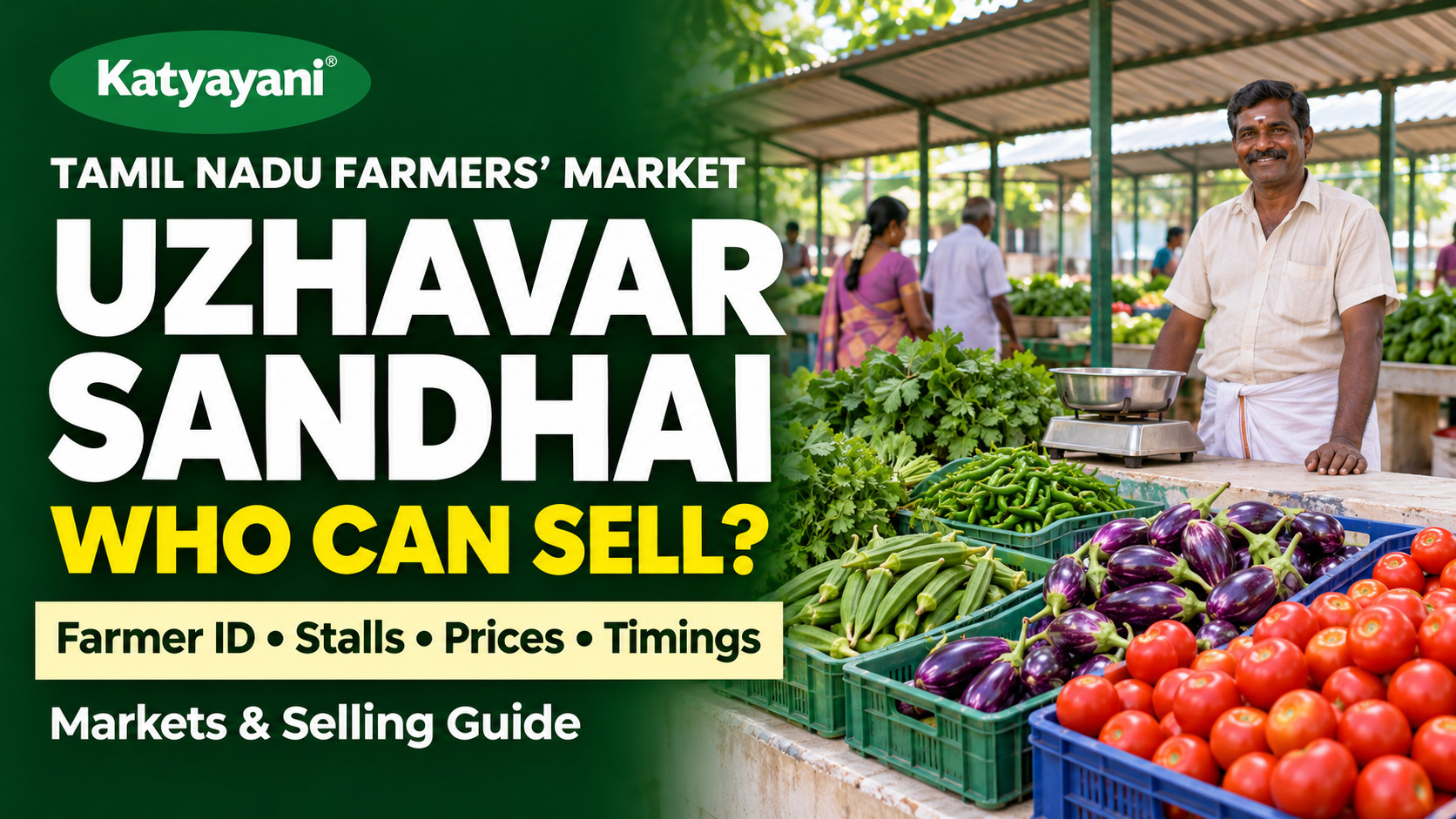
Uzhavar Sandhai means "farmers' market" in Tamil. It is a Tamil Nadu government scheme, started in 1999, where identified farmers sell their own vegetables and fruits directly to buyers, with no commission and a free shop. To sell, you need the photo identity card issued through the Horticulture Department process and you approach the Agricultural Officer of the nearest Sandhai. Prices are fixed daily by a committee, roughly above wholesale and below retail. The market count is not settled: official pages say 103, 131 and 141, a 2022 report says 180. Confirm today's count, hours and rent at your local market office.
What is Uzhavar Sandhai?
Uzhavar Sandhai (also spelt Uzhavar Santhai) means farmers' market in Tamil. It is a Tamil Nadu government scheme in which identified farmers sell their own vegetables and fruits directly to the public, with no middleman in between. The Agricultural Marketing and Agri Business Department runs it, and an officer sits in each market.
The TNAU page on the farmers market lists the aims in plain words: direct contact between farmers and the public, fresh vegetables and fruits every day at reasonable prices, correct weighing for buyers, a better price for the farmer than the wholesale rate, and a place where farmers can pick up technical advice and training. Some markets also give out seeds and other inputs.
In short, it sits between two ends. The farmer earns more than the wholesale rate, and the buyer pays less than the retail shop. That gap is what the scheme is built to create.
When did Uzhavar Sandhai start, and how has it changed?
The scheme began in 1999. The first market opened at Madurai on 14 November 1999 and the 100th at Pallavaram on 14 November 2000. TNAU records 103 markets by 30 April 2001. Twenty-eight closed between 2001 and 2005 and were reopened in June 2006 after renovation.
| Date | What happened | Source |
|---|---|---|
| 14 Nov 1999 | First Uzhavar Sandhai opened at Madurai | TNAU |
| 14 Nov 2000 | 100th market opened at Pallavaram | TNAU |
| 30 Apr 2001 | 103 markets established | TNAU |
| 2001 to 2005 | 28 markets closed | TNAU |
| June 2006 | Closed markets reopened | TNAU |
| March 2022 | About 180 markets reported working; Rs 15 crore for upgrades in that year's budget | Inmathi |
| May 2023 | Traditional food stalls approved in 25 markets | DT Next |
| 6 Aug 2026 | Rs 20 crore for renovation announced in the 2026-27 agriculture budget | DT Next |
The closure period is a useful reminder. A farmers' market needs steady footfall and steady supply. When either fades, the market empties, which is still the main risk today.
How many Uzhavar Sandhais are there in Tamil Nadu?
There is no single current official number that I could open. Government pages give 103, 141 and a 131-row list, while a 2022 news explainer reported 180. Treat 180 as the latest figure I found, say "around 180" if you must quote, and ask the Agricultural Marketing office in your district for the live list.
| Figure | Source | How old |
|---|---|---|
| 103 markets "currently functioning" | TNAU Farmers market page | Undated; matches the 2001 total |
| 141 markets functioning | TNAU citizen charter PDF | File dated 2009 |
| 131 rows in the list | TNAU list of Uzhavar Sandais | Undated; district column empty |
| 180 markets | Inmathi | 25 March 2022 |
| "More than 190" | A commercial blog (BigHaat) | Not sourced there, so not used here |
Why do the numbers differ? Markets were closed and reopened, new ones were added, and different pages were written in different years. A count from one page tells you the year it was written, not today's position. For the count in your district, ask the Agricultural Marketing office.
Where are the Uzhavar Sandhais located?
They are in towns and cities across Tamil Nadu, mostly in urban areas near bus stands and municipal land. The TNAU list names the markets, but its district column is empty, so I cannot give a reliable district-wise count. For your own area, ask the district Agricultural Marketing office.
The TNAU citizen charter says the markets have been set up in the urban areas of Tamil Nadu. The TNAU list is the nearest thing to an index. It runs to 131 rows and starts with Kanchipuram district entries such as Pallavaram, but the district names are missing for the rest, so do not use it to count markets per district.
Some districts are named in reports. The 2023 order on food stalls named these districts for the first phase of 17 markets: Coimbatore, Dindigul, Erode, Kanyakumari, Kallakurichi, Krishnagiri, Madurai, Nilgiris, Perambalur, Pudukkottai, Ramanathapuram, Salem, Theni, Tirunelveli, Tiruppur, Tiruchirappalli and Vellore (DT Next). That tells you where markets exist, not how many each district has.
The 2022 Inmathi explainer noted that markets sit on land given by local bodies, and that some suburban markets draw few buyers. In that report, six markets were due to move to more accessible sites: Kothagiri, Veppanthattai, Panruti, Chidambaram, Keelpennathur and Thiruvarur. Locations can change, so confirm the address before you travel.
Who can sell at Uzhavar Sandhai?
Only identified farmers who grow vegetables and fruits and hold the identity card issued through the Horticulture and Plantation Crops route can sell. The produce must come from the farmer's own land. Traders and middlemen are not the intended sellers; the scheme exists to remove them.
The TNAU citizen charter lists the eligibility in one line: farmers cultivating vegetables and fruits who possess the identity cards issued by the Department of Horticulture and Plantation Crops. The TNAU farmers market page adds that Horticulture officials identify vegetable-growing farmers in villages and that the card is issued on the recommendation of a team.
- Vegetable and fruit growers with the identity card can sell their own produce.
- Hill vegetables are sold through women's self-help groups and cooperative societies, according to TNAU.
- FPOs and women SHGs appear in the 2022 Inmathi report as shop holders, with their own rent amounts.
- Aavin and Tan Tea stalls are set up in some locations (TNAU).
If you are a grain, pulse or oilseed grower, the scheme is not built for your crop. Look at the regulated market route in the comparison section further down.
How do you get the Uzhavar Sandhai farmer ID card?
The card is issued after the Horticulture Department identifies you as a vegetable or fruit grower and a team recommends you. Start by meeting the Agricultural Officer at your nearest Uzhavar Sandhai or the district Agricultural Marketing office. Ask the officer which form and documents they need.
TNAU describes the card as carrying the land owner's photo and the nominee's photo, the village name, survey number, extent of land and the vegetables grown. It must be renewed every six months, based on the vegetables grown (TNAU). The citizen charter names the officers to approach: District Collectors, the Deputy Director of Agriculture (Agri Business), the Secretary of the Market Committee, or the Agricultural Officer of the Uzhavar Sandhai (TNAU charter).
- Go to the Agricultural Officer at the nearest Uzhavar Sandhai, or the Deputy Director of Agriculture (Agri Business) in your district.
- Tell them the crops you grow and the land you hold (village, survey number, extent). Keep your land record ready.
- Expect an officer or a Horticulture team to identify you as a grower.
- Carry photographs of yourself and your nominee, since both appear on the card.
- Collect the card, and note the market where it is valid and when it must be renewed.
Documents: Ask First: The exact document list is not published on the official pages I could open. Land records, an ID proof and photographs are the usual things officers ask for, but confirm with your officer before you travel. The charter itself says there is no time limit for sanction or rejection, so follow up politely if the card is delayed.
Do not confuse this card with the national Farmer ID under AgriStack. They are different. Our post on the Digital Agriculture Mission and AgriStack farmer ID explains the national one.
How do you get a stall (shop) at an Uzhavar Sandhai?
Once you hold the card, you take a shop on the day you sell. TNAU says shops are free of cost, allotted first come first served or by lots, and are not permanent. So you reach the market office on selling days, show the card and get a shop. Ask locally whether any rent applies in your market.
TNAU says no fee is charged for the shop. Some stalls and arrangements may carry their own charges, so ask the market's Agricultural Officer what applies to the shop you want before you start.
| Source | What it says about shop cost | Date |
|---|---|---|
| TNAU Farmers market | Shops allotted free of cost; first come first served or lots; not permanent | Undated |
| Inmathi | FPOs Rs 1,500 and women SHGs Rs 1,000 for shops | March 2022 |
| DT Next, Tiruvallur | A vendor cited Rs 4,500 monthly rent as hard to pay | April 2024 |
My advice: ask the Agricultural Officer for the current rule in writing or on the notice board, and do not pay anyone outside the market office. The point of the scheme is that the farmer sells without paying a trader's cut.
How are Uzhavar Sandhai prices fixed?
A daily committee of farmer representatives and officials fixes the rates. TNAU gives the rule as about 20% above the wholesale price and 15% below retail, and in another section as 20 to 25% above wholesale. Prices are displayed in front of each shop, and an officer checks that goods sell at the fixed rate.
The TNAU page describes the process. The market committee collects the moderate wholesale prices each morning, reported between 7:30 and 8:00 AM. The fixed prices are then shown in front of every shop, on large signboards and announced over a public address system. The Administrative Officer monitors sales at the fixed prices.
| Question | Answer from TNAU | Note |
|---|---|---|
| Who fixes the price? | A committee of farmer representatives and officials | Daily |
| Against what? | Wholesale and retail rates | Wholesale rate comes from the morning market report |
| How far above wholesale? | About 20% (salient features), or 20 to 25% (facilities) | The same page gives both |
| How far below retail? | About 15% | Only stated in the salient features |
| Where is it shown? | At each shop, on signboards and by announcement | Check the board before you buy |
Important: the percentages are a design rule from the TNAU page, not a guarantee for today's tomato rate. Actual prices move daily. Compare the board price with your nearby shop on the same day before you assume it is cheaper.
What are the Uzhavar Sandhai timings?
TNAU says the markets operate on all days of the week but gives no opening or closing hours. In practice, they run in the morning, and some run an evening session. Hours differ by market and have been changed locally, so check at your own Sandhai.
Two dated examples show the variation. The 2023 order on traditional food stalls set stall hours at 4 am to 1 pm (DT Next). In Tiruvallur, the market closed at 4 pm, vendors said their best sales were between 6 pm and 9 pm, and an officer said market hours were extended from 4 pm to 8 pm (DT Next). The food stall hours apply to those stalls only.
Practical tip: vegetables sell fastest in the early hours, when buyers come before work. If you are a farmer, plan harvest so produce reaches the market at opening time.
What facilities do farmers get at an Uzhavar Sandhai?
Farmers get a free shop, free weighing scales against a token, storage for unsold produce, and transport tie-ups with the state transport department. Most markets also have drinking water, toilets and security. Some give seeds, seedlings, organic farming guidance and post-harvest training. Facilities vary by market.
- Weighing: free scales are issued on a token at entry and returned after sales (TNAU).
- Transport: registered farmers can bring produce on special trips of the state transport department without luggage fare (TNAU). Ask whether this runs on your route.
- Storage: unsold items can be stored to sell the next day (TNAU).
- Civic facilities: drinking water, toilets, a canteen, drainage, a vehicle stand and security are listed (TNAU).
- Waste: plastic boxes collect rotten produce, and some markets compost vegetable waste (TNAU).
- Training and inputs: hybrid seeds, seedlings, vermicomposting demonstrations and post-harvest training (TNAU).
TNAU also states that each market has a staff of 11, including an Administrative Officer, Assistant Administrative Officers, watchmen, a scavenger and two Sandhai workers. The page's pay figures for watchmen and scavengers are old, so I have left them out.
What are the benefits of Uzhavar Sandhai for farmers?
The main benefit is a better price. The farmer sells at about 20% or more above the wholesale rate, avoids commission and gets paid on the spot. The market also gives a free shop, free scales, storage and a regular selling place. Training and inputs in some markets are an extra.
TNAU says the scheme is meant to pay farmers more than the wholesale price. Compare it with selling through a commission agent, where a cut is taken and payment can wait. At a Sandhai you meet the buyer yourself, so you also learn which vegetables sell and which do not. That feedback is worth more than most people expect.
| Benefit | What it means for you | Source |
|---|---|---|
| Better price than wholesale | Price rule set above wholesale | TNAU |
| Free shop | No stall rent as per TNAU; confirm locally | TNAU, Inmathi |
| Direct buyer contact | You see what customers ask for | TNAU |
| Weighing and storage | Free scales and overnight storage | TNAU |
| Training and inputs | Seeds, seedlings, organic guidance in some markets | TNAU |
What are the benefits for buyers, and how do you shop smartly?
Buyers get fresh produce straight from growers, correct weights and prices shown on boards, usually below the local retail shop. The risk is stock: some markets are quiet and varieties are limited. Check the price board against your usual shop, and prefer markets with steady footfall.
- Go early. Fresh stock and full variety are usually best at opening.
- Read the board. The fixed price is displayed in front of each shop; pay no more.
- Ask the grower. Locally grown items, seasonal greens and local varieties are the strength of the market.
- Report overcharging. The Administrative Officer is the person to tell.
- Do not expect everything. Many vegetables, such as cauliflower and carrot from hill stations, are bought in bulk from central markets, as the 2022 Inmathi report noted for some Sandhai stalls.
For city readers who grow food at home, our posts on rainy season vegetables and winter vegetables in pots cover what you can grow yourself and what you will still buy at the Sandhai.
Uzhavar Sandhai vs APMC regulated market vs direct selling: which is better?
Uzhavar Sandhai suits small vegetable and fruit growers selling fresh produce in small lots to the public. A regulated market (APMC) suits larger lots of any notified produce with traders bidding. Direct selling by your own channels gives the freedom to set price but needs time, transport and customers.
| Point | Uzhavar Sandhai | Regulated market (APMC) | Own direct selling |
|---|---|---|---|
| Who buys | The public, retail buyers | Traders and commission agents | Your own customers |
| Who can sell | ID-card farmers with vegetables and fruits | All farmers selling notified produce | Anyone |
| Price | Fixed daily by a committee | Quoted by traders; farmer agrees or not | You set it |
| Payment | Same day (retail sales) | Staff ensure immediate payment to the farmer (TNAU charter) | Depends on buyer |
| Shop or yard cost | Free per TNAU; ask locally | Market fee rules apply; check your market | Your own cost |
| Storage help | Overnight storage | Godowns; pledge loan in the older TNAU charter | Your own |
| Best for | Small lots, fresh, daily sales | Large lots, grains, pulses, oilseeds | Organic, branded, subscription produce |
The TNAU citizen charter adds two regulated market schemes. One ensures immediate payment to farmers once they agree the trader's price. The other is a pledge loan: produce can be stored in the market godown for up to 6 months, with a loan of 75% of its value up to Rs 1,00,000, interest-free for 15 days and 5% after that. That charter is dated 2009, so check current terms before you plan around it. Our post on the Kisan Credit Card covers an alternative finance route.
In real life, many farmers use more than one. Fresh leafy vegetables go to the Sandhai in small lots; a larger harvest goes to the regulated market. If you want to build your own brand, read how to start an agriculture business in India.
How does Uzhavar Sandhai link with e-NAM?
They are separate systems. Uzhavar Sandhai is a retail farmers' market for identified vegetable and fruit growers. e-NAM is the national online platform connected to regulated markets, where farmers and traders trade online. A Sandhai grower with surplus can use e-NAM through a registered regulated market.
The e-NAM portal is run by the Department of Agriculture and Farmers Welfare and lists APMCs, farmers, traders and FPOs as stakeholders, with a helpline at 1800 270 0224. On the Tamil Nadu side, the department's e-NAM page says e-NAM was introduced in the state from October 2017 and that, at the time of that page, 23 of 282 regulated markets were integrated. For the current number of integrated markets, check the e-NAM portal or ask your regulated market committee.
The same department page mentions a Unified Single Licence for traders, valid for three years across notified markets of the state, and SMS crop advisories and market prices for registered farmers. For a farmer, the useful step is simple: register on e-NAM at your nearest integrated regulated market if you sell bigger lots.
What problems do Uzhavar Sandhais face?
The main problems are poor footfall in some locations, markets on land that local bodies treat as a liability, shops left empty, trader-supplied produce and thin income for the market itself. Where the location is bad, farmers move to street selling, as in Tiruvallur in 2024.
The 2022 Inmathi explainer listed trouble getting drinking water connections, limited funds for electricity and wages, suburban markets with few buyers, and most markets earning very little from shop rent. It suggested dedicated land, moving suburban markets closer to buyers, extra income sources such as canteens, and a mobile Uzhavar Sandhai for organic produce customers. Those are suggestions in a news piece, not government decisions.
In Tiruvallur, only 5 of 28 shops were functional in April 2024. Vendors said they sell better outside the market and closing time was too early. An assistant administrative officer told DT Next that awareness programmes had been held, ID cards were distributed to farmers and street vendors, and hours had been extended from 4 pm to 8 pm (DT Next). It shows the lesson: timing and location decide whether a Sandhai works.
What is new in 2026: renovation, price boards, food stalls and Uzhavar Angadi?
The 2026-27 agriculture budget, presented on 6 August 2026, allots Rs 20 crore to renovate Uzhavar Sandhais and Rs 2 crore for electronic price boards in 50 of them. Traditional food stalls were also approved in 25 markets in 2023, and the department is inviting leases for an Uzhavar Angadi.
- Renovation: Rs 20 crore across the state, aimed at direct farm-to-consumer sales. The number of markets covered is not given (DT Next).
- Price boards: Rs 2 crore for electronic boards in 50 Sandhais to show real-time market rates (DT Next).
- Food stalls: the 2023 order approved traditional food stalls in 25 markets, with stall hours of 4 am to 1 pm, a ban on plastic bags and cups, and FSSAI guidelines (DT Next).
- Uzhavar Angadi: the department's site carries a notice inviting applications to lease an Uzhavar Angadi for 3 years or a Mobile Uzhavar Angadi for 1 year, last date 9 November 2026, 5:45 PM (department site). Eligibility and fee are not on that page, so read the linked notice.
If you plan to take up a lease or a food stall, treat it as a small business: read the tender or notice in full, keep your licence and food safety papers ready, and see our guide on agriculture subsidy schemes in India for finance and subsidy options.
How can a farmer earn more at an Uzhavar Sandhai?
Sell what buyers ask for, keep produce fresh and graded, and arrive at opening. Supply in small batches so you are never out of stock, accept digital payment, and give the buyer a reason to come back, such as a local variety. Joining a group helps share transport.
- Grade and clean. Remove damaged pieces and tie bunches neatly. It sells faster and supports a fair price.
- Stagger sowing. Sow short-duration greens and vegetables in batches so you have steady stock rather than one glut.
- Harvest cool. Pick in the cool hours and keep produce in shade on the way.
- Learn what is not selling. Ask buyers and the officer, then adjust next season's sowing.
- Work in a group. An FPO or SHG can share transport and a shop. Our post on SHG vs FPO helps you choose, and the FPO credit guarantee scheme covers loans for FPOs.
These are field-practice tips, not figures from a scheme document, so adapt them to your crop and market.
Can organic growers sell at Uzhavar Sandhai?
Yes, if they hold the identity card and grow vegetables or fruits. TNAU says some markets offer organic farming guidance and vermicomposting demonstrations. But organic certification is hard to obtain and the buyer base for organic produce is small, according to the 2022 Inmathi report, so proof of practice matters.
If you want a premium for organic produce, check the rules before you put the word organic on a board. India has two certification routes for organic claims; our post on organic certification: NPOP vs PGS explains them. Without certification, describe your practice honestly, for example, no chemical pesticide used, and let buyers visit.
The Inmathi explainer also suggested a mobile Uzhavar Sandhai for organic customers. Whether that is in place in your area is a question for the Agricultural Marketing office.
Conclusion
Uzhavar Sandhai is a simple idea that works best when three things line up: a farmer with the right identity card, a market with steady footfall, and a price the buyer trusts. Get the card through the Agricultural Officer of your nearest Sandhai, ask in writing about shop rent, check the price board each day, and keep the regulated market and e-NAM for larger lots. The official numbers on market count and timings are old, so confirm them locally before you plan your trips.
Questions Farmers Ask
What is Uzhavar Sandhai?
How many Uzhavar Sandhais are there in Tamil Nadu?
Who can sell in Uzhavar Sandhai?
How do I get the Uzhavar Sandhai farmer ID card?
How do I get a stall in Uzhavar Sandhai?
How are Uzhavar Sandhai prices fixed?
What are the Uzhavar Sandhai timings?
Is there rent or commission in Uzhavar Sandhai?
Is Uzhavar Sandhai cheaper than the local market?
What is the difference between Uzhavar Sandhai and APMC?
Is Uzhavar Sandhai connected to e-NAM?
What is new for Uzhavar Sandhai in 2026?

Senior Microbiologist and Production Executive
Senior Microbiologist and Production Executive at Katyayani Organics. BSc in Biotechnology, MSc in Microbiology, 2.5 years of experience.
View all authorsRead Next in Government Schemes
Karpoori Thakur Kisan Samman Nidhi (Bihar): Amount, Documents, How to Check Status and Where to Get Official Updates

Spices Board Schemes and Subsidies for Spice Farmers: Cardamom Replanting, Post-Harvest Machines, Organic Certification, Eligibility and How to Apply


Leave a Comment